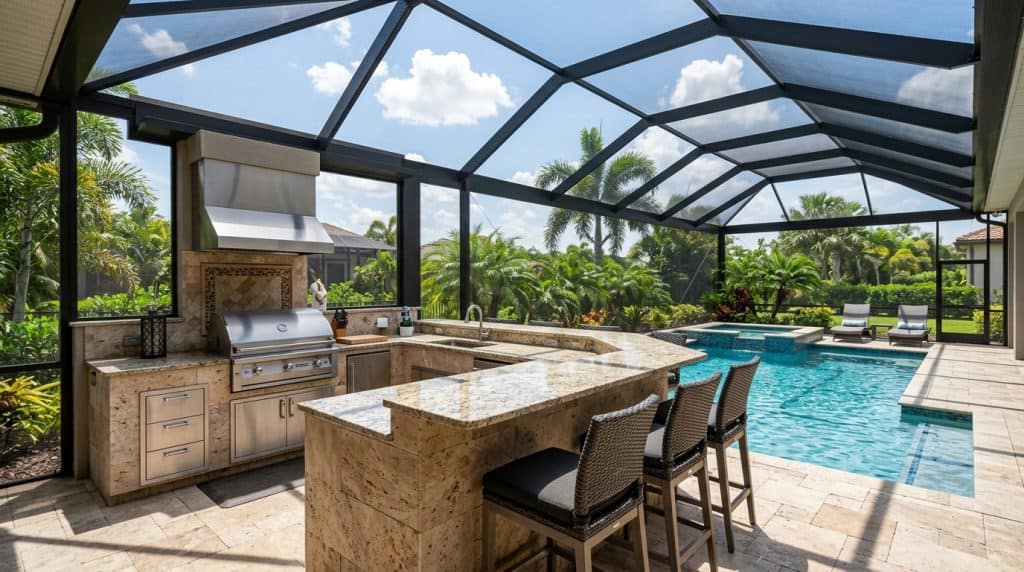
As a Master CPO (Certified Pool Operator) here in the heart of Tampa Bay, I’ve seen it all. From the luxury waterfront estates on Davis Island to the sprawling suburban retreats in FishHawk Ranch, the dream is almost always the same: a seamless flow between the house, the pool, and the kitchen. In Florida, our “pool cages” (screened enclosures) are essentially our second living rooms. But when you decide to stick a high-heat grill or a flickering fire pit under that mesh, the game changes from “relaxation” to “rigorous safety regulations.”
Designing an outdoor kitchen inside a screened pool enclosure is not as simple as placing a BBQ on the pavers. Between the Florida Building Code, local fire ordinances in Hillsborough and Pinellas counties, and the specific limitations of screen mesh materials, there is a lot that can go wrong. In this guide, we’re going to dive deep into the mechanics of smoke management, the math behind range hood CFM requirements, and how to navigate the often-frustrating world of HOA setbacks.
The Physics of Smoke: Why “Outdoor” Doesn’t Mean “Open Air”
The biggest misconception I encounter among homeowners is the belief that because a screen enclosure allows a breeze to pass through, it provides adequate ventilation for a grill. From a CPO’s perspective, a screened enclosure acts more like a semi-permeable filter than an open space.
When you ignite a gas or charcoal grill, you aren’t just producing heat; you’re releasing carbon monoxide (CO), particulate matter (soot), and vaporized grease. In a truly open backyard, these dissipate into the atmosphere. Inside a pool cage, the mesh—especially if it’s a tighter “no-see-um” weave—creates a micro-environment. The ceiling of the cage traps rising heat and smoke. This isn’t just a comfort issue; it’s a health and maintenance nightmare. Over time, that trapped grease builds up on the underside of your screen, turning your expensive Phifer mesh into a sticky, yellowing magnet for dust and pollen.
The Danger of “The Soot Cloud”
If you’ve ever noticed black streaks on the support beams of your lanai, you’re seeing the result of poor ventilation. In the Tampa humidity, that soot mixes with moisture to create an acidic residue that can actually corrode the powder-coating on your aluminum cage frames. This is why proper ventilation is the non-negotiable first step for any grill under lanai pool screen fire safety plan.
Range Hood CFM Requirements for Screened Patios
If your grill is located under a solid roof section of your lanai (which is common for outdoor kitchens attached to the home), a professional-grade vent hood is mandatory. But even if you are under a vaulted screen section, I strongly recommend a hood for grease management.
The standard for indoor kitchens is usually 100 CFM (Cubic Feet per Minute) for every 10,000 BTUs of a gas range. However, for an outdoor kitchen, we have to account for crosswinds and the sheer intensity of high-output grills. Here are the range hood cfm requirements for screened patio setups that we recommend at Tampa Bay Pool Care:
- Standard 30″ – 36″ Grill: Minimum 1,200 CFM.
- High-Output/Infrared Grills: 1,500 to 2,000 CFM.
- Hood Width: The hood should be 6 inches wider than the cooking surface (3 inches on each side) to create a proper “capture area.”
- Mounting Height: No more than 30 to 36 inches above the cooking surface. Any higher, and the Florida wind will blow the smoke right out from under the hood before it can be sucked up.
Pro Tip: Always look for a hood made of 304-grade stainless steel. The salt air in Tampa Bay will eat through cheaper 430-grade steel in less than two seasons.
Fire Pits Inside the Cage: Can It Be Done?
The short answer is yes, but the long answer involves a tape measure and a lot of common sense. When we talk about gas fire pit clearance to pool screen, we are primarily concerned with two things: radiant heat and embers.
The “No Wood” Rule
I tell my clients this plainly: Never burn wood inside a screened enclosure. Period. Wood fires produce unpredictable embers. A single “pop” from a piece of pine can send a glowing ember upward, where it will melt through your screen mesh in a fraction of a second. Furthermore, the soot from a wood fire is far more aggressive than gas, and it will ruin the aesthetics of your pool area within weeks.
Gas Fire Pit Safety & Clearances
Propane or natural gas fire pits are the way to go. They produce a clean flame and can be shut off instantly. However, they still generate immense radiant heat. Here are the safety benchmarks:
- Vertical Clearance: You need at least 10 to 15 feet of vertical clearance from the flame to the screen mesh. If you have a low-pitch roof on your cage, a fire pit is likely a no-go.
- Horizontal Clearance: Maintain at least 4 to 5 feet of distance from the fire pit to the screen walls. Heat can distort the polyester fibers of the screen long before it actually catches fire.
- The Heat Deflector: For fire pits located closer to structures, consider a “heat deflector” or “heat shield.” These are often stainless steel discs that sit above the flame to push the heat outward rather than upward.
Navigating HOA Setbacks and Florida Building Codes
In Florida, your pool cage isn’t just a fence; it’s a structure. In many Tampa municipalities, the “setback” for your pool enclosure is different from the setback for an “habitable structure.” This creates a gray area for outdoor kitchens.
The Impermeable Surface Issue
Many HOAs and local building departments have limits on “impermeable surface” ratios. When you add a large outdoor kitchen island, you are essentially adding a concrete or stone footprint. If your lot is already at its limit with the pool and deck, you might need a variance or a specific drainage plan to get your permit approved.
The Fire Marshal’s “5-Foot Rule”
While codes vary, many Florida jurisdictions follow the NFPA (National Fire Protection Association) guidelines which suggest that grills should be at least 5 to 10 feet away from combustible materials. While your aluminum cage is non-combustible, your house’s soffits and the screen mesh itself are not. If your outdoor kitchen is too close to the house wall, you may be required to install a fire-rated board (like HardieBacker) behind the grill area, even if it’s covered in stone veneer.
Diagnostic Checklist for Your Outdoor Kitchen Project
Before you sign a contract with a builder, walk through this checklist to ensure your outdoor kitchen inside screened pool enclosure won’t become a liability:
- Airflow Check: Does the area have natural cross-ventilation, or is it tucked into a “dead air” corner of the lanai?
- Gas Line Safety: Is your gas line equipped with a master shut-off valve located outside the enclosure? In an emergency, you don’t want to run into the smoke to turn off the fuel.
- Flooring Material: Are your pavers or travertine sealed with a slip-resistant, grease-resistant sealer? Grease spills are inevitable and can permanently stain unsealed stone.
- Electric Code: Are all outlets GFCIs and located at least 6 feet away from the pool’s edge? (Per NEC 680).
- The “Wind Load” Factor: Does your kitchen island design allow for wind to pass under or around it? In a hurricane, large, solid blocks can affect the wind-load pressure on your cage.
The CPO Perspective: How Your Kitchen Affects Your Pool Chemistry
This is a topic most contractors won’t mention. As a CPO, I’ve noticed that pools with “heavy-use” outdoor kitchens inside the cage often struggle with water balance more than others. Why?
Organic Load: When you grill, aerosolized fats and oils float through the air. Eventually, they settle on the surface of your pool water. This creates an “oil slick” that can clog your filter cartridges and increase your chlorine demand. If you’re wondering why your pool looks “dull” after a big BBQ weekend, it’s likely grease.
Ash and pH: If you ignore my advice and use a wood-burning pit or charcoal, the ash that drifts into the pool is highly alkaline. This can cause your pH to spike, leading to calcium scaling on your tiles and salt cell.
Maintenance Tips for Pool/Kitchen Combos:
- Enzyme Treatments: Use a natural enzyme product in your pool water. Enzymes “eat” the oils and fats from the grill before they can clog your filter.
- Mesh Power Washing: At least twice a year, gently power wash the screen mesh above the grill area with a degreasing agent to prevent buildup.
- Filter Cleaning: If you grill weekly, plan on cleaning your pool filter 25% more often than a standard pool owner.
Final Thoughts for Tampa Bay Homeowners
Building an outdoor kitchen inside screened pool enclosure is the ultimate way to embrace the Florida lifestyle. It adds significant value to your home and creates the perfect environment for entertaining. However, the intersection of fire, gas, and mesh requires professional planning.
Don’t cut corners on ventilation. Spend the extra money on a high-CFM range hood and a 304-grade stainless steel setup. Ensure your gas fire pit has the proper clearances to keep your screen from warping. And most importantly, always check with your local Hillsborough or Pinellas county building department to ensure your dream kitchen doesn’t result in a “Notice of Violation.”
At the end of the day, safety is what allows for true relaxation. By following these guidelines, you can flip burgers and enjoy the sunset without worrying about the integrity of your cage or the safety of your home. If you have questions about how your outdoor kitchen might be impacting your pool’s health, reach out to us at Tampa Bay Pool Care—we’re here to help you keep your backyard oasis in peak condition.
Quick Reference Safety Table
| Feature | Requirement | Why? |
|---|---|---|
| Grill Ventilation | 1,200+ CFM Hood | Prevents grease buildup & CO poisoning. |
| Gas Fire Pit | 10ft Vertical Clearance | Prevents melting the screen mesh. |
| Kitchen Island | Non-Combustible Materials | Fire safety and durability in humidity. |
| Pool Proximity | 6ft Electrical Setback | National Electric Code (NEC) compliance. |
Ready to upgrade your backyard? Just remember: a great outdoor kitchen starts with great planning, and a great pool starts with the experts at Tampa Bay Pool Care.