As a seasoned CPO with over two decades of experience keeping Tampa Bay pools sparkling, I’ve seen it all. From the relentless Florida sun beating down, encouraging algae with a vengeance, to the onslaught of live oak pollen after a springtime shower, and the sheer humidity that seems to cling to everything – our pools face unique challenges. And often, the difference between a pristine oasis and a persistent headache comes down to something surprisingly simple: how you point your pool’s return jets.
You might think, “They just push water back in, right?” And yes, they do. But the Tampa Bay Pool Care secret to optimal clarity and minimal maintenance lies in understanding the subtle, yet powerful, art of directing that water flow. We’re talking about optimizing your pool return jet flow to eliminate those stubborn pool circulation dead spots algae loves, enhance your skimmer’s efficiency, and ultimately, save you time, money, and frustration.
For Tampa, Clearwater, St. Petersburg, and Brandon homeowners, mastering your pool’s circulation isn’t just a nicety; it’s a necessity. Let’s dive deep into the secrets of eyeball direction and transform your pool from stagnant to spectacular.
The Hidden Enemy: What Are Pool Dead Zones? (And Why They Thrive in Tampa Bay)
First, let’s define our adversary. A pool dead zone is an area in your pool where the water is largely stagnant, meaning it doesn’t move or circulate effectively. Think of corners, steps, benches, or even areas under diving boards where the filter system’s flow simply doesn’t reach.
Why are these silent assassins particularly problematic for us here on the Gulf Coast?
- Intense UV & Algae Overdrive: Our glorious Tampa Bay sunshine, while wonderful for tanning, is also rocket fuel for algae. In stagnant dead zones, chlorine dissipates faster, and the lack of movement means fresh, chlorinated water isn’t reaching these spots. Combine that with our year-round warmth and intense UV, and you’ve got an algae breeding ground.
- Pollen & Debris Accumulation: Whether it’s the fine yellow dust from pines, the persistent green grains from live oaks (a constant battle under our grand oak trees!), or even red tide residue after certain conditions, pollen and debris settle. Without proper circulation to sweep them towards the skimmers, they pile up in dead zones, decomposing and feeding algae further.
- High Humidity & Microorganism Haven: Our subtropical humidity keeps everything damp, fostering conditions where various microorganisms thrive. Stagnant water, especially in the shade of a lanai screen enclosure, becomes an even more welcoming environment for these unwanted guests.
- Limestone Soil & Mineral Buildup: Tampa Bay sits on limestone. While not directly related to dead zones, the dissolved minerals in our water can contribute to scaling or staining if not properly circulated and filtered, especially in areas with poor water movement.
Dead zones are the silent saboteurs of pool health, leading to localized algae blooms, cloudy water, uneven chemical distribution, and increased cleaning effort. The good news? You have the power to fight back, and it starts with knowing precisely which direction should pool jets point.
Understanding Your Pool’s Circulation System: The Heartbeat of Clean Water
Before we adjust those eyeballs, let’s briefly revisit how your pool’s circulation system works. It’s a closed loop, designed to move and clean every drop of water in your pool.
- Skimmers & Main Drain: These are your pool’s “mouths,” drawing in surface debris and heavier particles from the bottom.
- Pump: The “heart” of the system, it pulls water from the skimmers and main drain.
- Filter: The “kidneys,” trapping suspended particles, algae, and debris.
- Heater/Sanitizer (Optional): Warms the water or dispenses sanitizing chemicals.
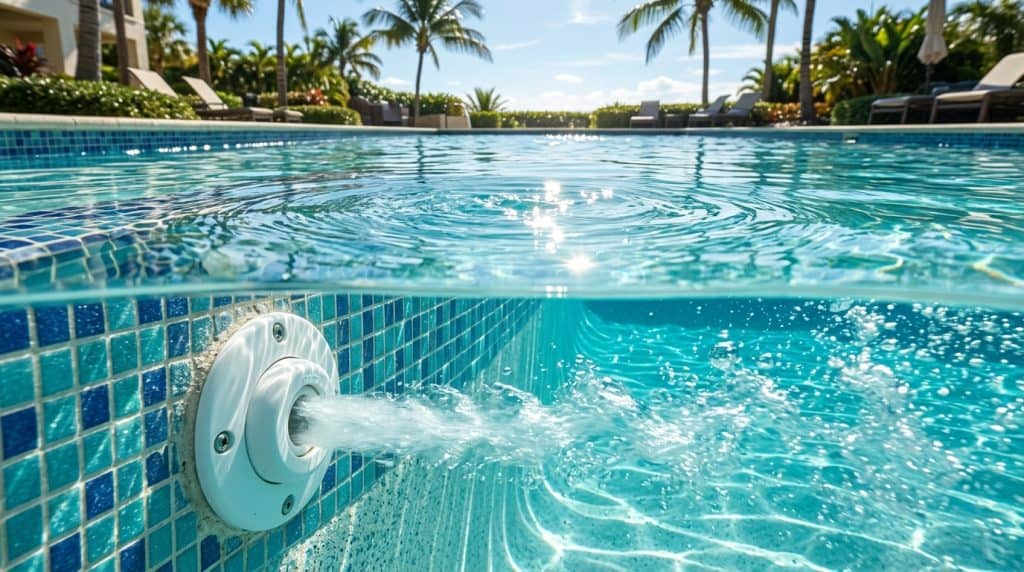
- Return Jets (Eyeballs): These are the “pushers,” returning clean, filtered, and chemically treated water back into the pool. They are your primary tool for creating a dynamic, cleansing current.
The goal is to create a constant, gentle current that sweeps every part of your pool, guiding debris towards the skimmers and main drain, and evenly distributing treated water. Without this comprehensive sweep, you’re essentially fighting Tampa Bay’s environmental challenges with one hand tied behind your back.
The Grand Strategy: Which Direction Should Pool Jets Point for Optimal Flow?
This is where the rubber meets the road. The optimal jet direction isn’t a one-size-fits-all solution; it depends on your pool’s unique shape, size, and the location of its skimmers and drains. However, there’s a foundational principle:
The Circular Water Flow Pattern Pool Strategy:
Your primary objective is to establish a gentle, continuous circular water flow pattern pool-wide. Imagine a slow-moving river or a gentle whirlpool. This current should push water towards your skimmers, ensuring surface debris is efficiently removed, and also circulate water from the deeper parts of your pool upwards, preventing bottom stagnation.
Here’s how to achieve it:
- Target the Skimmers: The most critical rule is to point your return jets so they push water *towards* your skimmer openings. This creates a current that actively sweeps surface debris (pollen, leaves, bugs, storm fallout) directly into the skimmer basket. If your jets are pushing water away from the skimmer, you’re working against yourself.
- Create a “Circular Sweep”: If you have multiple jets, aim them all in the same general direction around the perimeter of the pool. For example, if you have three jets on one side, angle them to push water clockwise (or counter-clockwise) around the pool. This creates that desired gentle current that reaches most areas.
- Address Deep Areas: Angle the jet eyeballs slightly downwards, typically around 10 to 20 degrees below the horizontal water line. This helps push clean water down towards the bottom of the pool, lifting heavier debris (like that fine limestone dust or sand that blows in after a storm) up into the main flow for filtration and preventing dead zones at the deepest parts.
- Focus on Problem Spots: If you consistently see algae or debris accumulating in a specific corner, on steps, or under a bench, consider dedicating one jet (or adjusting its angle) to specifically target that area. It’s okay to break the “perfect circular flow” rule slightly to eliminate a stubborn dead zone.
Specific Considerations for Tampa Bay Pool Shapes:
- Rectangular Pools: Often the easiest. Angle jets slightly towards one end, creating a long, slow current that pushes debris towards the skimmers usually located at the opposite end or along the long sides.
- Freeform or Kidney-Shaped Pools: More challenging. You might need to experiment more. Focus on directing flow along the longest stretches, using curved walls to your advantage to guide the water. Some jets might need a sharper angle to reach into “coves” or tighter corners.
- Pools with Steps, Benches, or Sun Shelves: These are prime real estate for dead zones. If possible, angle a jet to sweep across these features or aim slightly underneath them to dislodge settled debris and ensure circulation.
The Eyeball Fitting Angle: Fine-Tuning for Skimming and Filtration
Let’s get specific about the eyeball fitting itself. The adjustable nature of these fittings is your secret weapon.
Mastering the Horizontal Angle:
This is about setting the direction around the pool’s perimeter. As discussed, aim for a unified circular flow, pushing water towards the skimmer. For example, if your skimmer is on the north side, and your jets are on the south side, you’ll point them generally northward and then slightly to the east or west to initiate that circular motion.
Optimizing the Vertical Angle: The Pool Eyeball Fitting Angle for Skimming
This is crucial for both surface skimming and deep water circulation.
Most CPOs recommend setting your pool eyeball fitting angle for skimming by pointing the jets slightly downwards, typically 10-20 degrees below the horizontal waterline. Here’s why:
- Lifting Debris: Water exiting the jets creates a current that travels along the bottom and then rises. This upward motion lifts settled debris (sand, silt, heavy pollen) off the pool floor and into the main water column, making it easier for the filter to capture.
- Enhanced Skimming (Indirectly): By pushing water downwards and then allowing it to rise and spread, you create a stronger overall current that drives surface water towards the skimmer more effectively. If you point jets too high (e.g., directly at the surface), you can create surface turbulence that hinders skimming and can even push debris over the skimmer weir.
Experimentation is key! Watch how debris moves (or doesn’t move) after adjusting. The ideal angle will create a gentle ripple on the surface, pushing debris towards the skimmers without creating splash or excessive turbulence.
Diagnosing Dead Zones: A Tampa Bay Homeowner’s Checklist
How do you know if your jets are pointed correctly or if you have hidden dead zones? Put on your CPO hat and conduct a thorough inspection:
- Visual Inspection (The Easy Check):
- Are there specific areas where leaves, pollen, or bugs consistently gather?
- Do you see localized algae growth, even after shocking the pool? Check corners, behind ladders, on steps, or in shaded spots, particularly common in lanai-enclosed pools.
- Is there a persistent line of pollen or dirt along the waterline in certain areas?
- Does the water appear cloudy or murky in one section while other areas are clear?
- The Dye Test (The Definitive Check):
- Turn off your pool pump.
- Carefully place a few drops of dark food coloring (dark blue or red works best) in areas you suspect are dead zones (e.g., corners, steps).
- Turn your pump back on.
- Observe. If the dye dissipates and spreads quickly, that area has good circulation. If it lingers for several minutes or just slowly fades, you’ve found a dead zone.
- Repeat this test after adjusting your jets to see the improvement.
- Temperature Check (The Subtle Clue):
- On cooler days, use a pool thermometer to check water temperature in different areas. Areas with significantly lower temperatures might indicate poor circulation, as the water isn’t mixing well with the warmer, filtered water.
- Debris Movement Observation:
- Drop a handful of leaves or some non-staining pet food (kibble) into different areas of your pool. Watch how long it takes for the items to move towards a skimmer. Stagnant items indicate poor flow.
Advanced Strategies & Pro Tips from a CPO
Beyond the basics, here are a few advanced insights from my years of tackling Tampa Bay pools:
Multi-Jet Systems & Coordination:
If your pool has three or more return jets, coordinating them is crucial. Instead of having them all blast in random directions, aim for a cohesive circular flow. Two jets might push clockwise, and a third might be angled more directly at a known dead spot (like under a sun shelf) or pointed slightly more upwards to enhance skimming at a particular skimmer opening.
Adjustable vs. Fixed Eyeballs:
Most modern pools come with adjustable eyeballs, which are fantastic for fine-tuning. If you have older, fixed-direction jets, consider upgrading to adjustable ones. This small investment can make a huge difference in your pool’s health and your maintenance efforts.
Hurricane Prep & Recovery:
Our subtropical storms bring incredible amounts of debris. Before a hurricane, you might temporarily adjust your jets to push water more aggressively towards the skimmer to try and pre-clear the surface. *After* the storm, once debris is in the pool and you’ve run your equipment, you may need to temporarily adjust jets to focus on clearing heavy debris from specific areas before returning to your optimal settings. This is where strong filtration and proper jet direction work hand-in-hand to get your pool back in shape faster.
The Power of Velocity:
Sometimes, a jet isn’t just about direction, but also about the force of the water. If you have areas of persistent stagnation, consider installing a smaller eyeball insert. A smaller opening increases the velocity of the water exiting the jet, giving it a stronger “push” to reach further or dislodge more stubborn debris.
FAQ Section: Quick Answers for Tampa Bay Pool Owners
Q1: How often should I check or adjust my pool jet direction?
A1: It’s a good practice to visually check your jet direction monthly, especially after heavy rains or storms that might shift an eyeball. Perform a dye test annually or if you notice new dead zones, localized algae, or persistent debris accumulation. Small adjustments can often make a big difference.
Q2: Can proper jet direction really help with green algae?
A2: Absolutely! While proper chemical balance (chlorine, pH) is paramount, excellent circulation prevents dead zones where chlorine can deplete, allowing algae to take hold. By ensuring every drop of water circulates and gets filtered, you deny algae the stagnant conditions it needs to thrive. It’s a critical component of a comprehensive algae prevention strategy.
Q3: What if my pool only has one return jet? How do I create a circular flow?
A3: With a single jet, your task is a bit more challenging but still manageable. Aim your single jet to create the longest possible circular path around your pool, pushing water towards your skimmer. You might need to experiment with both horizontal and vertical angles to get the best sweep and ensure water reaches the furthest corners and bottom. Consider using a smaller eyeball insert to increase the velocity of the water, giving it more “reach.”
Sparkle & Shine: Your Tampa Bay Pool Deserves the Best
Optimizing your pool return jet flow isn’t just about moving water; it’s about proactively managing your pool’s health, ensuring maximum efficiency from your chemicals and filtration system, and ultimately enjoying a cleaner, clearer, and healthier swimming environment. Especially here in Tampa Bay, where Mother Nature is always trying to reclaim our pools, every little bit of advantage counts.
By understanding which direction should pool jets point, you empower yourself to tackle dead zones, boost skimming, and keep that dreaded green algae at bay. It’s a simple, yet profoundly impactful, adjustment that can transform your pool maintenance routine.
However, if you’re feeling overwhelmed, have complex pool geometry, or simply want the peace of mind that comes from professional expertise, don’t hesitate to reach out. The certified CPO technicians at Tampa Bay Pool Care are always ready to apply their local knowledge and 20+ years of experience to fine-tune your pool’s circulation and ensure it remains a sparkling oasis, ready for any beautiful Florida day. We proudly serve homeowners across Tampa, Clearwater, St. Petersburg, and Brandon – let us help you achieve peak pool performance!