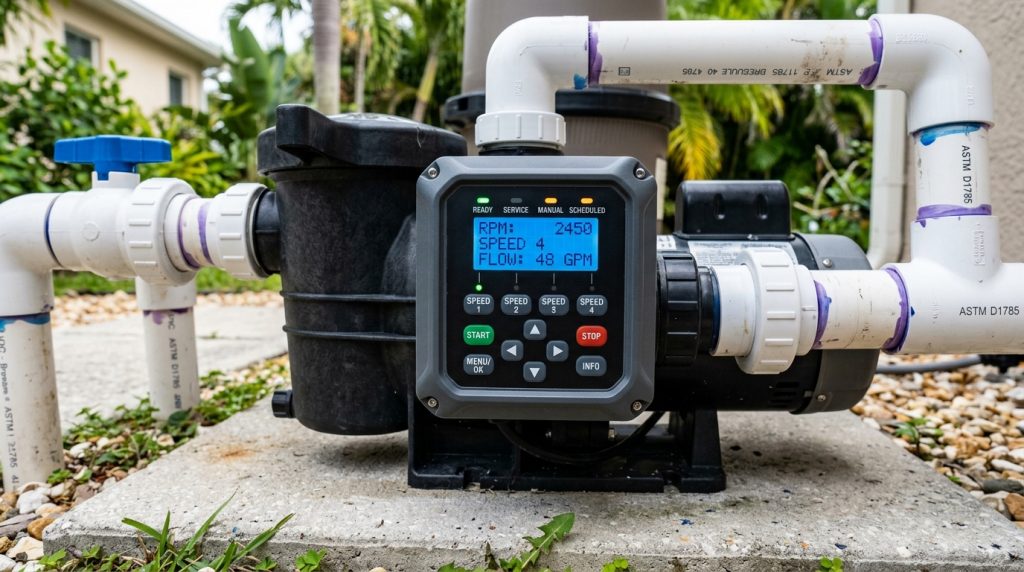
Tampa Bay’s relentless UV rays and heavy summer downpours demand constant chemical circulation, yet running a pool pump at maximum speed all day rapidly drains your wallet. Finding the precise sweet spot between energy conservation and pristine water clarity requires a calculated approach to pump scheduling. This guide reveals the exact mechanics of tuning your variable speed pump for maximum hydraulic efficiency.
The Physics of Flow: Why Flat RPM Schedules Fail Florida Pools
Operating a variable speed pool pump on a single, continuous speed defeats the entire purpose of its advanced permanent magnet motor. In Florida’s subtropical climate, your pool experiences rapid organic loading from pollen, live oak leaves, and afternoon thunderstorms, requiring dynamic filtration stages. To maintain pristine water quality without skyrocketing your electric bill, you must design an optimal rpm schedule variable speed pump program that aligns with your specific equipment demands. Homeowners who rely on professional weekly pool service and chemical maintenance understand that proper circulation prevents algae blooms while protecting expensive filtration gear from premature wear and tear. By dividing your pump’s daily run time into distinct, task-oriented RPM stages, you maximize both water turnover and energy savings.
The Skimming Stage: High-Velocity Surface Clearing
Effective surface skimming is your first line of defense against organic debris sinking to the bottom and causing stubborn organic stains. To pull floating leaves, bugs, and pollen into the skimmer baskets before they saturate and sink, your pump needs to generate enough velocity to create a strong surface pull. Typically, this requires running your pump between 2,200 and 2,800 RPM for a brief window of two to three hours daily. This high-speed stage creates a powerful vortex at the skimmer mouth, ensuring that floating debris is captured quickly, which ultimately reduces the sanitizer demand caused by decaying organic matter in the water column.
During this high-velocity skimming phase, the water moves rapidly through your filtration system, packing debris tightly into the pump and skimmer baskets. If your system experiences blockages or struggles to reach these velocities, it may indicate underlying hydraulic issues or air leaks. Homeowners experiencing sudden drops in flow or loud, vibrating motors should seek professional pool pump and motor repair in Tampa Bay to diagnose impeller clogs, failing bearings, or suction-side air leaks before attempting to tune their high-speed stages.
The Heating Stage: Satisfying Your Heat Pump’s Flow Demands
Pool heat pumps and gas heaters require a steady, specific volume of water passing through their heat exchangers to prevent overheating and system shutdowns. Operating your variable speed pump at too low of an RPM during heating cycles will trigger high-limit pressure switches, turning off your heater to protect its internal components. To avoid this, you must determine the minimum flow rate for pool heat pump gpm specifications, which typically ranges between 20 to 30 gallons per minute (GPM) for standard residential units. Because pipe diameter, plumbing elbows, and filter cleanliness affect resistance, you must program your pump to run at an RPM that reliably delivers this required GPM.
Generally, an RPM range of 1,800 to 2,200 provides the ideal balance, generating sufficient dynamic head pressure to keep the heater’s pressure switch closed without consuming excessive electricity. Running your heat pump at a speed higher than necessary wastes energy, while running it below the threshold causes frequent cycling, which damages the compressor and heat exchanger over time. By calculating the exact RPM required to meet your heater’s flow demands, you can establish an optimal rpm schedule variable speed pump program that warms your pool efficiently during cooler Florida winters.
| Operational Stage | Typical RPM Range | Estimated GPM | Primary Objective |
|---|---|---|---|
| High-Velocity Skimming | 2,200 – 2,800 RPM | 45 – 60 GPM | Clear surface debris before it sinks and decays |
| Heater / Heat Pump Activation | 1,800 – 2,200 RPM | 30 – 45 GPM | Satisfy pressure switches and optimize heat transfer |
| Low-Flow Sanitization & Filtration | 1,200 – 1,500 RPM | 15 – 25 GPM | Continuous chlorine generation and fine filtration |
The Sanitization Stage: Preventing Salt Cell Flow Faults
Saltwater pools utilize electronic chlorine generators that rely on a continuous, steady flow of water to safely convert salt into sodium hypochlorite. When the water flow drops too low, hydrogen gas can accumulate inside the electrolytic cell, creating a highly hazardous condition. To prevent this, salt systems feature safety flow switches that immediately shut down the cell and trigger a salt cell low flow error variable speed pump warning on your automation panel. To keep your pool sanitizing continuously throughout the day without generating these disruptive errors, your pump must run at a speed that consistently satisfies this mechanical flow switch.
While many salt cells can operate at flow rates as low as 15 to 20 GPM, plumbing configurations and dirty filters can easily cause the flow to dip below the threshold if your low-speed RPM is set too aggressively. Setting your low-flow filtration stage between 1,200 and 1,500 RPM usually provides enough pressure to keep the flow switch engaged while keeping energy consumption incredibly low. If you let your pool sit stagnant or run at speeds too low to generate chlorine, you risk a rapid algae outbreak that might require a fast 48-hour green pool recovery service to restore your water’s safety and clarity.
Calculating Your Optimal RPM Schedule Variable Speed Pump Protocol
To construct the perfect daily schedule, you must balance your pool’s total volume with the necessary turnovers required to keep the water clean and chemically balanced. For most residential pools in the Tampa Bay area, completing one full water turnover every 24 hours is the baseline standard, though high bather loads or heavy rains may require more. By combining a short high-speed skimming cycle, a moderate heating cycle, and an extended low-speed filtration cycle, you can construct an optimal rpm schedule variable speed pump routine that keeps your water crystal clear while slashing your monthly utility costs by up to 80 percent compared to single-speed pumps.
For example, pool owners utilizing advanced automation systems can program specific energy saving rpm stages pentair systems support, such as running at 2,500 RPM for 2 hours in the morning for skimming, transitioning to 2,000 RPM for 4 hours during peak heating hours, and finishing with 1,200 RPM for 10 hours for quiet, low-energy filtration and salt chlorination. This multi-stage approach ensures your pool’s hardware operates within its safe hydraulic limits while taking full advantage of the affinity laws of pumps, which dictate that cutting your pump speed in half reduces the power consumed by an astonishing eight-fold.
Future-Proofing Your Pool’s Hydraulic Efficiency
As Florida continues to update its residential energy conservation standards and environmental regulations, maximizing the efficiency of your pool’s filtration system becomes increasingly critical for long-term property value. Properly tuned variable speed pumps not only lower immediate electric bills but also reduce the mechanical stress on your entire filtration system, extending the operational lifespan of your filters, heaters, and chlorinators. Preparing your pool’s hydraulic schedule for the intense summer hurricane seasons and shifting winter temperatures ensures your backyard oasis remains resilient, clean, and highly cost-effective for years to come.