The first 28 days following the application of new pool plaster dictate its permanent durability, smoothness, and color vibrancy. During this initial hydration window, freshly applied cementitious plaster continuously releases calcium hydroxide into the water, requiring rigorous daily maintenance to prevent irreversible mottling, calcium scaling, and surface etching.
The Chemistry of Hydration: Why Plaster Dust Forms
Pool plaster is a blend of white portland cement, marble aggregate, quartz crystals, or pebble aggregates. When a pool is filled with water immediately following troweling, the hydraulic cement begins its primary cure. As cement hydrates, it sheds significant quantities of calcium hydroxide (often called plaster dust) into the water.
Calcium hydroxide has an extraordinarily high pH (approximately 12.0). As it dissolves, it rapidly spikes the pool water’s pH and total alkalinity. If water is left unmanaged, dissolved calcium hydroxide reacts with atmospheric carbon dioxide, converting into insoluble calcium carbonate. This calcium carbonate precipitates out of solution, depositing as a rock-hard, rough white scale across the smooth finish—permanently ruining the texture before the pool is even used.
To prevent scaling, the National Plasterers Council (NPC) established the standard 28-day startup protocol, prioritizing acid balancing and mechanical brushing to keep calcium suspended while the plaster cures uniformly.
The 28-Day Startup Roadmap
Adhering to a structured operational schedule guarantees that newly resurfaced pools achieve their maximum design life:
| Timeline | Brushing Frequency | Chemical Targets | Operational Restrictions |
|---|---|---|---|
| Day 1 (Fill Day) | Do not brush until full | Test fill water; add sequestering agent | Fill without stopping; no heaters or chlorinators. |
| Days 2 – 3 | Twice daily (Wall to drain) | pH: 7.2 – 7.6; Alkalinity: 80 – 100 ppm | Run pump 24/7; clean filter daily; no wheeled vacuums. |
| Days 4 – 14 | Once daily minimum | Begin adding small chlorine doses (1.5 – 3 ppm) | No salt addition; no automated suction sweepers. |
| Days 15 – 28 | Every other day | Balance LSI: -0.2 to +0.2; CYA: 30 – 50 ppm | Heater can be fired on Day 21; Salt added on Day 28. |
Mechanical Brushing Technique: Floor to Main Drain
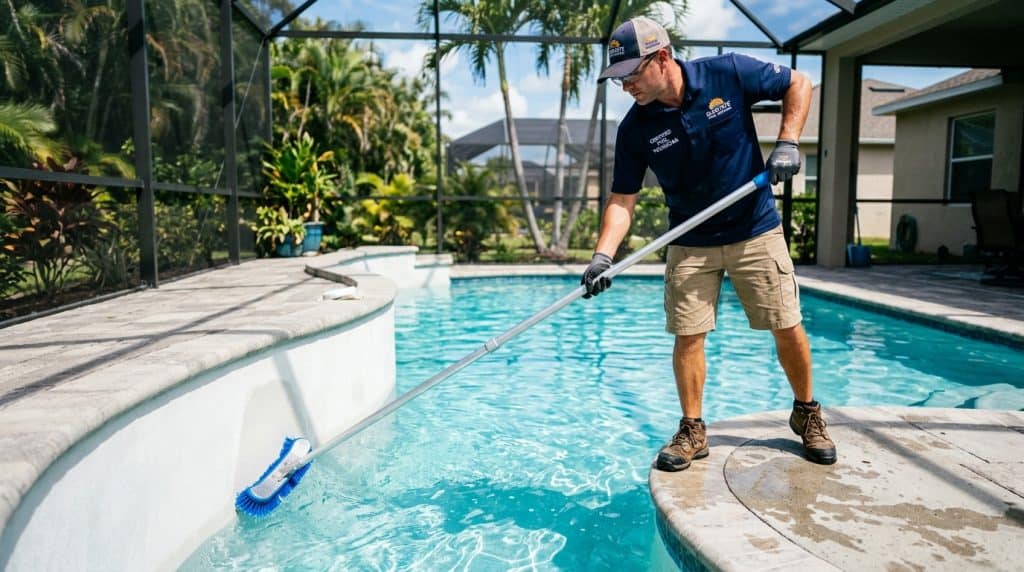
Brushing is not merely aesthetic cleaning; it is a critical mechanical burnishing phase. Using an all-nylon wall brush (wire bristles are strictly prohibited on fresh plaster), the technician pushes dislodged plaster dust downward toward the main drain, where continuous filtration captures the fine particles.
Brushing must begin on the shallow-end walls, working downward into the cove and across the floor into the deep-end sumps. If plaster dust is allowed to settle undisturbed on the floor for more than 24 hours, it adheres permanently, creating rough footprints and permanent hydration streaks.
Critical Equipment Prohibitions During the 28-Day Window
Violating standard operational rules during curing can permanently damage the finish and instantly void manufacturer warranties:
- No Wheeled Automatic Pool Cleaners: Wheeled suction sweepers or robotic cleaners will leave permanent tire track indentations across soft, curing plaster. Brushing must be performed manually.
- No Salt Additions for 28 Days: Adding sodium chloride to a newly plastered pool before 28 days will cause severe chemical etching and pitting. Salt chlorinator cells must remain powered off.
- No Pool Heaters for 21 Days: Firing gas heaters or heat pumps during early hydration causes calcium carbonate to bake instantly onto copper heat exchanger coils, clogging equipment and ruining water balance.
Prior to refilling, homeowners must verify safe pool draining procedures in Florida to prevent hydrostatic shell displacement during wet seasons. Professional pool contractors also conduct thorough hydraulic pressure and leak testing before filling to guarantee that subterranean pipes remain airtight.
Engaging certified pool service specialists to execute the 28-day startup protocol ensures that your major pool investment cures into a flawless, silky-smooth finish that will endure for decades.