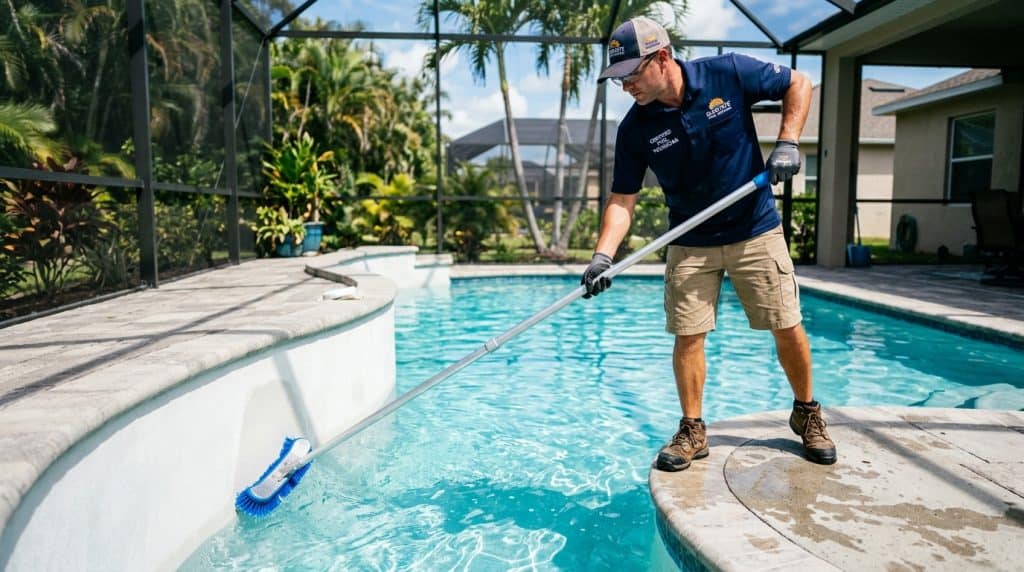
Understanding the Chemistry Behind Plaster Mottling and White Haze
After twelve years of managing routes from Wesley Chapel to St. Petersburg, I have seen how the intense Florida heat index accelerates chemical imbalances that manifest as unsightly surface degradation. When the chemistry of your water deviates from the Langelier Saturation Index (LSI) even slightly, the resulting calcium carbonate precipitation often creates a permanent cosmetic headache. We address these persistent surface issues through our comprehensive pool resurfacing and maintenance protocols, ensuring that the structural integrity of your vessel remains intact while restoring the aesthetic finish of your dark-colored pebble or quartz interiors.
The appearance of a white haze on dark pool plaster causes significant distress for homeowners, yet it is often misunderstood as a simple cleaning failure rather than a complex chemical reaction. When water is aggressive—meaning it is undersaturated with calcium—it attempts to pull calcium hydroxide from the curing plaster, leading to etching. Conversely, when water is supersaturated, it deposits calcium scale, which appears as cloudy white patches or streaks. Distinguishing between these two requires a careful look at the surface texture; etching feels rough or pitted to the touch, while calcium scale buildup often feels like a crusty or sandpaper-like deposit that sits on top of the finish.
Differentiating Plaster Mottling from Calcium Scale
Plaster mottling is a common cosmetic phenomenon characterized by blotchy, uneven coloring that frequently appears shortly after a new installation or a significant chemical adjustment. Unlike calcium scale, which is an external deposit, mottling is often tied to the hydration process of the cement. If the plaster was troweled at the wrong time or if the pool was filled with water that had a high pH, the hydration of the cement matrix becomes inconsistent. This leads to areas of varying density and color, which can be particularly noticeable on dark-colored finishes where the contrast between the pigment and the lighter calcium-rich areas is stark.
To determine if you are dealing with mottling vs calcium scale, perform a simple tactile and chemical test. If you can scrape the white material off with a fingernail or a pumice stone, it is likely mineral-based scale. If the discoloration is embedded within the plaster and the surface feels smooth, you are looking at mottling. For clients who require specialized intervention, our team provides routine weekly pool servicing across Tampa Bay to monitor LSI levels, which prevents the fluctuations that exacerbate these issues. Keeping the water balanced is the only way to ensure the pigment in dark pebble finishes remains uniform over the long term.
The Role of Aggressive Water and Etching
Aggressive water is defined by a negative LSI value, meaning the water is hungry for calcium and will actively strip it from your pool walls. This process, known as leaching, is the primary driver behind plaster etching. When the water chemistry is not managed to account for the specific requirements of the plaster finish, the cement binder is slowly dissolved, exposing the aggregate underneath. This not only ruins the appearance of the finish but also weakens the structural bond of the plaster over time. If left unaddressed, this etching creates a porous surface that is significantly more difficult to keep clean and susceptible to staining.
Preventing this degradation requires precise control over the pH, total alkalinity, and calcium hardness. In our local climate, evaporation rates are high, which causes a rapid concentration of total dissolved solids (TDS). As TDS levels climb, the efficiency of your sanitizers drops, and the chemical balance becomes increasingly volatile. We often find that homeowners struggling with persistent surface issues also have outdated filtration systems that cannot keep up with the debris load. In these cases, we recommend energy efficient pool pump troubleshooting and repairs to ensure that proper circulation and filtration are maintained, which is a fundamental component of protecting your pool’s interior.
Diagnostic Comparison Table: Surface Conditions
| Condition | Visual Indicator | Tactile Feel | Primary Cause |
|---|---|---|---|
| Calcium Scale | Cloudy, white, or crusty patches | Rough, sandpaper-like | High pH, High LSI, Supersaturated water |
| Plaster Mottling | Blotchy, uneven color variations | Smooth, consistent texture | Improper troweling or uneven hydration |
| Plaster Etching | Pitted surface, exposed aggregate | Rough, sharp, or gritty | Aggressive water, low LSI, low calcium |
Managing Dark Pebble and Quartz Color Unevenness
Dark-colored pebble finishes are highly sought after for their natural look, but they are unforgiving when it comes to chemical maintenance. Any variance in the curing process or subsequent chemical spikes will highlight color unevenness immediately. When addressing a dark pebble tec color unevenness fix, it is essential to first neutralize the water chemistry before attempting any cosmetic restoration. Often, what appears to be a color flaw is simply a thin layer of scale that is refracting light differently than the surrounding surface. A professional acid wash or a specialized scale remover treatment can often restore the dark, rich aesthetic of the finish without the need for a full resurface.
The longevity of these premium finishes depends heavily on the initial startup procedures. If the pool was not brushed adequately during the first 30 days, or if the water was not balanced according to the manufacturer’s specific guidelines, the surface will likely develop “hydration rings” or streaks. These are essentially permanent marks in the cement matrix. While some of these can be mitigated with mild, controlled chemical treatments, others are structural defects that require surface refinishing. By maintaining consistent water chemistry and ensuring that your equipment is optimized for your pool’s volume, you can prevent these aesthetic issues from evolving into costly structural repairs.
By prioritizing the health of your pool’s surface through rigorous, science-based chemistry management, you extend the life of your investment and ensure a safer swimming environment for your household. Proper water balance does more than just keep the plaster looking new; it protects the plumbing lines, the heating elements, and the mechanical seals from premature failure caused by corrosive or scaling water. As we move through the seasons, maintaining this chemical equilibrium remains the most effective strategy for preserving the beauty and structural integrity of your pool for years to come.
Need Dependable Pool Care in Tampa Bay?
Our licensed, background-checked route technicians keep your residential pool crystal clear, balanced, and fully code-compliant across Hillsborough, Pinellas, and Pasco counties.