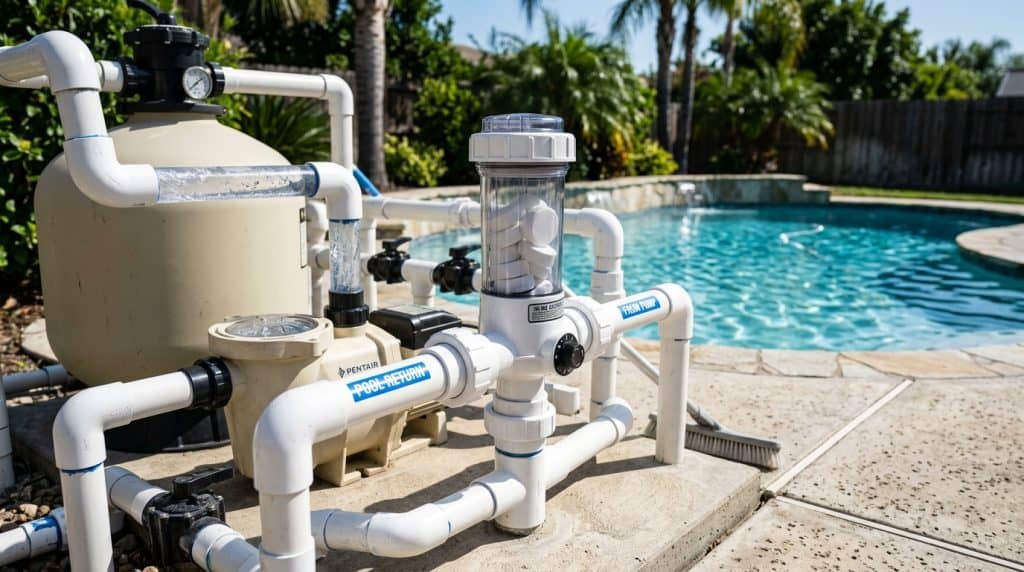
In the heart of the Tampa Bay region, from the sun-drenched pool decks of South Tampa to the sprawling backyard oases of Brandon and Riverview, pool owners face a relentless adversary: the Florida sun. With average summer temperatures hovering in the nineties and UV indexes soaring, chlorine consumption in our swimming pools is exceptionally high. To combat this, many Florida homeowners rely on inline chemical feeders—most notably the Hayward CL200 series or the Pentair Rainbow 320.
When these automatic tablet chlorinators work correctly, they are the unsung heroes of your filtration pad, slowly eroding 3-inch trichlor tabs to maintain a steady free chlorine residual of 2.0 to 4.0 ppm. But when they fail, your pool water can turn from sparkling blue to pea-soup green in less than 48 hours.
As a certified pool operator (CPO) with years of experience under the Florida sun, I have diagnosed thousands of equipment pads. Today, we are diving deep into the mechanics, troubleshooting, and safety protocols of inline feeders. Whether you are dealing with a hayward chlorinator not dissolving tablets, a rainbow 320 chlorinator check valve clogged, or unexplained chemical feeder pressure drop pool issues, this comprehensive guide will give you the practical knowledge to troubleshoot like a seasoned professional.
—
Understanding the Mechanics: How Inline Feeders Work
Before we can fix a broken chemical feeder, we must understand how it operates. Unlike offline feeders—which divert water through thin black tubing before returning it to the plumbing stack—inline feeders are plumbed directly into your return line. They are the final piece of equipment on your pad before the water returns to your pool, positioned safely after your heater to prevent highly acidic water from corroding copper heat exchangers.
Water flows through the bottom of the feeder chamber, coming into contact with the bottom tier of your 3-inch trichlor tablets. As the water passes through, it slowly erodes the tablets, dissolving the chlorine into the stream. The rate of erosion is controlled by a dial valve. Turning the dial opens or closes an internal orifice, regulating how much water is forced up into the tablet chamber.
While this design is elegant in its simplicity, it is highly dependent on consistent water pressure, hydraulic balance, and clean internal pathways. When any of these variables are compromised, things go wrong quickly.
—
Problem 1: The Hayward Chlorinator Not Dissolving Tablets
By far, the most common complaint we hear at Tampa Bay Pool Care is: “My chlorine levels have bottomed out, and my hayward chlorinator not dissolving tablets is driving me crazy! The chamber is full of dry (or mushy) tablets.”
If you open your Hayward CL200 chlorinator and find your tablets are either bone dry or sitting in stagnant, lukewarm water without dissolving, you are dealing with a hydraulic or physical blockage. Here is how to diagnose and resolve this issue step-by-step.
1. The Dreaded Air Lock
Because inline chlorinators are pressurized vessels, air can easily become trapped inside the dome of the lid, especially after you open it to add tablets or if your pump has primed after a filter clean. If air is trapped in the top of the chamber, water cannot rise high enough to touch and dissolve the tablets.
- The Fix: With the pool pump running, slowly unscrew the small vent screw (if your model has one) on the lid of the chlorinator, or back off the lid very slightly until you hear air escaping. Once water begins to trickle out of the top, immediately tighten the lid or screw. This vents the air and allows the chamber to fill with water.
2. The Clogged Dial Control Valve
The control dial on the front of the Hayward CL200 regulates the water flow using a small, calibrated plastic needle valve. Over time, calcium scale, stabilizer binders from cheap chlorine tablets, or tiny bits of debris from your filter can clog this tiny orifice.
- The Fix: Turn off your pool pump and close any isolation valves. Unscrew the dial assembly (be careful of the small spring and O-ring inside). Inspect the needle valve for debris. If it is coated in calcium scale, soak the valve in a 10:1 water-to-muriatic-acid mixture for 5 minutes, rinse it thoroughly, and reassemble.
3. Blocked Base Orifice or Inlet Screen
At the bottom inside of the Hayward CL200 chamber, where the water enters from the main pipe, there is a small inlet hole. If tablets break down into “mush” or “sludge” (often caused by using cheap, low-grade tablets with excessive binders), this mush will settle at the bottom and completely seal off the water inlet.
- The Fix: Empty the chlorinator of all tablets. Use a garden hose with a high-pressure nozzle to blast out any gooey, paste-like residue at the bottom of the chamber. Avoid inhaling any fumes during this process!
—
Problem 2: Rainbow 320 Chlorinator Check Valve Clogged
The Pentair Rainbow 320 is another industry staple. Instead of using a dial directly on the body like the Hayward, the Rainbow 320 utilizes a external control valve and a small black feeder tube that draws water from the bottom of the pipe and sprays it up into the tablet chamber. It also features a critical check valve at the bottom inlet to prevent highly concentrated chlorine from backflowing into your pool heater or filter when the pump is shut off.
A major failure point on this system is when you find the rainbow 320 chlorinator check valve clogged.
When this check valve clogs or fails, water cannot enter the chamber, leading to zero chlorine erosion. Conversely, if the check valve fails in the *open* position, it can allow concentrated acidic water to seep backward, destroying your pool heater’s copper heat exchanger or degrading your pump’s rubber seals.
Diagnostic Checklist for Rainbow 320 Check Valve & Feed Tube:
- Turn off the pump and relieve all pressure from the filtration system.
- Locate the small black control valve and tubing on the side of the Rainbow 320. Unscrew the compression nuts to remove the tube.
- Look inside the bottom fitting (where the feeder meets the PVC pipe). You will see a small spring-loaded check valve (Part # R172248 or similar).
- Use a pair of needle-nose pliers to gently extract the check valve assembly.
- Inspect the internal spring and rubber seat. Often, calcium deposits or chlorine paste will seize the spring, keeping the valve permanently shut.
- Soak the check valve in a mild acid solution or warm water to dissolve the calcium. If the spring is rusted or broken, replace the check valve immediately.
Additionally, check the small screen at the inlet of the black control tube. This screen easily catches tiny debris that bypasses your filter, starving the chlorinator of the water flow it needs to function.
—
Problem 3: Chemical Feeder Pressure Drops & Plumbing Dynamics
Many pool owners install variable speed pumps (VSPs) to save on electricity costs. While VSPs are fantastic for your energy bill, they can introduce a new headache: a significant chemical feeder pressure drop pool technicians constantly have to troubleshoot.
Inline chlorinators rely entirely on pressure differentials to force water through the chlorinator chamber. When you run your variable speed pump at low speeds (such as 1,500 to 2,000 RPMs) to save energy, the water pressure inside your return line drops drastically.
Without sufficient Total Dynamic Head (TDH), the water chooses the path of least resistance—which is straight down the main PVC return pipe, bypassing the chlorinator’s internal diverted channel entirely. The result? Your inline chlorinator stops dissolving tablets, and your pool turns green, despite your pump running 18 hours a day.
| Pump Speed (RPM) | System Pressure (PSI) | Chlorinator Performance |
|---|---|---|
| 3000+ (High) | 18 – 25 PSI | Excellent; Rapid tablet erosion. Watch for over-chlorination. |
| 2200 – 2800 (Medium) | 12 – 17 PSI | Optimal; Steady, balanced chlorination for daily maintenance. |
| 1000 – 1800 (Low) | 3 – 8 PSI | Poor/None; Flow rate is insufficient to overcome gravity/resistance in feeder. |
How to Solve the VSP Pressure Problem
If you are experiencing a pressure drop that is halting your chlorination, you have two primary options:
- Program a High-Speed Cycle: Set your pump schedule to run at a higher speed (e.g., 2,800 RPM) for at least 3 to 4 hours a day. This ensures a period of high-pressure flow to dissolve enough chlorine to carry your pool through the day, while you can utilize lower speeds for the remaining filtration hours.
- Install a Venturi/Scoop Fitting: Some inline chlorinators can be retrofitted with an internal scoop or “venturi tube” inside the main PVC pipe. This scoop physically catches the moving water and forces it up into the chlorinator, even at lower flow velocities.
—
Danger Zone: Opening Inline Chlorinator Safely (Gas & Chemical Hazards)
Before you grab your strap wrench and head out to your pool pad, we must discuss safety. This is the most crucial section of this entire guide. Underestimating a pressurized chlorine chamber can result in severe chemical burns, permanent lung damage, or blindness.
When trichlor tablets sit in stagnant water inside a sealed, airtight plastic dome, they off-gas. This creates a highly concentrated pocket of chlorine gas (specifically nitrogen trichloride) trapped at the top of the chamber. When you unscrew the lid, this gas expands rapidly, releasing a concentrated toxic plume directly into your face if you are not careful.
If you are opening inline chlorinator safely gas and chemical exposure are your biggest hazards. Follow this strict protocol every single time you service your chlorinator:
The CPO-Approved Safety Protocol:
- Wear Proper PPE: Never open a chlorinator without heavy-duty chemical-resistant gloves and wrap-around safety goggles. A splash of acidic, chlorine-saturated water in your eye can cause permanent damage.
- Turn Off the Pump: Never attempt to open an inline chlorinator while the pool pump is running. The chamber is under high pressure, and the lid will blow off, drenching you in acidic chemicals.
- Relieve System Pressure: Turn the air relief valve on top of your main pool filter counter-clockwise to release all pressure from the plumbing lines. Wait until the pressure gauge on your filter reads 0 PSI.
- Position Yourself Correctly: Stand upwind of the chlorinator. Never lean directly over the top of the lid. Keep your face as far away from the vessel as possible.
- The “Crack and Back” Method: Turn the lid slowly to break the seal. As soon as you hear the hiss of gas escaping, step back immediately and turn your head away. Let the chlorinator vent for at least 30 to 60 seconds before removing the lid completely.
- Have a Hose Handy: Keep a running garden hose nearby to quickly wash down any accidental chemical spills on your skin, clothing, or the surrounding grass and equipment.
—
CPO Pro Tips: Preventing Chemical Feeder Failures
Preventative maintenance is always cheaper and easier than emergency troubleshooting. Implement these professional habits to keep your chemical feeder operating flawlessly year-round in the challenging Florida climate:
1. Only Use High-Quality Trichlor Tablets
It is tempting to buy cheap bulk chlorine tablets from big-box stores. However, these cheap tablets often contain inferior binders and fillers. As they dissolve, these binders break down into a sticky, chalky sludge that clogs check valves, dial orifices, and dial needles. Stick to high-quality, 99% Trichlor-S-Triazinetrione tablets that erode cleanly without leaving a thick residue.
2. Lubricate the O-Ring Regularly
The large O-ring inside your Hayward or Rainbow chlorinator lid is subjected to harsh chlorine gas and high acidic levels. If it dries out, it will swell, crack, or twist, causing air leaks (which drop system pressure) or water leaks.
Critical Warning: *Never* use petroleum-based lubricants (like Vaseline) on your chlorinator O-ring. Petroleum degrades rubber rapidly. Only use a high-quality, 100% silicone-based lubricant (like Jack’s Multilube).
3. Use a Strap Wrench
If your chlorinator lid is stuck, do not hammer it or use a metal pipe wrench, which can easily crack the plastic housing. Keep a rubber strap wrench on your pool pad. It provides excellent leverage to unscrew stubborn lids safely without damaging the equipment.
—
When to Call the Pros at Tampa Bay Pool Care
Troubleshooting your own pool equipment can be satisfying, but working with high-concentration chlorine gas, pressurized PVC plumbing, and complex hydraulic pressure loops carries inherent risks. If you are struggling with a stubborn clog, suspect a plumbing air leak, or simply prefer to leave handling dangerous chemicals to the experts, we are here to help.
At Tampa Bay Pool Care, our team of fully licensed, CPO-certified pool technicians has the specialized diagnostic tools and replacement parts to get your pool’s chlorination system back in perfect working order. We proudly service pools throughout the Tampa Bay area, ensuring your water remains clean, clear, and perfectly balanced even through the hottest summer months.
Don’t let a faulty chlorinator turn your beautiful Florida pool into an unsafe green lagoon. Contact Tampa Bay Pool Care today to schedule a professional equipment inspection or to discuss our convenient weekly pool maintenance plans!