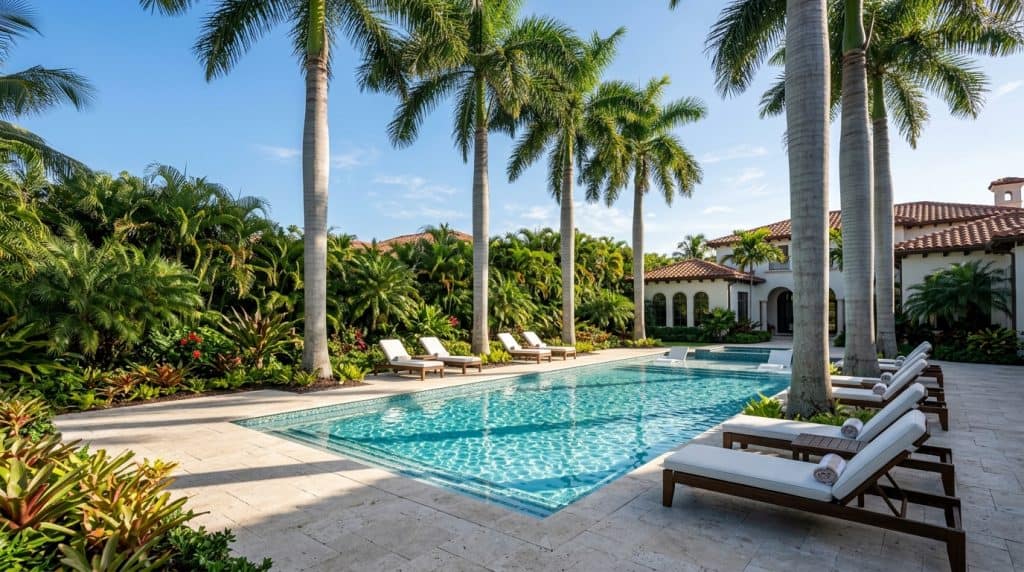
There is nothing quite like the sight of swaying palm trees framing a crystal-clear backyard pool in Tampa Bay. It is the quintessential Florida dream. However, as a master Certified Pool Operator (CPO) who has spent decades maintaining, repairing, and resurfacing pools across Hillsborough, Pinellas, and Pasco counties, I have seen this dream turn into a costly nightmare.
While palms are generally considered safer for landscaping near pools than massive hardwoods like live oaks or camphor trees, they are far from risk-free. When planted too close to your pool shell, certain palm species can cause severe structural damage. Furthermore, their seasonal dropping of sticky, sap-laden berries can destroy your water chemistry, ruin your filtration equipment, and leave ugly, permanent stains on your pool deck and plaster.
In this guide, we will dive deep into the botanical realities of palm trees, examine the primary culprits behind structural damage, look at the mess of seasonal berry drops, and explore the preventative measures—like root barriers—that can save your pool from catastrophic failure.
Are Palm Tree Roots Dangerous to Pools? The Botanical Reality
To answer the burning question—are palm tree roots dangerous to pools?—we first have to understand how palms grow. Unlike deciduous trees (like oaks or maples) which are dicots and grow massive, woody taproots that expand in diameter and can easily crack thick concrete, palms are monocots. Botanically, palms are closer to giant grasses than they are to traditional trees.
Instead of a single, expanding taproot, palms possess a fibrous root system. They produce thousands of thin, shallow roots that grow outward from a central point called the root initiation zone, which is located at the base of the trunk. These roots do not grow thicker over time; they remain roughly the size of a pencil.
Because of this, palm roots do not actively “drill” through solid concrete pool shells in the way an oak root might. However, yes, they can still be highly dangerous to pools under the right conditions. Here is how:
- Hydrostatic and Lateral Pressure: While individual roots are thin, the sheer volume of thousands of fibrous roots pack together into an incredibly dense, expanding root ball. As this mass grows, it exerts tremendous physical pressure on the surrounding sandy Florida soil, pushing against pool walls and lifting concrete decks.
- Exploiting Existing Weaknesses: If your pool shell has minor hairline cracks, structural settling cracks, or deteriorating plumbing lines, palm roots will aggressively seek out the moisture. They will wedge themselves into these tiny crevices, expanding and worsening the leaks.
- Soil Displacement and Voids: In the Tampa Bay region, our soil is predominantly sandy (such as Myakka fine sand). When a dense root system grows rapidly, it displaces this sand. If the tree dies, is cut down, or the roots decay, it leaves massive underground voids. Without soil support, the heavy shotcrete or gunite pool shell can crack under the weight of its own water, or the surrounding pool deck can sink and collapse.
The Primary Culprit: Queen Palm Roots Near Pool Shell Damage
If there is one palm tree that keeps pool renovation specialists busy in Florida, it is the Queen Palm (Syagrus romanzoffiana). Queen palms are incredibly popular because they are inexpensive, grow rapidly, and offer a classic tropical canopy. Unfortunately, they are also one of the worst palms to plant within ten feet of a swimming pool.
How Queen Palm Roots Cause Shell Damage
When dealing with queen palm roots near pool shell damage, the issue is almost always a combination of proximity and rapid root-ball expansion. A mature Queen Palm can reach heights of 30 to 40 feet, and its root zone can easily spread 10 to 15 feet laterally from the trunk.
When planted too close to a pool’s edge, the dense root mass presses directly against the pool’s structural beam (the top edge of the pool shell where the coping sits). Over time, this pressure can cause the coping stones to pop loose, crack the tile line, and shear the underground plumbing lines—such as skimmer lines and return pipes—running beneath the deck. If the root mass expands directly against the vertical gunite wall, it can cause the concrete shell to bow inward, resulting in structural cracking and major water loss.
The Double Whammy: Queen Palm Sticky Berries Staining Pool Deck
The threat of the Queen Palm isn’t just underground; it also looms directly overhead. Throughout the summer and fall, Queen Palms produce massive, heavy stalks containing hundreds of bright orange, fleshy fruits.
If you have ever dealt with a queen palm sticky berries staining pool deck situation, you know how incredibly frustrating it can be. These berries are rich in natural sugars, sap, and dark organic tannins. When they drop onto your pool deck, several bad things happen simultaneously:
- Aesthetic Ruin: The berries quickly rot under the hot Florida sun, melting into a sticky, tar-like goo. The dark pigments and tannins leach directly into porous concrete pavers, acrylic spray-decking, or natural stone, leaving dark brown and purple stains that are notoriously difficult to remove.
- Pest Infestations: The high sugar content of the rotting fruit acts as a beacon for wasps, bees, ants, and rodents, turning your pool area into an unsafe environment.
- Water Chemistry Havoc: Berries that fall into the pool water immediately begin to decompose. They introduce massive organic loads, spiking your phosphate levels and rapidly consuming your free chlorine. This often leads to sudden, stubborn black or green algae blooms. Furthermore, the hard seed pits inside the berries can easily bypass skimmer baskets, get sucked into your pool lines, and jam or destroy your pump’s impeller.
Palm Variety Risk Matrix: Which Palms are Safe?
To help you navigate your backyard landscaping choices, here is a quick diagnostic matrix of common palm varieties found in Tampa Bay, rated by their risk to your pool’s structural integrity and water quality.
1. Queen Palm (Syagrus romanzoffiana)
- Root Damage Risk: High
- Debris/Berry Risk: Severe
- Safe Distance: At least 12–15 feet away from the pool shell.
2. Areca Palm (Dypsis lutescens)
- Root Damage Risk: Moderate-High. Because they grow in dense, multi-trunked clumps, their root masses can become incredibly wide and heavy, easily lifting pool pavers and cracking thin concrete decks.
- Debris/Berry Risk: Low
- Safe Distance: 8–10 feet away.
3. Bismarck Palm (Bismarkia nobilis)
- Root Damage Risk: High. While beautiful with its silver-blue fronds, the Bismarck Palm grows an incredibly massive trunk and trunk base. The root initiation zone is huge and will easily displace pool decking.
- Debris/Berry Risk: Moderate
- Safe Distance: 15–20 feet away.
4. Sabal / Cabbage Palm (Sabal palmetto)
- Root Damage Risk: Low. As Florida’s state tree, the Sabal palm has a highly compact, non-aggressive root ball.
- Debris/Berry Risk: Moderate (produces small black berries, but they are less sticky than Queen Palms).
- Safe Distance: 4–6 feet is generally safe.
5. Pygmy Date Palm (Phoenix roebelenii)
- Root Damage Risk: Very Low. These slow-growing dwarf palms have small, non-invasive root systems.
- Debris/Berry Risk: Low (watch out for the sharp spines on the frond bases!).
- Safe Distance: 3–5 feet. Perfect for poolside planters.
Preventative Engineering: Root Barrier Installation Near Pool
If you already have beautiful palms near your pool and want to prevent future damage, or if you are planning a new landscaping project, you do not necessarily have to chop down your trees. The most effective preventative solution is a professional root barrier installation near pool structures.
A root barrier is a physical, impermeable shield buried underground between the palm tree and the pool shell. It forces the palm’s fibrous roots to grow downward and away from your pool plumbing and concrete shell, rather than laterally toward it.
Step-by-Step Guide to Root Barrier Installation
- Trenching: A trench is dug between the palm tree and the pool deck. This trench must be positioned at least 3 to 4 feet away from the trunk of the palm to avoid destabilizing the tree. The trench should be dug to a depth of at least 18 to 24 inches, as most palm roots reside in the top two feet of soil.
- Root Pruning: Any existing roots extending toward the pool are carefully pruned using a clean, sharp saw. Clean cuts help prevent fungal infections in the tree. Note: Never cut more than 30% of a palm’s total root system, or the tree may fall over during a high-wind storm.
- Barrier Placement: High-density polyethylene (HDPE) root barrier panels are inserted vertically into the trench. These panels feature vertical ribs on the side facing the tree, which guide the roots straight down into the deeper soil layers.
- Backfilling: The trench is backfilled with soil and compacted to ensure there are no air pockets that could cause the pool deck to settle.
Investing in a root barrier early on is incredibly cheap insurance compared to the thousands of dollars you would spend repairing cracked gunite, replacing subterranean PVC pipes, or completely rebuilding a collapsed pool deck.
How a CPO Tackles Palm Berry Stains and Chemistry Spikes
If your pool has already fallen victim to dropping Queen Palm berries, regular skimming isn’t going to cut it. You need a targeted chemical and physical approach to prevent permanent damage to your plaster and pool deck.
Removing Sticky Berry Stains from Decks
Do not let berry juices sit on your deck. The longer they bake in the Florida sun, the deeper they penetrate. For concrete pavers and acrylic decks, wet the area and apply a solution of outdoor bleach (sodium hypochlorite) diluted with water, or a specialized organic stain remover. Let it sit for 10 minutes, scrub vigorously with a stiff-bristled brush, and rinse thoroughly. Avoid using high-pressure power washers on acrylic decks, as this can blast the decorative coating right off the concrete.
Rescuing Your Water Chemistry
When a heavy berry load hits your water, your chlorine demand will skyrocket. If you do not react quickly, the water will turn green overnight.
- Empty your skimmer and pump baskets daily during berry season.
- Shock the pool with liquid chlorine to break down the organic compounds (tannins) that stain your plaster.
- Use a high-quality phosphate remover to strip out the food source that algae thrives on.
- If your plaster has already turned yellow or brown from berry tannins, a professional CPO can perform an acid wash or use specialized stain-lifting treatments to restore your pool’s bright finish.
Keep Your Backyard Paradise Safe and Pristine
Palms and pools go hand-in-hand, but they require careful planning, proper species selection, and proactive maintenance. If you are noticing cracks in your pool tile line, shifting pavers, mysterious water loss, or stubborn organic staining on your pool shell, it is time to bring in the professionals.
At Tampa Bay Pool Care, we specialize in keeping your backyard oasis running smoothly. Whether you need expert water chemistry management to handle seasonal berry drops, leak detection to check for root-related plumbing damage, or a complete pool resurfacing and renovation to repair structural wear, our team of experienced pool professionals is here to help. Reach out to us today to protect your investment and keep your pool sparkling all year long!