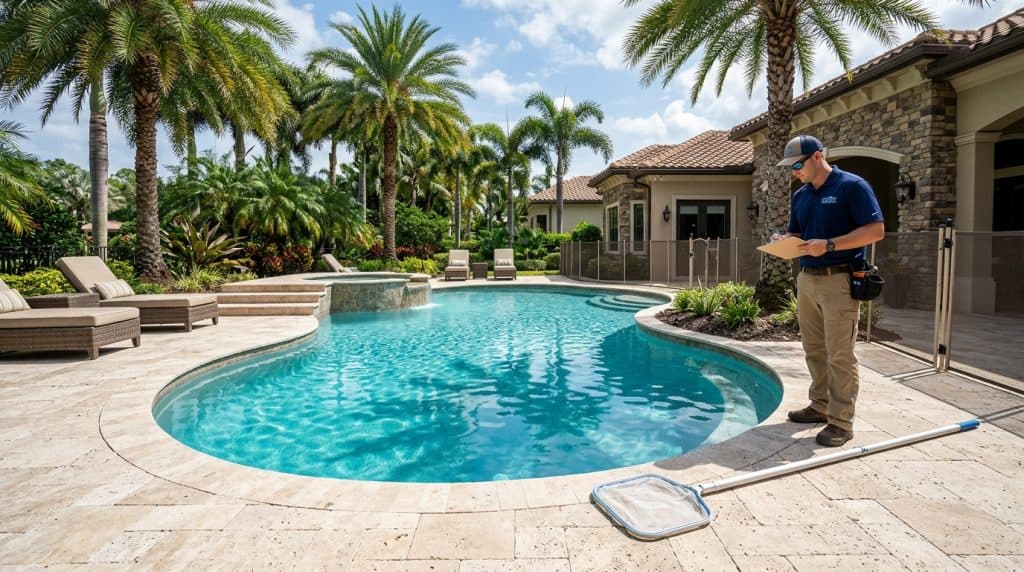
As a Master Certified Pool Operator (CPO) serving the Tampa Bay, Florida region for years, I have seen almost everything float, crawl, or swim its way into a swimming pool. While we all love the lush, tropical ecosystem of Hillsborough, Pinellas, and Pasco counties, this vibrant environment comes with some unique pool maintenance challenges. Specifically, we share our home with an array of native reptiles.
Every spring and summer, as temperatures rise and afternoon thunderstorms roll across the Gulf, local wildlife goes on the move. Young male alligators seek out new territory, and native snakes hunt for frogs and lizards. All too often, these excursions end with an accidental plunge into a backyard swimming pool. If you walk out to your backyard with your morning coffee and find yourself staring into the eyes of a prehistoric predator or a coiled serpent, do not panic. This comprehensive guide outlines the exact emergency containment protocols, safety measures, contact directories, and sanitization procedures required to resolve the situation safely and professionally.
—
The Reptilian Attraction: Why Wildlife Ends Up in Your Pool
Before diving into emergency steps, it is important to understand why these creatures are attracted to your pool in the first place. Pools are not natural habitats for reptiles, but they present several tempting features:
- The Heat and Cooling Cycle: Reptiles are ectothermic (cold-blooded). During scorching Tampa afternoons, a pool offers a quick way to cool down. Conversely, pool concrete, brick pavers, and coping stone retain heat long after the sun goes down, drawing reptiles seeking warmth during cooler nights.
- Abundant Prey: Skimmer baskets and pool steps are notorious for trapping frogs, toads, mice, and large insects. For a hungry snake or juvenile alligator, a pool is essentially an open-air buffet.
- Accidental Falls: Alligators and snakes have poor depth perception. When sliding along a pool deck or trying to drink from the edge, they frequently slip in. Because of the slick tile borders and steep vertical walls of modern pools, they quickly find themselves trapped with no easy way to climb out.
Understanding this behavior helps us manage these encounters safely, without causing unnecessary harm to the animal or risking human injury.
—
Alligator in Backyard Pool Tampa: Who to Call and Emergency Steps
Finding an alligator in your pool is a quintessential Florida experience, but it is one that must be treated with the utmost seriousness. Even a small alligator (under four feet) possesses immense jaw strength, razor-sharp teeth, and lightning-fast reflexes. If you spot an alligator in backyard pool tampa who to call is your very first question.
Step 1: Maintain a Safe Distance and Establish a Perimeter
Do not attempt to poke, prod, lasso, or capture the alligator yourself. Under Florida law, it is illegal to kill, harass, or possess an alligator without a permit. Keep all family members, especially children and pets, inside the house. Keep your eyes on the animal from a safe distance behind a window or screen enclosure if possible, as alligators can move surprisingly fast on land and can easily leap out of shallow water if agitated.
Step 2: Contact the Authorities immediately
For any alligator inside a residential swimming pool, you need to contact professional, state-sanctioned wildlife trappers. The primary resource is the Florida Fish and Wildlife Conservation Commission (FWC).
- The FWC Nuisance Alligator Pool Hotline: Call the Statewide Nuisance Alligator Program (SNAP) at 1-866-FWC-GATOR (1-866-392-4286).
- Local Emergency Services: If the alligator is large (over 4 feet) and poses an immediate threat to life or safety, dial 911. Local sheriff’s deputies in Tampa, Brandon, Riverview, and Clearwater are well-trained in basic wildlife containment and can assist while waiting for an FWC-contracted trapper.
When you call the fwc nuisance alligator pool hotline, be prepared to provide your exact address, the approximate size of the alligator, and its current behavior (e.g., resting at the bottom, actively swimming, or trying to climb out). FWC will dispatch a licensed nuisance alligator trapper to safely hook, secure, and remove the animal from your property.
Step 3: Keep the Area Secure Until Help Arrives
While waiting for the trapper, do not run your pool filtration system if you can avoid it, as the movement of water can stress the animal. Ensure all gates to your pool deck are shut tight so the alligator cannot escape into neighboring yards or local retention ponds before the trapper arrives.
—
Snake in Pool Skimmer Removal Safety and Identification
Snakes are far more common pool intruders than alligators. They regularly slip through screen enclosures or crawl under loose doors. Unfortunately, they frequently end up trapped in the skimmer basket, where suction holds them in place. When it comes to snake in pool skimmer removal safety, the golden rule is simple: assume every snake is venomous until positively identified otherwise.
Identifying Florida’s Venomous Water Snakes
Tampa Bay is home to several venomous snake species, but the one most commonly associated with water is the Cottonmouth (Water Moccasin). It is frequently confused with harmless native water snakes (such as the Banded Water Snake). Here is how to quickly tell them apart from a safe distance:
| Feature | Harmless Water Snake | Venomous Cottonmouth |
|---|---|---|
| Head Shape | Narrow, oval-shaped head | Blocky, triangular, distinct neck |
| Eye Pupils | Round pupils | Vertical, cat-like slits |
| Swimming Style | Body mostly submerged, only head above | Entire body floats high on the water |
| Behavior | Flees quickly when approached | Coils, stands ground, opens white mouth |
Safe Snake Extraction Protocol
If you suspect the snake in your skimmer is venomous (or if you are unsure), do not attempt to touch it. Call a local wildlife removal service immediately. If you are 100% confident the snake is a non-venomous species (like a black racer or garter snake), follow this safety protocol:
- Turn Off the Pump: Shut down the pool pump immediately. This stops the suction in the skimmer throat, allowing the snake to breathe and reducing its stress, making it less likely to strike when approached.
- Use a Long-Handled Tool: Never reach your hand into a skimmer basket if a snake is present. Use a long telescoping pool pole with a skimmer net attached.
- The Bucket Method: Place a deep, clean plastic bucket on the pool deck. Gently scoop the snake out of the skimmer basket using your net, and place it immediately into the bucket. Cover the bucket with a lid or board.
- Release Safely: Carry the bucket to the edge of your property, near a conservation area or wooded patch, and gently tip it over to allow the snake to slither away. Remember, snakes play a vital role in our local ecosystem by keeping rodent and pest populations under control.
—
Disinfecting Pool After Reptile Removal: The Master CPO Sanitation Protocol
Once the animal is safely removed from your backyard, your job is not quite done. As a CPO, my primary concern shifts immediately to water chemistry and bather health. Reptiles are notorious carriers of pathogens, most notably Salmonella bacteria, as well as various parasites and fecal waste.
Simply netting the animal out and jumping back in for a swim is a recipe for recreational water illnesses (RWIs). Here is my step-by-step professional protocol for disinfecting pool after reptile removal to restore your water to pristine, sanitary conditions.
Step 1: Isolate and Clean the Skimmer & Filtration System
Before treating the body of water, we must sanitize the equipment where the reptile may have left high concentrations of organic matter.
- Empty the skimmer basket and pump basket of any debris, leaves, or animal waste. Use heavy-duty rubber gloves during this process.
- Wash the baskets thoroughly with a 10% bleach-to-water solution, letting them air dry in the hot Florida sun (UV light is an excellent natural disinfectant).
- If you have a cartridge filter, remove the elements and spray them down thoroughly with a filter cleaner or replace them if they are heavily soiled. For D.E. or sand filters, perform a comprehensive backwash cycle.
Step 2: Balance the pH and Total Alkalinity
Before you attempt to shock your pool, your water chemistry must be balanced. Chlorine is highly sensitive to pH levels. If your pH is too high (above 7.8), your chlorine will be sluggish and far less effective at killing bacteria. Target these parameters:
- pH: 7.2 to 7.4 (this slightly lower range maximizes the sanitizing power of your shock).
- Total Alkalinity (TA): 80 to 120 ppm.
Step 3: Superchlorinate (Shocking the Pool)
To eliminate dangerous pathogens like Salmonella and E. coli, you must raise your free chlorine levels significantly. This is known as superchlorination.
- The Formula: For a standard reptile intrusion (such as a snake or a small alligator), you want to raise your Free Chlorine (FC) level to at least 10 to 20 parts per million (ppm) and maintain it there for a minimum of 24 hours.
- What to Use: Use high-quality Liquid Chlorine (Sodium Hypochlorite) or Calcium Hypochlorite (cal-hypo) shock. Avoid using stabilized chlorine tablets (trichlor) for shocking, as this will raise your Cyanuric Acid (CYA) levels unnecessarily.
- Calculation Example: For a standard 15,000-gallon pool, adding approximately 2 to 2.5 gallons of 12.5% liquid pool chlorine will successfully elevate your chlorine levels to the target disinfection range.
Step 4: Run the Circulation System
Run your pool pump continuously for a full 24-hour cycle. This ensures that the highly chlorinated water circulates through every inch of plumbing, steps, main drains, and water features, eliminating any lingering bacteria.
Step 5: Final Testing and Re-entry
After 24 hours of continuous filtration, test the water using a high-quality liquid drop test kit (like a Taylor K-2006). Verify that:
- Free Chlorine has drifted back down to safe swimming levels (typically 1 to 4 ppm).
- pH is stabilized between 7.4 and 7.6.
- Combined Chlorine (CC) is 0.2 ppm or lower, indicating that all organic contaminants have been completely oxidized.
—
Proactive Prevention: Keeping Florida Wildlife Out of Your Pool
The best emergency protocol is the one you never have to use. By implementing a few simple, proactive adjustments to your pool deck and backyard, you can drastically reduce the chances of encountering a snake or alligator in your water.
1. Install Wildlife Ramps and Escape Routes
If a small animal or snake does fall into your pool, they will swim along the perimeter looking for an exit. Installing a device like a FrogLog or a critter ramp in the pool corners gives small reptiles a way to climb out safely on their own, preventing them from ending up dead and decomposing in your skimmer basket.
2. Maintain Your Screen Enclosure
In Tampa Bay, pool cages (screen enclosures) are our first line of defense. However, they only work if they are fully sealed. Inspect your enclosure monthly for:
- Tears, rips, or separations along the screen spline.
- Gaps under the doors. Install tight rubber sweeps or weather stripping at the base of all screen doors to block snakes from sliding underneath.
- Erosion or gaps where the aluminum frame meets the concrete or dirt footer. Fill these gaps with quick-dry cement or heavy gravel.
3. Landscaping and Perimeter Management
Keep your grass cut short and trim back any overgrown bushes or ground cover close to your pool deck. Snakes hate crossing wide, open spaces where they are vulnerable to predators like hawks. Additionally, avoid placing large decorative rocks or wood piles directly adjacent to your pool screen, as these provide ideal nesting habitats for cold-blooded creatures.
—
Partnering with Local Pool Professionals
Managing the delicate chemical balance of a Florida pool—especially after a wildlife intrusion—can be stressful. Maintaining proper sanitizer levels, cleaning filtration systems, and ensuring your pool equipment is operating at peak efficiency requires consistent attention.
If you want peace of mind knowing your family is swimming in safe, sanitary, and pristine water year-round, let the professionals handle the heavy lifting. The experienced team at Tampa Bay Pool Care provides comprehensive, certified pool maintenance services tailored specifically to the unique challenges of our local Florida climate. From chemical balancing to equipment repair and deep cleans, they keep your backyard oasis safe, clean, and wildlife-free.
Remember: keep your distance, know who to call, sanitize rigorously, and enjoy the beautiful Florida sunshine safely!