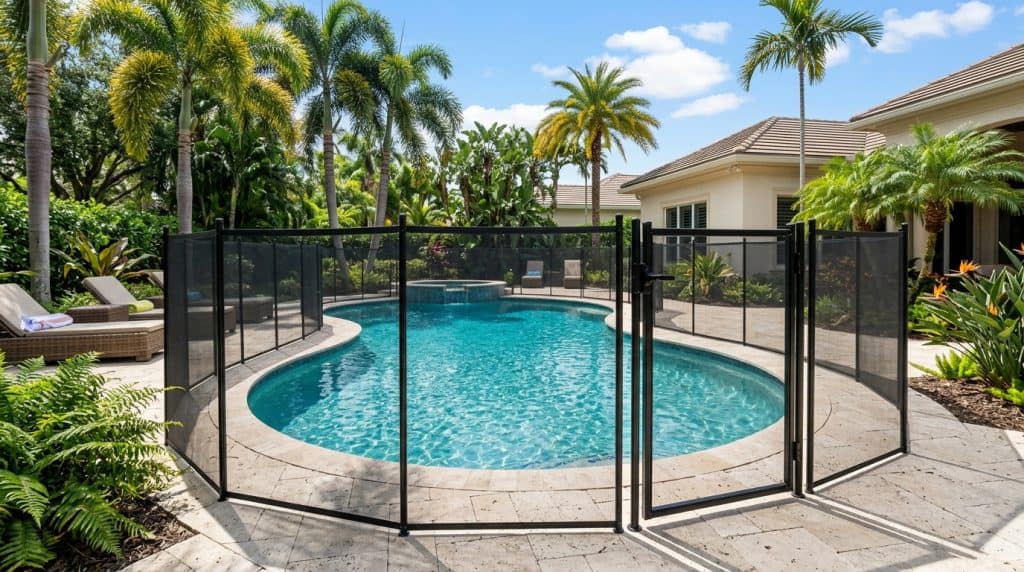
In Florida, outdoor living effortlessly merges covered lanais with open water, but intense seasonal rainfall and year-round backyard recreation expose property owners to severe municipal liability. Navigating statutory compliance demands absolute precision when physical barriers and automated alarms serve as the definitive line between a tranquil aquatic retreat and catastrophic municipal penalties or life-altering tragedy.
Navigating the Florida Residential Swimming Pool Safety Act (Chapter 515)
Enacted to curb pediatric drowning incidents across the state, Chapter 515 of the Florida Statutes sets rigorous benchmarks that govern both newly constructed swimming pools and residential retrofits during property transfers. Compliance is not merely an optional best practice for suburban homeowners; it is a mandatory legal standard enforced through municipal building departments and county code officers. When technicians perform weekly pool service and chemical maintenance, they routinely observe how direct exposure to sunlight, humidity, and chemical vapor degrades safety hardware over time. Understanding florida pool safety fence laws ensures that your aquatic recreation zone remains a compliant, secure sanctuary rather than a legal and physical hazard.
Under the statutory framework, residential pool owners must implement at least one of four legally recognized safety measures before a pool can pass final municipal inspection or legally operate. These measures comprise a compliant safety barrier isolating the water from the home, an approved safety pool cover, functional exit alarms on all perimeter doors and windows providing direct pool access, or self-closing and self-latching devices installed on all access pathways. Adhering to baseline florida pool barrier requirements shields families from devastating accidents while insulating real estate assets from severe non-compliance citations that halt real estate closings or void standard homeowner insurance policies throughout Central Florida. Public and commercial facilities face even more stringent barrier guidelines; read about these regulatory differences in our guide on commercial vs residential pool maintenance in Florida code.
Gate Specifications and Barrier Engineering Standards
Physical pool fences must adhere to uncompromising structural dimensions to effectively prevent unsupervised access by toddlers and domestic animals. Florida law requires the barrier to stand at least 4 feet (48 inches) high on the exterior side, measured from the finished ground grade outside the perimeter. The distance between the bottom of the barrier and the ground surface cannot exceed 2 inches, ensuring a child cannot crawl beneath the structure. Furthermore, any barrier openings or mesh spacing must be sufficiently narrow to prevent a 4-inch sphere from passing through, effectively removing footholds that curious children could exploit to climb over the perimeter enclosure.
The engineering of access gates warrants strict scrutiny during any municipal audit or insurance evaluation, particularly in high-end communities requiring luxury residential pool care in South Tampa. Every pedestrian gate must open outward, away from the swimming pool vessel, and feature an automated self-closing and self-latching mechanism. The latch release device must sit at least 54 inches above the ground level or be situated on the pool side of the gate at least 3 inches below the top edge, positioned so that small hands reaching through or over cannot trip the latch. Adhering to these structural dimensions ensures that your perimeter conforms to regional pool perimeter safety rules hillsborough county inspectors actively enforce.
Exit Alarms, Window Sensors, and Indoor Access Points
When the exterior wall of an occupied dwelling serves as an integral boundary of the pool barrier enclosure, the structure introduces severe vulnerabilities that require mechanical countermeasures. Florida Statute 515 explicitly mandates that every door, sliding glass entrance, and low-sill window with direct, unhindered access to the pool deck must carry an approved exit alarm. These acoustic signaling devices must meet UL 2017 standards, producing a continuous, piercing 85-decibel alert audible at a distance of 10 feet immediately upon an unauthorized breach. Because harsh gulf humidity can corrode internal electrical contacts, verifying sensor readiness must parallel diagnostic procedures like electronic acoustic pool leak detection to preserve total deck integrity. In Florida homes where the lanai serves as the primary code barrier, ensuring door hardware latches securely is covered in our guide to screen enclosure and pool cage maintenance in Tampa.
Modern statutory allowances accommodate momentary adult transit through the integration of temporary deactivation touchpads located at least 54 inches above the finished threshold. These momentary bypass switches quiet the alarm for approximately 15 to 20 seconds, permitting passage without initiating an audible alarm sequence across the household. Battery-operated alarms require scheduled testing, terminal corrosion removal, and frequent cell replacement to avoid dead-circuit vulnerabilities. Incorporating these automated components satisfies the strictest interpretations of florida pool safety fence laws, establishing redundant layers of acoustic notification that protect minors who manage to slip through indoor living zones toward the water line undetected.
Municipal Inspections and Hillsborough County Enforcement
Municipal code enforcement divisions across the greater Tampa Bay metropolitan area treat residential aquatic safety as an aggressive life-safety priority rather than an administrative formality. Preparing for a formal child safety gate pool inspection tampa requires an exhaustive examination of latch tension, hinge spring-back strength, latch strike alignment, and electrical sensor functionality. In jurisdictions like Brandon, Valrico, and suburban Hillsborough County, building officials will immediately fail an inspection if a self-closing gate drags across paver joints or fails to latch autonomously from an open distance of merely two inches, bringing permitted renovation work to a dead standstill.
| Barrier Component | Florida Statutory Minimum Spec | Common Failure Point | Standard Remediation Strategy |
|---|---|---|---|
| Barrier Height | 48 inches above external grade | Mulch or paver buildup raising outside grade | Grade regrading or barrier panel elevation adjustments |
| Gate Swing Direction | Outward, away from the water | Installed swinging inward toward pool vessel | Re-hanging hinge posts and reversing latch striker plates |
| Latch Release Height | 54 inches above the finished surface | Latches mounted low for adult hand convenience | Installing upward post extensions and top-pull latch systems |
| Exit Access Alarms | UL 2017 compliant; 85 dB output at 10 feet | Dead batteries, disconnected wiring, bypassed switches | Installing hardwired or monitored smart security sensors |
Failing to remedy identified barrier deficiencies carries legal consequences that extend well beyond municipal re-inspection fees. Under Florida Statute 515.27, an individual who fails to equip a newly constructed pool with at least one approved safety feature commits a second-degree misdemeanor, punishable by monetary fines or mandatory imprisonment. Homeowners served by reliable pool service routes in Brandon and Valrico increasingly discover that private insurance underwriters systematically cross-examine municipal barrier permits before binding coverage or resolving accidental premises liability claims, making ongoing structural vigilance vital to real estate equity preservation.
The Future of Perimeter Protection and Preventative Deck Security
Residential pool safety architecture is rapidly evolving past conventional passive barriers into sophisticated, integrated ecosystems that unite mechanical physics with intelligent exterior telemetry. Cutting-edge optical sensors, integrated tension mesh structures, and tamper-resistant self-closing hydraulic hinges now withstand severe tropical storm cycles while offering frictionless access for authorized adults. Modern Florida building standards continuously advance toward whole-property envelope security, where smart perimeter sensors actively communicate with exterior lighting networks, multi-stage filtration pumps, and homeowner automation systems to illuminate deck zones the instant a perimeter line experiences unauthorized movement. Certified technicians inspect gate latches and safety barriers during weekly visits; explore typical service rates in our Tampa Bay pool service pricing guide.
Maintaining regulatory compliance transcends the simple avoidance of code citations; it establishes an enduring standard of domestic stewardship that preserves property value amidst changing regional demographics. As municipal building departments refine barrier testing methodologies and insurance adjusters enforce strict safety audits across coastal Florida, investing in commercial-grade latching hardware and pristine acoustic door safeguards provides sustained legal immunity. Treating structural barrier integrity as an ongoing component of your property infrastructure preserves peace of mind, ensuring that the visual serenity of your backyard oasis remains permanently anchored by an unbreachable perimeter of defense.