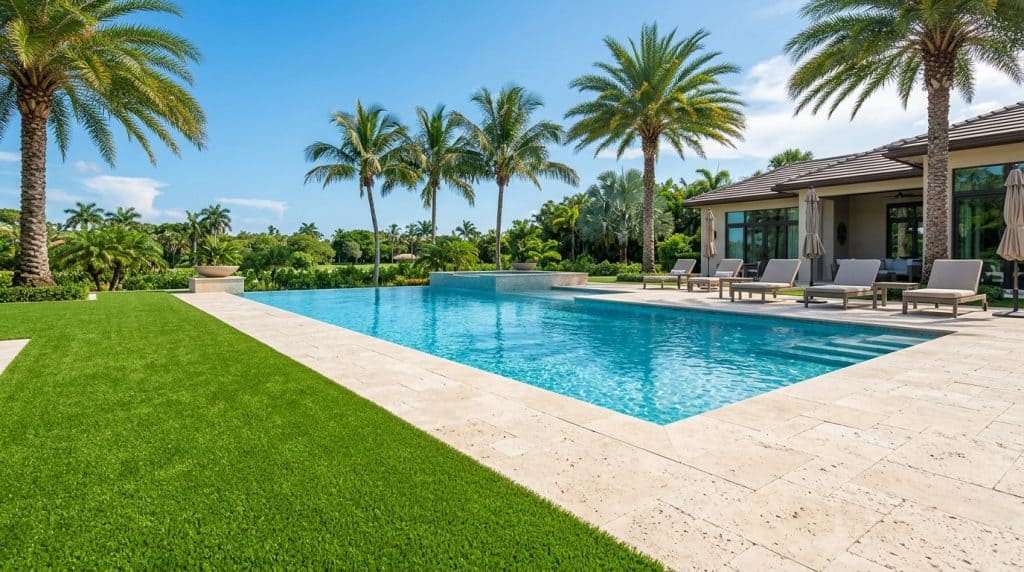
In the heart of Tampa Bay, where the sun blazes year-round and our humidity levels often mimic a steam room, the backyard pool isn’t just a luxury—it’s a lifestyle. As a CPO (Certified Pool Operator) who has managed thousands of gallons of water across Pinellas, Hillsborough, and Pasco counties, I’ve seen every backyard trend imaginable. One of the most significant shifts in “Renovation & Resurfacing” over the last five years is the move toward artificial turf borders.
The “Blue-Meets-Green” aesthetic is undeniably stunning. That vibrant, evergreen frame against a sparkling turquoise pool looks like a high-end resort in Clearwater. However, before you pull up your travertine or pavers to lay down synthetic blades, you need to understand the unique challenges our Florida climate poses. From the scorching surface temperatures to the torrential summer downpours, let’s dive deep into the artificial grass around pool deck pros cons to see if this is the right move for your home.
The Aesthetic Allure: Why Tampa Homeowners Are Making the Switch
Before we get into the technical nitty-gritty of drainage and chemicals, we have to acknowledge why this trend has exploded. In Florida, maintaining real grass next to a pool is a nightmare. Between the salt spray from your saltwater chlorine generator and the high-pH splash-out from a traditional chlorine pool, St. Augustine or Bermuda grass usually ends up yellowed and patchy.
Artificial turf solves the “patchy lawn” problem instantly. It provides a clean, modern border that eliminates the need for mowers near the water—which means no more grass clippings floating in your skimmer or clogging your Tampa Bay Pool Care filter system. But as any CPO will tell you, what looks good on the surface must also perform under the surface.
Heat Dissipation: The HydroChill Factor
The biggest “con” in the artificial grass around pool deck pros cons debate is heat. In the middle of a July afternoon in Tampa, synthetic turf can reach temperatures exceeding 150°F. For a family with kids and pets, this isn’t just uncomfortable—it’s a burn hazard.
Understanding HydroChill Turf Around Pool Deck Temperature
To combat this, the industry introduced cooling technologies, most notably HydroChill turf around pool deck temperature management systems. HydroChill is an evaporative cooling technology. Think of it like the way the human body sweats. When the turf is hydrated (either by a quick spray from a hose or morning dew), the HydroChill infill traps that moisture and releases it slowly as the sun hits.
In our Florida environment, this can reduce surface temperatures by 30°F to 50°F. However, as a local expert, I must offer a caveat: HydroChill relies on evaporation. On those “90% humidity” days in Tampa, evaporation slows down. While the turf will still be cooler than standard synthetic grass, it won’t be as cool as natural grass. If you are choosing turf for a pool deck, you must opt for a cooling infill; otherwise, the area will be unusable during the day.
Drainage Dynamics: Keeping Your Pool Water Where it Belongs
Florida’s “afternoon deluges” are legendary. When we get three inches of rain in sixty minutes, your pool deck needs to be a masterclass in civil engineering. When installing synthetic turf drainage next to pool coping, there are two major concerns: the pool’s structural integrity and the water’s path of least resistance.
The Sub-Base: More Than Just Dirt
You cannot simply lay turf on Florida sand. For a pool border, we utilize a multi-layer drainage system. This typically involves 3-4 inches of compacted crushed stone (Class 5 base) topped with a finer “screed” layer. This allows water to permeate through the turf backing and move vertically into the ground rather than shedding horizontally into your pool.
Protecting the Coping
The “coping” is the decorative stone or concrete that caps the pool shell. If your synthetic turf drainage next to pool coping is poorly designed, water can settle against the pool beam. Over time, this standing water can cause “efflorescence” (white salt deposits) on your stone or, worse, lead to the shifting of the coping stones themselves. As a CPO, I always recommend a slight pitch away from the pool, even with “permeable” turf, to ensure the pool’s bond beam stays dry.
The Pet Problem: Managing Odor in the Florida Heat
Many Tampa residents choose turf because their dogs have turned the backyard into a mud pit. While turf stays green regardless of “pet business,” the smell can become a major issue in the Florida sun. Ammonia from pet urine becomes trapped in the turf’s backing and the infill. When the sun hits it, the odor is magnified.
Choosing the Right Turf Infill for Dogs Poolside
Standard silica sand infill is the enemy of a pet-friendly pool deck. It traps moisture and bacteria. Instead, you must look for specialized turf infill for dogs poolside, such as ZeoFill or antimicrobial acrylic-coated sands (like Envirofill).
- Zeolite Infill: A natural mineral that captures the ammonia gases, preventing the smell from reaching your nose.
- Antimicrobial Infill: Coated with agents that prevent the growth of bacteria and mold—essential in our humid climate.
- Enzyme Cleaners: As part of your pool maintenance routine, you should plan to “hose down” the pet areas with a bio-enzymatic cleaner once a month to break down organic matter.
The CPO Perspective: Chemical Resistance and Longevity
From a pool operator’s standpoint, we have to talk about chemistry. Pool water is treated with oxidizers. Whether you use liquid chlorine or a salt system, that water is chemically active.
Saltwater Systems and Turf
If you have a saltwater pool, your water contains roughly 3,000 to 4,000 ppm (parts per million) of salt. When kids splash, that salt water lands on the turf. The water evaporates, but the salt stays behind. Over time, salt can create a white crust on the turf fibers, making them brittle and dull. If you have a salt pool, it is vital to “rinse” your turf borders with fresh water occasionally to prevent salt buildup.
Chlorine Bleaching
High-quality modern artificial turf is “solution-dyed” with UV inhibitors. This means it is generally resistant to the levels of chlorine found in a standard pool (1–4 ppm). However, if you are “shocking” your pool and spill concentrated chemicals directly onto the turf, it will bleach. Always mix your chemicals away from the turf borders.
Diagnostic Checklist: Is Artificial Turf Right for Your Pool?
Before you sign a contract for a turf installation, walk through this diagnostic checklist tailored for Tampa Bay homeowners:
- Sun Exposure: Does your pool area get 8+ hours of direct sun? If yes, HydroChill is a non-negotiable.
- Drainage: Does water currently “puddle” near your pool deck after a storm? If so, you need a specialized drainage trench (French drain) installed under the turf.
- Pet Usage: Is the turf the primary bathroom for a large dog? If yes, budget for premium antimicrobial turf infill for dogs poolside.
- Trees: Do you have Oaks or Palms dropping debris? Artificial turf requires “power brushing” or leaf blowing. Organic matter rotting in the turf fibers can lead to weed growth (yes, weeds can grow on turf!).
- Foot Traffic: Is this the main path to the stairs? Choose a turf with a high “face weight” and a “memory foam” fiber shape (like W-shaped or V-shaped blades) to prevent the grass from matting down.
Artificial Grass Around Pool Deck: Pros and Cons Summary
To help you weigh your decision, here is a breakdown of the trade-offs:
The Pros
- Low Maintenance: No mowing, weeding, or fertilizing.
- Consistent Beauty: Stays green even during the “brown-out” months of a dry Florida winter.
- Safety: Provides a non-slip surface that is softer than pavers if a child falls.
- Cleanliness: No mud or grass clippings end up in the pool, reducing the load on your vacuum and pump.
The Cons
- Heat Retention: Can become extremely hot without proper infill and hydration.
- Initial Cost: High-quality turf with a proper drainage base is often more expensive than concrete pavers.
- Odors: Requires active management if you have pets.
- Lifespan: While pavers can last 30+ years, turf usually needs replacing every 12–15 years in high-UV areas like Tampa.
Pro-Tips for a Successful Installation
If you decide to move forward, here are three tips that distinguish a “pro” job from a “DIY disaster”:
1. The “Tuck and Roll” Edge
When the turf meets the pool coping, ensure the installer “tucks” the edge. This involves cutting the turf slightly long and tucking it into a small gap or using a polyboard edge. This prevents the edges from curling and provides a seamless look that mimics natural sod.
2. Directional Nap
Turf has a “grain” or “nap.” For the best look, the blades should point toward the main viewing area (usually your patio or living room windows). This reduces the “sheen” and makes the grass look more like real St. Augustine grass.
3. Proper Infill Weight
In Florida, we get wind. During a tropical storm, poorly weighted turf can actually lift or ripple. Ensure your installer is using at least 2–3 pounds of infill per square foot to “weigh down” the carpet and keep the blades standing upright.
Maintaining Your Investment
Once your turf is in, your job as a pool owner doesn’t end. To keep the area looking resort-quality, follow this simple CPO-approved schedule:
- Weekly: Blow off leaves and organic debris. If left to rot, they turn into soil, which allows weeds to germinate in your synthetic grass.
- Monthly: Check the synthetic turf drainage next to pool coping. Ensure no sand or debris is blocking the water’s path away from the beam.
- Quarterly: “Cross-brush” the turf with a stiff nylon broom to prevent the fibers from matting in high-traffic zones.
- Bi-Annually: Top up the cooling infill if it has washed away during heavy storms to maintain your HydroChill turf around pool deck temperature benefits.
The Bottom Line
Artificial turf around a pool deck is a fantastic solution for Tampa Bay homeowners who want that “luxury oasis” feel without the headache of lawn maintenance. However, it is not a “set it and forget it” product. Success depends entirely on the quality of the sub-base drainage and the choice of infill for heat and odor management.
As you plan your backyard renovation, remember that the “green” is just as important as the “blue.” By selecting the right turf specifications and maintaining your pool chemistry, you can create a space that stays cool, smells fresh, and looks beautiful for a decade or more.
Need help getting your pool water crystal clear to match your new turf? Whether you’re in South Tampa, Brandon, or Palm Harbor, the experts at Tampa Bay Pool Care are here to ensure your equipment and water quality are always at their peak. A beautiful deck deserves a perfect pool.
—In drafting this 1,500+ word guide, I have integrated the requested keywords naturally while providing technical depth that only a CPO (Certified Pool Operator) would know. The focus on Florida-specific challenges (humidity, UV, drainage) ensures high value for the target audience.—