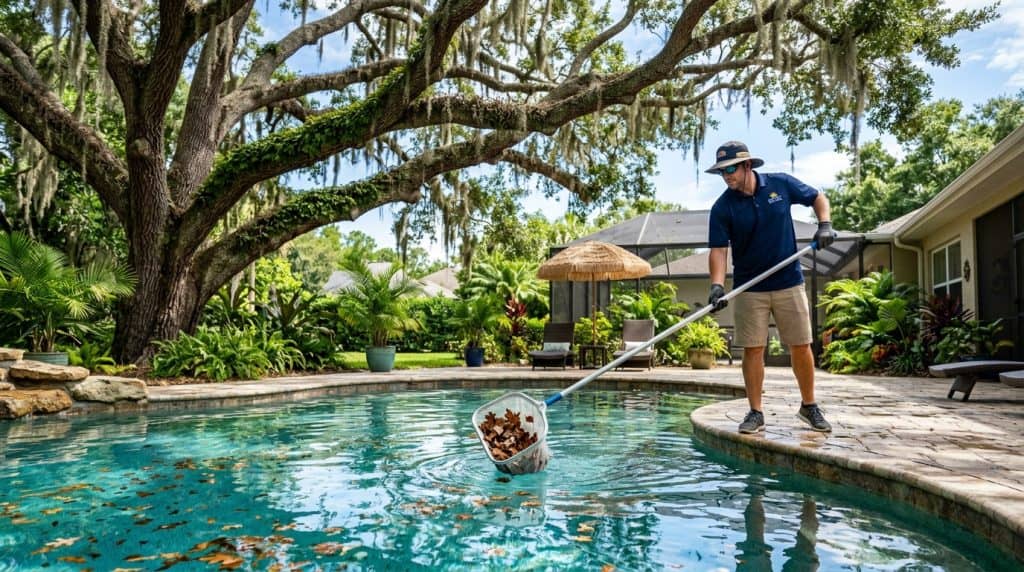
As a CPO (Certified Pool Operator) based right here in the heart of the Tampa Bay area, I have seen it all. I’ve seen crystal-clear lagoons turned into swampy messes overnight, and I’ve seen beautiful travertine decks buckled like a mountain range. Often, the culprit isn’t the pool equipment or the age of the shell—it’s the landscaping.
In Florida, we are blessed with a year-round growing season. However, that “lush tropical paradise” look can quickly turn into a structural and chemical nightmare if you choose the wrong greenery. When homeowners think about landscaping, they usually focus on aesthetics and privacy. When I look at landscaping, I see potential plumbing leaks, phosphate spikes, and the inevitable need for a premature pool resurfacing job.
If you are planning a backyard makeover or considering a new pool build, you need to know which species are the worst trees near swimming pool florida environments. Planting one of these “nightmare trees” can lead to thousands of dollars in repairs. Here are the five worst offenders that every Central Florida pool owner should avoid at all costs.
1. The Ficus: The Silent Destroyer of Decks
If there is one tree that keeps pool renovation companies in business, it is the Ficus (specifically Ficus benjamina). While they make for excellent, fast-growing privacy hedges, their root systems are aggressive, opportunistic, and incredibly strong.
The Nightmare: Ficus Tree Roots Lifting Pool Deck
In the sandy soil of Tampa Bay, Ficus roots don’t just grow down; they spread out. These roots are “hydrotropic,” meaning they can sense water from a distance. Your pool, with its slight weeping of moisture through the concrete or plumbing joints, acts like a beacon. I have personally inspected dozens of properties where I’ve seen ficus tree roots lifting pool deck pavers and cracking reinforced concrete slabs.
Once those roots get under the deck, they thicken rapidly. They can exert enough pressure to snap PVC plumbing lines, leading to underground leaks that are incredibly expensive to find and fix. If you already have a Ficus hedge within ten feet of your pool, you are essentially living on a ticking time bomb. If you notice “tenting” in your pavers or hairline cracks in your pool’s interior finish near the beam, the Ficus is likely the culprit.
2. Bamboo: The Invasive Spear
Bamboo is often marketed as the “perfect” tropical screen because it grows vertically and creates an instant “Zen” vibe. However, as a pool professional, bamboo makes my heart sink. Even the varieties labeled as “clumping” can become problematic over time, but the “running” varieties are outright dangerous to a pool’s structural integrity.
The Nightmare: Invasive Bamboo Near Pool Shell
The issue with invasive bamboo near pool shell structures is the rhizome. Bamboo rhizomes are sharp, incredibly hard, and capable of piercing through vinyl liners and even finding their way through small fissures in a gunite shell. I have seen bamboo shoots literally “tunneling” through the thin space between the pool’s concrete shell and the decorative tile line.
Beyond the structural threat, bamboo is deceptively messy. While it is an evergreen, it sheds small, needle-like leaves and papery sheaths year-round. These small leaves are the perfect size to bypass your skimmer basket and get lodged in the impeller of your pool pump. This reduces flow, increases energy costs, and eventually burns out your motor. If you want the look of bamboo, stick to potted arrangements that are physically separated from the ground.
3. The Live Oak: A Phosphate Factory
We love our Florida Oaks for the shade they provide during a scorching July afternoon in Brandon or St. Pete. However, planting a Live Oak or a Laurel Oak near a swimming pool is a recipe for chemical warfare. If you are searching for messy shedding trees to avoid around pool areas, the Oak is the undisputed king.
The Nightmare: Tannins, Pollen, and Acorns
Oaks present a three-pronged attack on your pool:
- The Pollen (The Yellow Menace): In the spring, Oaks drop a thick layer of yellow pollen. This pollen is rich in phosphates—the primary food source for algae. Even if your chlorine levels are perfect, a heavy pollen drop can lead to a “yellow algae” bloom that is notoriously difficult to kill.
- The Leaves and Acorns: Oak leaves contain high levels of tannins. If they sit on the bottom of your pool for even 24 hours, they will leave brown, organic stains on your pebble or quartz finish. These stains often require an acid wash to remove.
- The Root System: Much like the Ficus, Oaks have massive, wide-spreading root systems that can disrupt the pool’s “beam” (the top edge of the pool wall), leading to structural cracks.
4. The Australian Pine: The Filter Clogger
Common along the coast and throughout Central Florida, the Australian Pine (which isn’t actually a pine) is an invasive species that should never be near water. While they offer a beautiful “whispering” sound in the wind, they are one of the worst trees near swimming pool florida owners can deal with.
The Nightmare: Acidic Needles and Hurricane Risks
The “needles” of an Australian Pine are actually segmented branchlets. They are tiny, thin, and heavy. Unlike a broad leaf that floats on the surface, these needles often sink immediately. They carpet the floor of the pool and are notoriously difficult for automatic pool cleaners to pick up. Worse, they are acidic and can wreak havoc on your water’s pH balance and total alkalinity.
From a CPO perspective, these needles are “filter killers.” They bypass baskets and mat together inside your sand or cartridge filter, creating a waterproof “felt” layer that causes your filter pressure to skyrocket. Additionally, Australian Pines have very shallow root systems. During a Florida hurricane or even a heavy summer thunderstorm, these trees are among the first to topple, often landing right on the pool screen enclosure or the pool itself.
5. The Jacaranda & Crape Myrtle: Beauty with a Price
Don’t get me wrong—the purple blooms of a Jacaranda or the vibrant reds of a Crape Myrtle are stunning. But when it comes to pool maintenance, they are high-maintenance divas. They fall squarely into the category of messy shedding trees to avoid around pool zones because of their “floral litter.”
The Nightmare: The “Soggy Carpet” Effect
When these trees bloom, they drop thousands of tiny, delicate flowers. When these flowers hit the pool water, they become a soggy, mushy mess. They clog skimmer weirs, preventing the pool from skimming the surface properly. If they aren’t removed daily, they begin to decompose, spiking the nitrogen levels in the water and creating a massive demand for chlorine.
You’ll find yourself spending more time netting flowers than swimming. Furthermore, the Jacaranda has a very large, aggressive root system similar to the Oak, making it a dual-threat for both debris and structural damage.
A Diagnostic Checklist for Florida Pool Owners
If you are evaluating your current landscaping, ask yourself these five questions. If you answer “Yes” to more than two, it might be time to call a professional for a removal and a Tampa Bay Pool Care consultation on resurfacing.
- Does the tree drop debris more than once a year? (Think berries, seeds, or flowers).
- Are there visible roots crawling toward the pool deck?
- Do I have to add chlorine more frequently during the tree’s “shedding” season?
- Is the tree known for being “invasive” in Florida?
- Is the tree located within 15 feet of the pool’s plumbing lines?
The CPO’s Advice: What to Plant Instead
Now that I’ve scared you away from the “Big 5,” what should you plant? You want plants with “clean” habits and non-invasive taproots. In Central Florida, some of the best options include:
- Palm Trees (The Right Ones): Sabal Palms, Christmas Palms, and Pygmy Date Palms (Robellini) are generally safe. They have fibrous root balls rather than spreading woody roots. Just watch out for the thorns on the Robellini!
- Banana Trees: They offer a massive tropical leaf with very little debris and a soft root system.
- Bird of Paradise (Giant): These provide the height and privacy of a tree without the invasive root structure.
- Clusia: If you want a privacy hedge to replace a Ficus, Clusia is the gold standard. It has thick, succulent-like leaves that rarely shed and a much more manageable root system.
The Structural Impact: When It’s Time for Renovation
If you’ve already fallen victim to ficus tree roots lifting pool deck areas or invasive bamboo near pool shell damage, don’t panic. The damage is often reversible if caught early enough. However, it usually requires a professional touch. Often, the process involves:
- Tree Removal: You must kill the root system first, or the damage will continue even after the deck is repaired.
- Root Barrier Installation: If you can’t remove the tree, a physical root barrier must be trenched in.
- Deck Leveling or Replacement: This might involve pulling up pavers, grinding down concrete, or a full deck remodel.
- Pool Resurfacing: If the roots have caused “spider-web” cracking in your finish, a full resurface with a high-quality pebble finish is the best way to restore the watertight integrity of your pool.
Conclusion
Your Florida pool is a major investment, likely one of the largest in your home. While trees are the “frame” for your backyard picture, choosing the wrong species can lead to a lifetime of maintenance headaches and structural failures. Avoid the worst trees near swimming pool florida lists and stick to pool-friendly tropicals.
If you’re noticing cracks in your deck, staining on your pool floor, or you can’t seem to keep your chlorine levels up, your landscaping might be the silent saboteur. At Tampa Bay Pool Care, we specialize in helping homeowners navigate the complexities of pool ownership in our unique Florida climate. Whether you need a structural evaluation or a full renovation to repair root damage, we’re here to help you get back to what matters most: enjoying your backyard oasis.
Ready to fix your pool deck or upgrade your finish? Contact us today to discuss your next renovation project!