As a Master CPO (Certified Pool Operator) here in the heart of Tampa Bay, I’ve seen thousands of lanais. I’ve seen the good, the bad, and the “clogged-my-skimmer-twice-today” ugly. In our subtropical Florida climate, we are blessed with a year-round growing season, but for a pool owner, that blessing can quickly become a curse if you choose the wrong greenery.
When we talk about renovation and resurfacing, we often focus on the tiles and the pebble finish. But the landscaping surrounding your pool is just as vital. If you’ve just invested in a beautiful resurfacing project from Tampa Bay Pool Care, the last thing you want is a messy tree dropping tannins that stain your new finish or tiny leaves that bypass your filtration system and wear out your pump.
The goal is simple: You want the “resort look” without the “resort maintenance.” This guide breaks down the best plants around pool screen enclosure setups, focusing on low-litter, non-shedding tropicals that thrive in the 813 and 727 area codes.
The CPO’s Golden Rule: Why “Low Litter” Matters
From a maintenance perspective, the “messiness” of a plant isn’t just about aesthetics; it’s about water chemistry. As a CPO, I look at plants as potential phosphate sources. When leaves, pollen, or flowers fall into your pool or sit on your screen, they decompose. This decomposition releases organic matter into the water, which serves as a buffet for algae.
Furthermore, many Florida favorites (like the Jacaranda or certain Oaks) drop tiny debris that can pierce through mesh screens or accumulate in the “gutters” of your lanai. This leads to sagging screens and clogged downspouts. To keep your pool pristine, we need to focus on low maintenance pool lanai plants in Tampa that keep their leaves to themselves.
Diagnostic Checklist: Is a Plant “Pool-Friendly”?
- Non-Shedding: Does it drop leaves seasonally or year-round?
- Low Pollen: Will it coat your screen in yellow dust?
- Non-Invasive Roots: Will it crack your pool deck or pavers?
- Salt/Chlorine Tolerance: Can it handle the occasional splash of treated water?
- Thorn-Free: Is it safe for swimmers in bathing suits walking by?
The Top 4 Tropical Superstars for Tampa Lanais
In Tampa, we fall into USDA Hardiness Zone 9b or 10a. This means we need plants that can handle the blistering July heat but also survive the occasional 35-degree night in January. Here are my top picks for the best plants around pool screen enclosure areas.
1. Bird of Paradise (Strelitzia reginae)
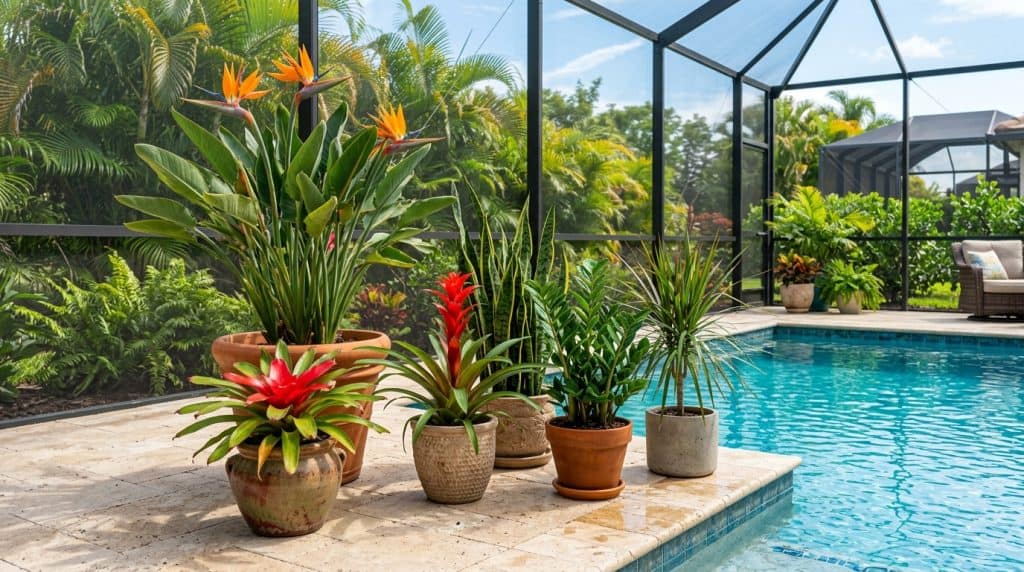
If you want that iconic Florida look, placing a bird of paradise around pool deck areas is your best bet. There are two main types: the Orange Bird (smaller, bushier) and the Giant White Bird (which can grow 20 feet tall).
Why it works: They have thick, waxy leaves that rarely shed. Unlike palms that may drop seeds or fronds, the Bird of Paradise stays relatively contained. The “Orange” variety is perfect for large pots inside the lanai or planted just outside the screen. It provides height and architectural interest without the mess.
2. Crotons (Codiaeum variegatum)
When it comes to crotons and bromeliads poolside landscaping, you’re looking at the kings of color. Crotons, specifically varieties like ‘Petra’ or ‘Mammy,’ offer fiery reds, oranges, and yellows that don’t rely on flowers (which eventually die and fall off).
Why it works: Crotons are incredibly hardy in Tampa. They are evergreen, meaning they don’t drop their leaves in the winter. They provide a dense visual barrier if you’re looking for privacy around your screen enclosure, and they require very little pruning.
3. Bromeliads
Bromeliads are the ultimate low-maintenance choice. These are “tank” plants that hold water in their central cups. They come in hundreds of varieties, from the silver-toned Aechmea fasciata to the vibrant Neoregelia.
Why it works: They have no “shedding” cycle to speak of. They grow slowly and thrive in the humid microclimate created by a pool. Pro-tip: Keep them in pots so you can move them if we get a rare hard freeze in Tampa.
4. Pygmy Date Palm (Phoenix roebelenii)
While many palms are messy, the Pygmy Date Palm is a manageable classic. It stays small (usually under 10 feet) and offers that tropical canopy feel.
The CPO Warning: Pygmy Date Palms have sharp spines at the base of their fronds. Never plant these directly in a walkway. However, as an accent piece 3-4 feet away from the screen, they are perfect. They drop very little debris compared to a Queen Palm or a Washingtonia.
Designing for the Screen: Inside vs. Outside
When planning your low maintenance pool lanai plants in Tampa, you have to distinguish between what goes inside the cage and what goes outside.
Inside the Lanai (Containers)
Inside the screen, you are dealing with “Filtered Light.” The mesh blocks about 10-30% of UV rays. This is actually ideal for plants that would otherwise get scorched in the Florida sun.
- Adonidia Palms (Christmas Palm): Great for corners. Very clean.
- Rhapis Palms (Lady Palm): Thrives in the shade of the lanai roof.
- Snake Plants (Sansevieria): Virtually indestructible and produces zero litter.
Outside the Screen (Perimeter)
The goal here is privacy and windbreaks without creating a gutter-cleaning nightmare.
- Podocarpus: These are often used as “living fences.” They have needle-like leaves that rarely fall and can be trimmed into a tight hedge.
- Areca Palms: Excellent for privacy, but be warned—they require more thinning as they age to stay looking “clean.”
Practical Maintenance: Keeping the Water Clear
As a CPO, my biggest concern with poolside landscaping is runoff. When it rains in Tampa—and we know it rains hard—fertilizers and mulch from your plant beds can wash through the screen and into your pool.
The “Buffer Zone” Strategy
I recommend a 12-to-18-inch “buffer zone” of decorative river rock or Mexican beach pebbles between your screen and your mulch beds. This prevents heavy rains from splashing dirt and mulch onto your lanai deck or into the water. This also prevents “screen splash,” where dirt kicks up and stains the bottom of your white or bronze aluminum enclosure.
Avoid the “Dirty Dozen”
Avoid these plants at all costs if you value your pool’s filtration system:
- Bougainvillea: Gorgeous, but the papery flowers blow everywhere and have nasty thorns.
- Bamboo: The “root” systems are aggressive, and they shed leaves constantly.
- Oak Trees: The pollen tassels and leaves will destroy your pool’s chemistry in March.
- Oleander: It’s toxic to pets and sheds flowers frequently.
The Impact of Plants on Pool Renovation
If you are in the middle of a pool renovation and resurfacing, now is the time to rethink your landscaping. Old, overgrown bushes can trap moisture against your screen, leading to algae growth on the enclosure itself.
When we resurface a pool, we want that finish to last 15-20 years. If you have a large tree overhanging the screen, the constant shade can lead to uneven temperature distribution in the water, and the debris can cause “organic staining” on new quartz or pebble finishes. By switching to crotons and bromeliads poolside landscaping, you reduce the risk of metal and mineral stains that come from decaying plant matter.
CPO Pro-Tips for Tampa Homeowners
1. Watch the pH
Certain plants, like Azaleas or Gardenias, prefer acidic soil. If you are fertilizing these heavily right next to your pool, the runoff can affect your pool’s total alkalinity and pH. Always use slow-release granular fertilizers rather than liquid sprays near the water.
2. Irrigation Placement
Ensure your sprinkler heads are pointed away from the pool screen. Constant reclaimed water hitting your screen enclosure causes calcium buildup (scaling) on the mesh, which is incredibly difficult to clean and can eventually lead to the mesh becoming brittle.
3. Pest Control
Tropical plants like Hibiscus can attract whiteflies or aphids. These pests produce “honeydew,” a sticky substance that can get on your screen and attract sooty mold. Choosing hardier plants like bird of paradise around pool deck areas minimizes pest issues, as their thick leaves are less attractive to sap-sucking insects.
Conclusion: The Perfect Tampa Oasis
Creating a tropical paradise around your Tampa Bay pool doesn’t have to mean spending every Saturday morning with a skimmer net and a leaf blower. By selecting low maintenance pool lanai plants in Tampa that are “clean,” non-shedding, and salt-tolerant, you protect your investment.
Whether you are looking to refresh your current look or you’re in the middle of a total renovation and resurfacing project, remember that the best plants are the ones you can enjoy without the work. Focus on the structural beauty of the Bird of Paradise, the vibrant, static color of Crotons, and the architectural ease of Bromeliads.
If you need help getting your pool water back to crystal clear after a landscaping mishap, or if you’re ready to upgrade your pool’s finish to match your new tropical oasis, reach out to the experts at Tampa Bay Pool Care. We know exactly what it takes to keep a Florida pool running perfectly, regardless of what’s growing around it. Keep your filters clean, your chemistry balanced, and your lanai green!
Quick Summary Table for Tampa Pool Owners
| Plant Name | Litter Level | Sun Needs | Best Placement |
|---|---|---|---|
| Orange Bird of Paradise | Very Low | Full Sun / Partial | Accent Pots / Near Screen |
| Petra Croton | Low | Full Sun (for best color) | Perimeter Hedges |
| Neoregelia Bromeliad | Zero | Filtered Light | Inside Lanai / Shaded Beds |
| Podocarpus | Low | Any | Privacy Screening |