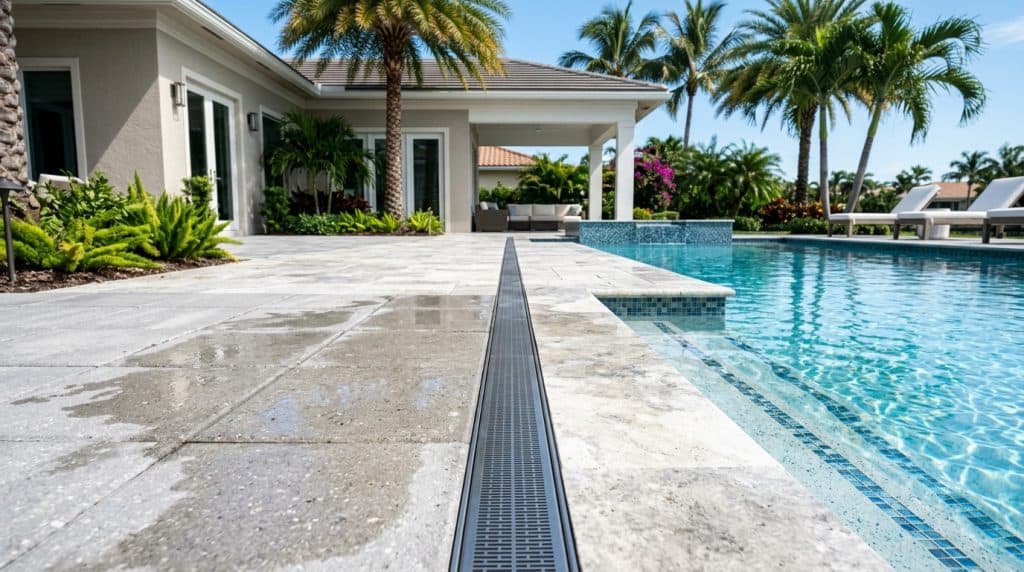
If you live in Tampa, St. Petersburg, or Clearwater, you know the drill. It’s 3:00 PM on a Tuesday in July. The sky turns a bruised shade of purple, the cicadas go silent, and suddenly, the sky opens up. In Florida, we don’t just get “rain”; we get deluges that can drop three inches of water in an hour. For a pool owner, this isn’t just a localized weather event—it’s a high-stakes battle for your water chemistry.
As a CPO (Certified Pool Operator) working right here in the Tampa Bay area, I’ve seen it a thousand times. A beautiful, crystal-clear pool is transformed into a swampy mess of brown mud, cypress mulch, and nitrogen-rich fertilizer in less than sixty minutes. Why? Because the deck drainage failed. When you have a deck drain clogged pool overflow becomes inevitable, leading to a “reverse flow” where the yard washes into the pool rather than the pool shedding water into the yard.
In this comprehensive guide, we are going to dive deep into the engineering and maintenance required to keep your pool pristine during a Florida tropical downpour. From slot drain installation pool deck florida style to preventing mulch washing into pool heavy rain fix strategies, we’re covering it all.
The Anatomy of a Florida Pool Drainage Failure
Most pool decks in Tampa Bay are designed with a slight pitch (usually 1/4 inch per foot) meant to direct water toward a drainage channel. However, during a true Florida deluge, three things typically go wrong:
- Volume Overload: The drain channel simply isn’t wide enough to handle the sheer cubic volume of water.
- Debris Blockage: Leaves, pine needles, and sand clog the narrow slits of the drain.
- Back-Pressure: The “daylight” end of the drain (where it empties into the yard) is underwater or buried in mulch, preventing exit flow.
When these failures occur, the water level on your deck rises. Once it crests the “lip” of your pool coping, it creates a bridge. Now, all the fertilizer you just spread on your St. Augustine grass and all the mulch in your flower beds has a direct highway into your salt or chlorine system. This isn’t just a cleaning headache; it’s a chemical nightmare.
Why Fertilizer Washout is a $500 Problem
Many homeowners think a little dirt in the pool is no big deal—just vacuum it out, right? Wrong. In Florida, our fertilizers are packed with phosphates and nitrogen. These are essentially “steroids” for algae. If your yard washes into your pool, your phosphate levels will spike from 100 ppb (parts per billion) to over 2,000 ppb overnight.
Once phosphates are that high, your chlorine becomes ineffective. You’ll find yourself spending hundreds of dollars on phosphate removers, “Green-to-Clean” kits, and professional filter cleanings. This is why investing in trench drain around pool retaining water solutions is actually a cost-saving measure in the long run.
Diagnostic Checklist: Is Your Deck Ready for the Next Storm?
- The “Daylight” Test: Do you know where your deck drains actually exit? Go find the pipe in your yard. If it’s buried under three inches of dirt or overgrown grass, your drain is useless.
- The Pitch Check: During a light rain, does water sit in puddles on the pavers? This indicates “birdbaths” or poor grading that will overflow during a heavy storm.
- The Slot Inspection: Look at the plastic grates on your deck. Are they cracked or filled with hardened calcium and dirt?
- The Perimeter Level: Is your mulch bed higher than your pool deck? If so, you have created a natural funnel for mud.
Solution 1: Slot Drain Installation (The Florida Standard)
In most Tampa backyards, you’ll see slot drain installation pool deck florida contractors recommend. These are the thin, 1-inch to 2-inch wide plastic channels that run between your house and the pool or along the perimeter of the screen enclosure.
Slot drains are popular because they are discreet. However, they are prone to clogging. To ensure your slot drains don’t lead to a deck drain clogged pool overflow, you must perform seasonal maintenance. Use a high-pressure garden hose (or a specialized “drain jet” nozzle) to flush the channels from the highest point to the exit. If the drain is packed with sand, you may need to use a shop vac to pull debris out of the access points.
Solution 2: High-Capacity Trench Drains
If you have a sloping backyard that constantly sheds water toward the pool, a standard 1-inch slot drain will fail. You need a trench drain around pool retaining water fix. Trench drains are wider (usually 4 to 6 inches) and feature heavy-duty grates. They can move ten times the volume of water that a slot drain can.
For homes in hilly areas of Pasco County or the “highlands” of South Tampa, trench drains are the “nuclear option” for drainage. They can be integrated into your paver deck and connected to a 4-inch PVC pipe that leads all the way to the street or a dedicated French drain system.
Solution 3: Preventing Mulch and Mud Washout
Even with great drains, the source of the mess is often the landscaping. If you are tired of the mulch washing into pool heavy rain fix search, consider these CPO-approved landscaping adjustments:
1. Switch to Decorative Stone
Wood mulch floats. It’s light, airy, and designed to move with water. In a Florida storm, it becomes buoyant and sails right into your skimmer. Replacing the 3-foot perimeter around your pool deck with Mexican Beach Pebbles or crushed lava rock solves this instantly. Stone doesn’t float, and it acts as a natural “filter” for silt.
2. The “Recessed” Garden Bed
Most landscapers build “raised” beds. For pool owners, this is a disaster. Your garden beds should be 1-2 inches lower than the edge of the pool deck. This creates a “catch basin” effect where the garden absorbs the water before it can overflow back onto the deck.
3. Installing a Mow Strip or Retaining Border
A 4-inch concrete or aluminum border between your grass and your deck can act as a literal levee. It stops the “mud-creep” that happens when saturated soil expands during a week of rain.
Maintenance: Clearing the “Clogged Pool Overflow”
What happens when you are already in the middle of a storm and you see the water rising? A deck drain clogged pool overflow is an emergency. The most common culprit is the “screen trap” at the end of the line. Many Florida builders install a small mesh screen at the exit pipe to keep frogs and snakes out. During a storm, this screen gets plastered with grass clippings and completely seals the pipe.
Pro-Tip: During the rainy season (June–September), remove those end-of-pipe screens. It’s better to deal with a frog in the drain than a flooded pool deck that ruins your home’s foundation or your pool’s salt cell.
If you suspect a blockage deeper in the line, you can use a “drain bladder” (available at local hardware stores). This tool attaches to a garden hose, expands inside the pipe to create a seal, and uses pulsating water pressure to blow out the obstruction.
The Role of the Overflow Line
Most modern Florida pools have a dedicated “overflow” pipe built into the tile line or the skimmer. This is a 2-inch pipe that should ideally lead to the street or a drainage pit. If your pool water is reaching the top of the coping, your overflow is either non-existent, too small, or clogged.
As a Tampa Bay Pool Care expert, I always recommend checking this overflow port. Stick a hose in it and make sure water is coming out at the curb. If it’s blocked, you are essentially relying on your deck drains to do two jobs: drain the deck and drain the pool. That’s a recipe for failure.
Professional Grading and Hardscaping
Sometimes, the issue isn’t maintenance—it’s physics. If your yard was graded incorrectly when the house was built, you might have a “negative grade” where the entire backyard slopes toward the pool. In these cases, no amount of cleaning will save you.
The fix involves installing a French Drain system coupled with a trench drain around pool retaining water setup. This involves digging a deep trench, lining it with filter fabric, laying perforated pipe, and backfilling with gravel. This creates a subterranean “void” where thousands of gallons of water can sit and slowly percolate into our sandy Florida soil without ever touching your pool deck.
After the Storm: The Recovery Process
If the worst happens and your drainage fails, you need to act fast to prevent permanent staining and algae blooms.
- Manual Removal: Use a leaf rake (the net kind) to scoop out as much mulch and organic debris as possible. Do NOT use your automatic pool cleaner (vacuum) for this—it will clog instantly.
- Flocculant or Clarifier: If the water is brown (silt/mud), you may need to use a “Floc” treatment to drop the suspended particles to the bottom, then vacuum to “waste.”
- Test Phosphates: As mentioned, fertilizer washout is a phosphate bomb. Test the water. If it’s over 500 ppb, treat it immediately.
- Clean the Filter: After a washout, your filter (cartridge or DE) is likely packed with fine silt and mud. Even if the pressure looks okay, clean it. Mud can “bridge” the pleats of a cartridge, rendering it useless.
Summary: Protect Your Oasis
In Tampa Bay, your pool is your sanctuary, but our tropical climate is always trying to reclaim it. Preventing a deck drain clogged pool overflow is about proactive engineering. Whether it’s a new slot drain installation pool deck florida project or simply clearing out the trench drain around pool retaining water, your efforts today will save you from a “green pool” nightmare tomorrow.
Don’t wait for the next hurricane or tropical storm to find out your drainage is inadequate. Take a walk around your pool today, find your exit pipes, check your mulch levels, and ensure your “daylight” is clear.
If you’re feeling overwhelmed by the technical side of pool chemistry or drainage recovery, don’t go it alone. Expert help is available to ensure your backyard stays a paradise, even when the Florida weather turns wild. For professional maintenance and storm recovery, trust the experts at Tampa Bay Pool Care to keep your water crystal clear and your equipment running at peak performance.
Key Takeaways for Tampa Bay Residents:
- Clean your deck drains every three months.
- Ensure garden beds are lower than the pool deck.
- Replace floating mulch with heavy river rock.
- Verify that your pool overflow line is clear of debris and lizard nests.
- Check the “exit” point of your drainage pipes at the curb or yard perimeter.