As a certified pool operator (CPO) managing swimming pools across the Tampa Bay area, I’ve seen firsthand how the Florida climate treats pool chemistry. Between our unrelenting UV index, frequent afternoon cloudbursts, high bather loads, and the occasional tropical system, keeping your water balanced is a daily battle. Under the scorching Florida sun, a perfectly clear pool can turn into a swampy green lagoon in less than 48 hours if your sanitizer levels bottom out.
Naturally, homeowners are always looking for ways to simplify this chore. The promise of a digital continuous pool water monitor that tracks your water chemistry 24/7 and sends alerts directly to your smartphone sounds like magic. But can these smart devices truly replace the gold-standard manual drop tests, such as the Taylor K-2006 kit?
In this guide, we’ll break down the market’s leading smart monitors, put them head-to-head in a classic battle of accuracy, and examine whether they can withstand the brutal realities of a Florida summer.
—
The Florida Pool Paradox: Why Our Chemistry is a Different Beast
Before we look at the hardware, we have to understand the environment we’re putting these devices into. In states like Ohio or Colorado, a pool might require minimal chemical adjustments. In Florida, however, your pool is a dynamic biological combat zone. Here are the main stressors our pools face daily:
- The UV Strip-Mining Effect: Sunlight destroys free chlorine. Unstabilized chlorine has a half-life of about 30 to 45 minutes under direct Florida sunlight. Even with Cyanuric Acid (CYA) in the water, our intense UV rays rapidly deplete your sanitizer.
- Dilution and Acidic Deluges: Tampa Bay’s signature summer thunderstorms can dump inches of rainwater into your pool in an hour. This rain isn’t just pure water; it can lower your pH, dilute your salt and stabilizer levels, and introduce environmental nitrates and phosphates.
- Extreme Thermal Stress: Pool water temperatures in July and August routinely climb into the low 90s. Warm water is the perfect incubator for organic pathogens and algae spores, demanding incredibly tight chemical tolerances.
To survive this environment, a smart monitor must be highly accurate, durable, and resistant to environmental interference. Let’s look at the two giants dominating the smart monitoring space today: WaterGuru Sense 2 and Sutro.
—
WaterGuru Sense 2: The Skimmer Specialist
If you are looking for a discreet device that stays completely out of sight, the WaterGuru Sense 2 is likely on your radar. Designed to sit directly inside your pool’s skimmer, it replaces your existing skimmer cover with an engineered, battery-operated lid.
How the WaterGuru Sense 2 Works
Unlike simple probes that rely on electrical conductivity, the WaterGuru Sense 2 uses colorimetric analysis—essentially a highly automated version of the liquid test kits professionals use. The device draws a tiny sample of water into an internal chamber containing a cassette with chemical test pads. It shines light through the reacted pad and uses an optical sensor to read the color change, converting it into digital data sent to your home Wi-Fi network.
The “WaterGuru Sense 2 Review Florida Pool” Experience
When conducting a waterguru sense 2 review florida pool owners should know that placement inside the skimmer is both its greatest strength and a potential point of vulnerability.
Because it lives in the skimmer, it measures water that is actively circulating, ensuring a highly representative sample of your pool’s overall health. The app is incredibly polished, offering clear directions on exactly how many pounds of salt, shock, or acid to add based on your pool’s volume.
However, the skimmer is also where all of Florida’s organic debris collects. Think of live oak leaves, pollen, pine needles, and those giant palmetto bugs. If your skimmer basket overflows, or if debris blocks the intake port of the WaterGuru, your readings can become skewed. Additionally, because the unit relies on active water flow, you must run your pool pump during its scheduled daily test window to get an accurate reading.
Smart Skimmer Monitor Chlorine Accuracy
When it comes to smart skimmer monitor chlorine accuracy, the WaterGuru Sense 2 performs admirably. By using dry reagent pads sealed inside a cassette, it avoids the probe drift common with older digital monitors. It measures Free Chlorine (FC), pH, Total Alkalinity (TA), Calcium Hardness (CH), and Cyanuric Acid (CYA). In our field testing, the free chlorine readings were usually within 0.5 ppm of a professional Taylor liquid drop test—more than accurate enough for daily monitoring.
—
Sutro: The Floating Lab
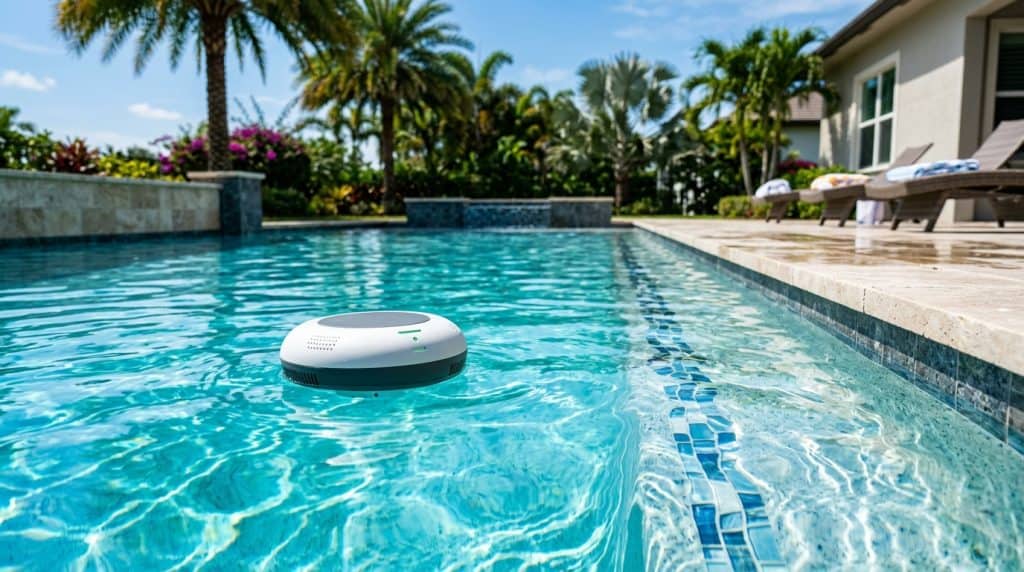
If the WaterGuru is a stealthy skimmer insert, the Sutro is an unabashed floating laboratory. Resembling a futuristic, oversized salt shaker, the Sutro floats freely in your pool or can be tethered to a specific spot (like near your steps, away from the skimmer mouth).
How the Sutro Works
Sutro takes a slightly different approach to chemical analysis. Inside its heavy-duty floating housing is a replaceable cartridge filled with actual liquid reagents, sourced from LaMotte (a highly respected name in professional pool testing).
Three times a day, the Sutro automatically draws pool water into its internal mixing chamber, mixes it with the liquid reagents, and uses an onboard optical sensor to read the color change. It measures Free Chlorine, pH, and Total Alkalinity. Because it uses true “wet chemistry” reagents, its testing methodology is virtually identical to what a pool service technician does at your pool equipment pad.
The Florida Reality of a Floating Monitor
Sutro’s design has a few clear advantages in the Florida sun. Because it floats on the surface, it isn’t buried in a skimmer basket full of leaves. It also doesn’t care whether your pool pump is running or not when it takes a reading, as it samples the surface water directly.
The downside? It is highly visible. If you have kids, dogs who love to fetch, or a screen enclosure that drops heavy shadows, the Sutro will be bobbing around right in the middle of it. Furthermore, the intense Florida heat can degrade the liquid reagents inside the floating cartridge faster than they would in cooler climates, occasionally leading to slightly drifted readings toward the end of a cartridge’s 1-month lifespan.
—
Sutro vs. WaterGuru vs. pHin: An Accuracy Comparison
When evaluating sutro vs waterguru vs phin accuracy, we must first address the elephant in the room: pHin. Once a highly popular choice, the pHin monitor was discontinued. It relied on an ORP (Oxidation-Reduction Potential) probe to estimate sanitizer levels.
In Florida, ORP probes are notoriously unreliable because our high CYA (stabilizer) levels shield the probe, causing it to read falsely low chlorine levels even when the water is perfectly sanitized. The industry has largely moved away from pure ORP probes for residential pools for this exact reason.
That leaves us with Sutro and WaterGuru. Let’s look at how they stack up against professional manual testing:
| Metric Tested | WaterGuru Sense 2 | Sutro | Taylor K-2006 (Drop Test) |
|---|---|---|---|
| Testing Method | Dry Reagent Cassette (Optical) | Liquid Reagents (Optical) | Manual Wet Chemistry (Visual) |
| Free Chlorine | Highly Accurate (±0.5 ppm) | Highly Accurate (±0.5 ppm) | Gold Standard (±0.2 ppm) |
| pH Accuracy | Excellent (±0.1) | Excellent (±0.1) | Excellent (±0.1) |
| Cyanuric Acid (CYA) | Yes (with specific cassettes) | No (Requires manual input) | Yes (Turbidity method) |
| Calcium Hardness | Yes (with specific cassettes) | No (Requires manual input) | Yes (Drop titration) |
| Subscription Cost | Medium (Cassette replacements) | High (Monthly cartridge plan) | Low (Reagent replacements yearly) |
Both the WaterGuru and the Sutro offer incredible accuracy because they avoid the pitfalls of continuous-immersion pH and ORP electrodes, which degrade rapidly when left constantly submerged in chlorinated water. By sealing their sensors and reagents away from the harsh pool water between tests, both brands have successfully solved the longevity and drift issues that plagued older smart monitors.
—
Can Continuous Digital Monitors Replace Drop Tests?
As a CPO, my short answer is: No, but they can dramatically reduce how often you need to perform them.
Think of a digital continuous pool water monitor like the dashboard of your car. Your fuel gauge, tire pressure monitor, and engine temperature sensor are incredibly useful for daily driving. They tell you if something is immediately wrong so you can pull over before your engine blows up.
However, those dashboard sensors don’t replace your mechanic putting the car on a lift, checking the brake pad thickness, and analyzing the engine codes during an annual service.
A smart monitor is your daily dashboard. It will alert you instantly if a heavy rainstorm has stripped your chlorine or if your salt chlorinator has stopped working, saving you from a costly algae bloom. However, you still need a high-quality manual drop test kit for several critical reasons:
1. High-Range Testing Limitations
If your pool has turned green or you are fighting an active black algae infestation, you must raise your free chlorine to “shock” levels (often 15 to 30 ppm depending on your CYA levels). Neither the WaterGuru nor the Sutro can accurately read free chlorine levels this high; their optical sensors are calibrated for normal operational ranges (usually 0 to 10 ppm). To track your chlorine demand during a shock cycle, you must use a manual FAS-DPD drop test.
2. The Langelier Saturation Index (LSI)
To protect your pool’s plaster, pebble finish, and expensive heating equipment from scaling or corrosion, you must calculate your water’s LSI. This calculation requires five inputs: pH, Alkalinity, Calcium Hardness, Cyanuric Acid, and Water Temperature.
While WaterGuru can measure all of these, it does not do so continuously on a single standard cassette. Sutro does not measure Calcium Hardness or CYA at all. To get a true, comprehensive LSI calculation, a monthly manual drop test of all five parameters is still essential.
3. Sensor Calibration Audits
Even the best digital optical sensors can suffer from optical scaling (calcium buildup on the lens) or reading errors due to water turbidity. As a best practice, you should always verify your smart monitor’s readings with a manual drop test once a month to ensure the hardware is still performing as expected.
—
The CPO-Approved Digital Monitoring Strategy for Florida Pools
If you want to integrate smart technology into your pool care routine while keeping your water pristine and your equipment protected, I recommend this hybrid approach:
- Use the Smart Monitor for Daily Diagnostics: Let your WaterGuru or Sutro handle the day-to-day tracking. If you see your pH spiking (common in Florida pools with salt cells or water features), you can address it immediately with small doses of acid rather than waiting for a weekly test.
- Perform a Weekly “Sanitizer Check”: Do a quick manual check of your free chlorine and pH once a week using a simple liquid test kit. This takes two minutes and confirms your smart monitor is on track.
- Run a Monthly Complete Lab Test: Every month (or after a major storm), perform a complete manual drop test using a Taylor K-2006 kit or bring a water sample to a trusted professional. Test your CYA, Calcium Hardness, and Total Alkalinity, then balance your pool according to the LSI. If you’d rather leave the balancing to the professionals, consider partnering with a certified local service like Tampa Bay Pool Care to keep your system running perfectly.
—
Final Verdict: Which Smart Monitor is Right for You?
Choosing between these two heavyweights comes down to your pool setup and your personal aesthetic preferences.
- Choose the WaterGuru Sense 2 if: You want a completely invisible device, you have an active pool cover, you want to measure CYA and Calcium Hardness without buying secondary kits, and you already run your pool pump for at least 4 to 6 hours during the day.
- Choose the Sutro if: You want a floating unit that tests independently of your pump run times, you prefer liquid-reagent testing chemistry, and you don’t mind a subscription model that automatically ships fresh testing cartridges to your door every month.
Whichever route you choose, embracing digital continuous pool water monitors is a fantastic way to stay ahead of the Florida heat. While they may not completely replace the need for manual chemistry checks, they act as an invaluable early warning system, keeping your pool safe, sparkling, and ready for a swim at a moment’s notice.