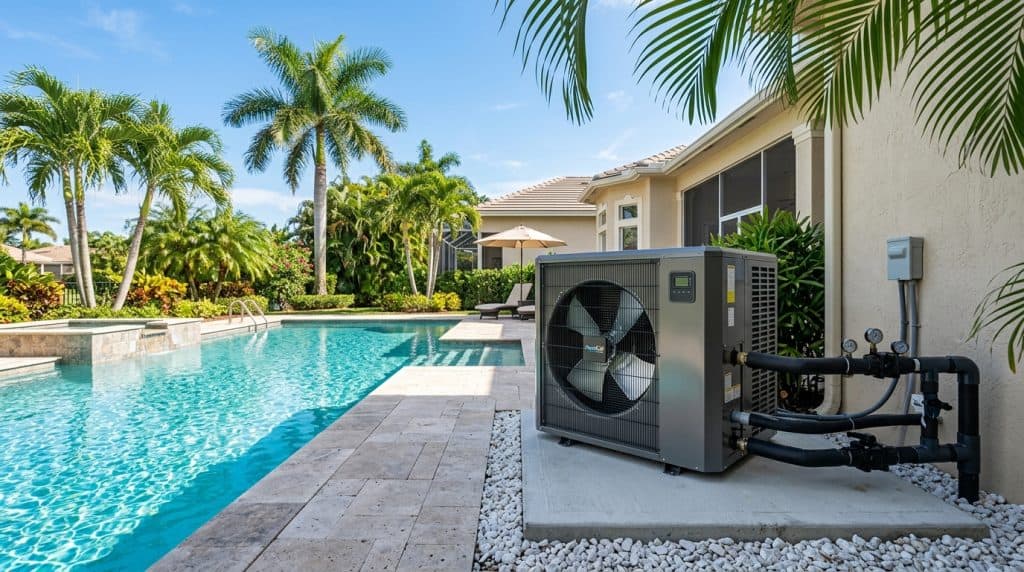
Step into any backyard in Tampa, St. Petersburg, or Clearwater during the dog days of July and August, and you are met with a wall of dense, heavy humidity. You run to your backyard pool looking for sweet relief, dive in, and… it feels like stepping into hot soup. When your pool water climbs past 90°F, it is no longer refreshing. It is downright exhausting.
As a Certified Pool Operator (CPO) who has managed commercial and residential swimming pools across the Tampa Bay region for years, I hear the same complaint every summer: “My pool is too hot to enjoy!”
When you are staring at a pool thermometer that reads like a low-grade fever, you need real, mechanical solutions. In this comprehensive guide, we will dive deep into the science and technology of lowering your pool temperature. We will explore how to cool pool water in the Florida summer using advanced equipment like reverse-cycle heat pumps, dedicated evaporative chillers, and budget-friendly aerators.
—
The Science of the “Bathwater” Pool: Why Warm Water is a Hazard
Before we look at the equipment, we must address why high water temperatures are more than just a comfort issue. If your pool water is 94 degrees, knowing how to lower it is a matter of chemical safety, structural preservation, and health.
1. Rapid Chlorine Degradation
Chlorine is highly sensitive to temperature and UV light. In warmer water, chemical reactions speed up exponentially. At 94°F, free chlorine molecules convert to combined chlorine (chloramines) at an accelerated rate, leaving your pool virtually unprotected against pathogens. You will find yourself dumping gallon after gallon of liquid chlorine or running your salt chlorine generator at 100% duty cycle, only to watch your free chlorine levels drop to zero by mid-afternoon.
2. The Algae Bloom Sweet Spot
Algae is a photosynthetic organism that thrives in warm, sunlit environments. Once your pool crosses the 85°F threshold, you enter the ideal incubation zone for black, yellow (mustard), and green algae. If your water hits 90°F or higher, an algae bloom can take over an entire pool in less than 24 hours if your sanitizer levels dip even slightly.
3. Scaling and LSI Imbalance
In pool chemistry, we monitor the Langelier Saturation Index (LSI) to determine if water is corrosive, balanced, or scale-forming. Water temperature plays a massive role in this formula. As water temperature rises, the LSI shifts positive. This means warm water is highly prone to depositing calcium scale on your pool tile, interior finish, and—most critically—inside your salt cell or heater manifold, leading to expensive equipment failures.
4. Physical Discomfort and Dehydration
The human body cools itself in water through heat dissipation. When pool water matches or exceeds your skin temperature (typically around 91°F to 93°F), your body can no longer shed heat effectively. Swimming or playing in hot water can lead to rapid dehydration, heat exhaustion, and elevated heart rates.
—
Pool Chiller vs Aerator Fountain Tampa: The Budget vs. Performance Battle
When homeowners begin researching cooling options, they often compare simple, low-cost options to high-end mechanical systems. Let’s break down the classic debate: pool chiller vs aerator fountain tampa.
The Aerator and Fountain Approach (Low Cost, Low Yield)
An aerator is a simple, screw-in pipe attachment that fits into your pool’s return line jet. It sprays a fan of water droplets over the pool surface. Fountains perform a similar function.
- How it works: Aerators rely on evaporative cooling. When water is sprayed into the air, a small percentage of it evaporates. Because evaporation is an endothermic (cooling) process, it extracts heat from the surrounding water droplets, lowering the temperature of the water that falls back into the pool.
- The Florida Reality Check: Evaporative cooling requires dry, low-humidity air to work efficiently. In Tampa Bay, our summer relative humidity routinely hovers between 80% and 95%. When the air is already saturated with moisture, evaporation slows to a crawl.
- The Verdict: If you run an aerator or fountain exclusively at night (when ambient temperatures drop and humidity decreases slightly), you can expect a modest 2°F to 4°F temperature reduction. While inexpensive, aerators cannot keep up with consecutive 95°F days, and they drastically increase your pool’s evaporation rate, forcing you to refill the pool with mineral-heavy tap water more frequently.
The Dedicated Evaporative Chiller (High Efficiency, Moderate Cost)
A dedicated evaporative pool chiller (such as a Glacier Pool Cooler) is a mechanical unit installed on your equipment pad.
- How it works: Your pool pump diverts water into the top of the chiller. The water is sprayed over a specialized internal media grid while a powerful, industrial-grade fan blows massive volumes of air through the chamber. This forces rapid evaporation inside the controlled environment of the unit. The chilled water is then collected in a basin at the bottom and pumped back into the pool.
- Performance in Tampa: Unlike a simple aerator, a dedicated evaporative chiller is incredibly efficient. It can easily lower your pool temperature by 8°F to 12°F, even in high Florida humidity.
- Cons: Because they rely on evaporation, they consume water. You will see an increase in your water bill as your automatic water leveler tops off the pool to compensate for the lost volume.
—
Reverse Cycle Heat Pump Cooling Pool: The Year-Round Masterpiece
For pool owners seeking absolute control over their water temperature regardless of the weather, a reverse cycle heat pump cooling pool system is the gold standard.
Most pool owners are familiar with standard heat pumps used to warm pools in March or November. However, a reverse-cycle heat pump features a specialized internal component called a reversing valve (similar to the heat pump that heats and cools your home).
How a Reverse-Cycle Heat Pump Works in “Cool” Mode
- Heat Absorption: The unit draws warm pool water through its titanium heat exchanger.
- Refrigerant Cycle: Instead of extracting heat from the air to warm the water, the reversing valve switches the flow of the R410A refrigerant. The system extracts heat out of the pool water and transfers it into the liquid refrigerant.
- Heat Dissipation: The hot refrigerant is pumped through the condenser coils, and a powerful fan blows the heat out into the atmosphere.
- Cooling Delivery: The chilled pool water is returned directly to your pool.
Why Reverse-Cycle Heat Pumps Excel in Florida
While evaporative chillers rely on dry air, a reverse-cycle heat pump is a closed thermodynamic loop. It does not care about humidity levels. Whether it is a rainy, 98% humidity afternoon or a dry morning, a reverse-cycle pump like the AquaCal HeatWave IceBreaker or Built Right Heat Pump will steadily pull heat out of your pool.
With a reverse-cycle system, you simply set your desired temperature on the digital controller (for example, 85°F). If the pool water hits 86°F, the cooling cycle kicks on. If the water drops below 84°F during an unexpected winter cold snap, the heating cycle kicks on. It provides a true, set-it-and-forget-it thermostat experience for your backyard oasis.
—
CPO Diagnostic Checklist: Selecting Your Cooling Method
To help you decide which cooling technology aligns with your budget, pool size, and lifestyle, use this diagnostic breakdown tailored specifically for Tampa Bay properties.
| Feature / Factor | Aerator Jet | Evaporative Chiller | Reverse-Cycle Heat Pump |
|---|---|---|---|
| Upfront Cost | Very Low ($50 – $150) | Moderate ($2,500 – $4,500) | High ($5,500 – $9,000+) |
| Average Temp Drop | 2°F – 4°F (At Night Only) | 8°F – 12°F | 10°F – 15°F+ (Fully Controllable) |
| Humidity Impact | Highly Sensitive | Mildly Sensitive | None |
| Water Loss Rate | High Evaporation | High Evaporation | Zero (Closed Loop) |
| Winter Heating? | No | No | Yes (Dual-Zone Comfort) |
—
Practical CPO Tips: How to Cool Pool Water in the Florida Summer Today
If you are waiting for an equipment upgrade or looking for immediate ways to shave a few degrees off your swimming pool, here are the professional operational adjustments we use to keep pools refreshed in the heat:
1. Run Your Filtration Cycle at Night
Most pool owners run their single-speed or variable-speed pumps during the hottest hours of the day to maximize UV sanitization. However, if your pool is overheating, try shifting your primary run times to start at 10:00 PM and run through 6:00 AM. This circulates the water when the ambient air temperature is at its lowest, allowing natural thermal radiation to dump heat back into the cool night air.
2. Utilize Shade Sails and Pergolas
Solar radiation is the primary driver of high water temperatures. Direct, uninterrupted Florida sunlight can transfer an immense amount of thermal energy into your water. By installing temporary commercial-grade UV shade sails over a portion of your pool, you can drop surface water temperatures by 3°F to 5°F. It also protects your swimmers from intense ultraviolet rays.
3. Manage Your Screen Enclosure Care
If you have a screen enclosure (commonly called a lanai), it already acts as a giant shade filter, blocking roughly 10% to 15% of direct sunlight. Ensure your screen mesh is clean and free of pollen, dust, and mildew. Airflow is crucial; if air cannot circulate freely through your screen enclosure, a heat dome effect is created over your pool deck, driving up water temperatures.
4. Tactical Partial Water Exchanges
If you find your pool water at 94 degrees and are wondering how to lower it immediately for a weekend party, a strategic partial drain and refill can assist. The municipal or well water supply in the Tampa Bay area typically sits at a cool 76°F to 80°F underground. Draining your pool down by 6 to 12 inches and refilling it with cool tap water will immediately drop your overall thermal baseline.
Safety Warning: Never fully drain a pool in Florida without professional guidance. High water tables can cause concrete pools to lift or “pop” out of the ground, causing catastrophic structural damage.
—
Installation Considerations: Electrical, Plumbing, & Space Requirements
If you decide to invest in a dedicated chiller or a reverse-cycle heat pump, installation is not a simple plug-and-play process. To ensure your system runs safely and efficiently, several infrastructure requirements must be addressed:
- Electrical Upgrades: A standard heat pump or reverse-cycle chiller is a heavy-draw electrical appliance. It typically requires a dedicated 240V double-pole circuit breaker (usually 50 to 60 amps) run from your main electrical panel to your pool equipment pad.
- Plumbing Bypass Loop: Any high-quality heating/cooling installation must include a three-way bypass valve loop. This allows you to isolate the unit during routine maintenance, water treatments, or winterization without interrupting your pool’s primary filtration flow.
- Clearance and Ventilation: Reverse-cycle heat pumps and evaporative chillers move massive volumes of air. They require at least 5 feet of overhead clearance and 2 feet of lateral clearance from walls, fences, and landscaping to prevent recirculating their own exhaust air.
—
Keeping Your Pool Healthy and Refreshing with Tampa Bay Pool Care
Managing pool chemistry, optimizing filtration runs, and installing complex cooling equipment can be overwhelming during the sweltering Florida summers. That is why professional oversight is so valuable.
At Tampa Bay Pool Care, we specialize in maintaining pristine, crystal-clear, and perfectly balanced water for families across the Tampa Bay area. Our CPO-certified technicians understand the unique environmental challenges of Florida summers—from balancing LSI in 94-degree heat to diagnosing malfunctioning heat pumps and salt chlorine systems.
If you are tired of swimming in warm bathwater and want to explore professional equipment upgrades, or if you simply want to hand over your weekly chemistry battles to trusted local experts, we are here to help. Contact us today to keep your pool cool, safe, and sparkling all summer long!