Ah, the unmistakable scent of a swimming pool! For many, it conjures images of summer fun and refreshing dips. But for us here in Tampa Bay, when that “chlorine smell” becomes overwhelmingly strong, accompanied by burning eyes and irritated skin, it’s not a sign of a clean pool. Quite the opposite, my friends. It’s a red flag waving vigorously in the humid Gulf Coast breeze, signaling a common yet often misunderstood water chemistry problem: high combined chlorine.
As a CPO-certified pool operator with over two decades of experience navigating the unique challenges of Tampa, Clearwater, and St. Petersburg pools, I’ve seen it all. From the relentless Florida sun beating down, turning pristine water into an algae farm overnight, to the endless deluge of live oak pollen during spring, and the sudden deluges of subtropical storms washing organic debris into our backyard oases. These environmental factors contribute significantly to the formation of chloramines – the true culprit behind that noxious odor and discomfort. Don’t worry; I’m here to demystify the science and guide you through the process of Tampa Bay Pool Care, specifically focusing on the powerful solution known as breakpoint chlorination.
The ABCs of Pool Chlorine in the Sunshine State
Before we dive into solving the problem, let’s understand the different forms of chlorine in your pool. Think of them as a team, but sometimes one member goes rogue.
- Free Chlorine (FC): This is your superhero! Free chlorine is the active sanitizer that attacks and destroys bacteria, viruses, and other contaminants. It’s what keeps your water sparkling clear and safe. We measure this with a good test kit.
- Combined Chlorine (CC) or Chloramines: This is the rogue agent. When free chlorine has done its job oxidizing contaminants (like sweat, urine, body oils, pollen, and other organic matter), it combines with these nitrogen-based compounds. Once combined, it forms chloramines. These guys are poor sanitizers, give off that “chlorine smell,” and cause eye and skin irritation. They’re effectively “spent” chlorine, but they still register on some tests, misleading you into thinking you have enough active sanitizer.
- Total Chlorine (TC): This is the sum of both active and spent chlorine. It’s simply your Free Chlorine (FC) plus your Combined Chlorine (CC). So, TC = FC + CC.
In an ideal world, your Combined Chlorine level should be as close to zero as possible – certainly no higher than 0.2 ppm. If your TC is significantly higher than your FC, you’ve got a chloramine problem, often indicated by a strong chlorine smell in outdoor pool environments, especially here under the intense Florida sun.
Why Your Tampa Bay Pool Smells Like Chlorine (and Burns Your Eyes): The Chloramine Conundrum
That familiar, pungent odor that makes you think of a public swimming bath is *not* the smell of clean, healthy chlorine. It is, in fact, the smell of chloramines doing their irritating work. Here in Tampa Bay, several environmental factors conspire to create these undesirable compounds:
- Intense UV Radiation: Our glorious Florida sun, while fantastic for tanning, rapidly breaks down free chlorine. This means your sanitizing power is constantly under attack, increasing the demand for chlorine and, consequently, the chances of it combining with contaminants.
- Organic Load from Nature: Living in a subtropical paradise means dealing with abundant organic matter. Think about the endless live oak pollen coating surfaces in spring, leaves blowing in from nearby landscaping, the occasional squirrel or frog, and debris washed in by a summer thunderstorm. All these introduce nitrogenous compounds that readily react with chlorine to form chloramines. Lanai screen enclosures offer some protection but certainly aren’t impervious to fine pollen or wind-driven debris.
- Swimmer Contaminants: Even the cleanest swimmers bring sweat, body oils, and personal care products into the pool. Kids, especially, contribute significantly, making pool water burning eyes chloramines a common complaint for families. A quick rinse before swimming goes a long way!
- High Humidity: Our naturally high humidity encourages algae and bacterial growth, further increasing the organic load and the demand on your chlorine, creating more opportunities for chloramine formation.
When these chloramines accumulate, they aren’t just an annoyance. They are less effective sanitizers than free chlorine, meaning your pool is less protected against pathogens. They cause discomfort, damage pool surfaces over time, and can even contribute to respiratory irritation for frequent swimmers. This is why addressing high combined chlorine is absolutely critical for pool health and swimmer comfort.
Unlocking the Solution: Understanding High Combined Chlorine Breakpoint Chlorination
So, how do we get rid of these pesky chloramines and restore our pool’s sanitizing power? The answer lies in a process called breakpoint chlorination. Simply adding more chlorine might seem intuitive, but if not done correctly, it can actually make the chloramine problem worse.
Breakpoint chlorination is the process of adding a sufficient amount of chlorine to completely oxidize *all* the nitrogenous compounds present in the water, breaking the bonds of the chloramines and converting them into harmless nitrogen gas, which simply off-gases from the water. It’s a chemical tipping point where, once enough chlorine is added, a dramatic shift occurs, and free chlorine levels suddenly rise while combined chlorine disappears.
The Critical Role of Oxidation
When you perform breakpoint chlorination, you’re not just killing germs; you’re performing a massive oxidation event. Chlorine is a powerful oxidizer. It literally “burns up” organic contaminants. Initially, as you add chlorine, it reacts with the nitrogen compounds, forming chloramines (monochloramine, dichloramine, trichloramine). As you continue to add more chlorine past this initial stage, the chlorine starts to break down these chloramines themselves, until you reach the “breakpoint.” At this point, all nitrogenous compounds have been oxidized, and any additional chlorine you add will remain as active free chlorine.
This is why you often need to add a significant amount of chlorine during this process. It’s not about slowly raising the level; it’s about overwhelming the system to reach that critical point, ensuring all chloramines are destroyed and your pool is left with a healthy residual of free chlorine.
Your Step-by-Step Guide to Performing Breakpoint Chlorination
Performing breakpoint chlorination effectively requires precision and patience. Here’s how us pros tackle it in the Tampa Bay area:
Calculating Your Breakpoint Chlorination Dose
The golden rule for breakpoint chlorination is to add chlorine equivalent to 10 times your Combined Chlorine (CC) level. Some stubborn cases, particularly with heavy organic loads from hurricane debris or prolonged neglect, might require 12-15 times the CC. Let’s walk through the steps:
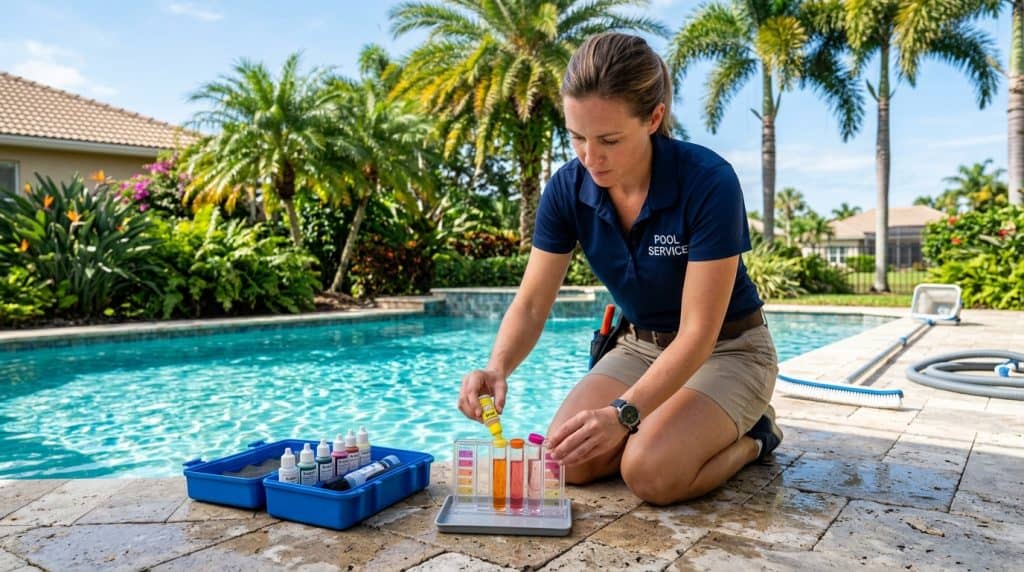
- Thorough Water Testing: First and foremost, get accurate readings. Use a reliable test kit (DPD is essential for FC and TC, leading to CC). Also, check your pH, alkalinity, and CYA (Cyanuric Acid).
- Measure Free Chlorine (FC).
- Measure Total Chlorine (TC).
- Calculate Combined Chlorine (CC): CC = TC – FC.
- Example: If FC = 1.0 ppm and TC = 3.0 ppm, then CC = 2.0 ppm. This is a very clear indication of high combined chlorine breakpoint being necessary.
- Determine Your Target Breakpoint Dose: Multiply your CC by 10 (or 12 for severe cases).
- Using our example (CC = 2.0 ppm), your target dose is 2.0 ppm * 10 = 20 ppm. This is the amount of additional chlorine you need to add, above your current FC, to reach breakpoint.
- Account for Stabilizer (CYA): If your CYA is high (e.g., above 50-60 ppm), you might need to add slightly more chlorine to compensate for its moderating effect on chlorine’s strength. However, the 10x CC rule generally holds as a strong baseline.
- Select Your Chlorine Product: For breakpoint chlorination, you need a strong, unstabilized chlorine source.
- Liquid Chlorine (Sodium Hypochlorite): This is typically 10-12.5% strength. It’s fast-acting and adds no CYA. This is my preferred choice for most Florida pools.
- Calcium Hypochlorite (Cal-Hypo) Shock: This is granular and typically 65-75% strength. It’s effective but adds calcium to your water, which can be a concern in areas with naturally hard water or for certain pool surfaces. Always pre-dissolve Cal-Hypo in a bucket of water before adding to the pool to prevent surface damage.
- DO NOT use Dichlor or Trichlor: These are stabilized forms of chlorine and will add more CYA, potentially making future chlorination less effective and leading to “chlorine lock.”
- Calculate Product Quantity: Use a reliable pool calculator app or chart to determine how much of your chosen product is needed to reach your target dose (e.g., 20 ppm for our example pool). This will depend on your pool’s volume (gallons) and the product’s strength. For liquid shock, it’s often a few gallons per 10,000 gallons of water for a heavy shock.
Performing the Breakpoint Chlorination Procedure
- Balance pH and Alkalinity FIRST: Before adding a large amount of chlorine, ensure your pH is between 7.2-7.6 and alkalinity is between 80-120 ppm. High pH or low alkalinity can make the chlorine less effective or cause pH to swing drastically.
- Circulation is Key: Ensure your pool pump is running, and keep it running continuously for at least 24-48 hours after shocking. This ensures even distribution of the chlorine and helps it work efficiently.
- Add the Chlorine Safely:
- For Liquid Chlorine: Slowly pour it around the perimeter of the pool, avoiding direct contact with surfaces. Wear appropriate PPE (gloves, eye protection).
- For Cal-Hypo (Granular Shock): Pre-dissolve the measured amount in a large bucket of pool water (never add water to granular chlorine; add chlorine to water). Stir well, then slowly pour the dissolved solution around the pool’s perimeter. Rinse the bucket thoroughly.
- Brush and Clean: Brush down pool walls and floor to dislodge any contaminants. Clear skimmer and pump baskets.
- Monitor and Retest: After 6-8 hours, or ideally the next morning, retest your FC, TC, and CC. You should see a significant drop in CC (hopefully close to zero) and a high FC reading. If CC is still present, you may need to add more chlorine, especially if you underestimated the initial organic load.
- Allow Chlorine to Drop: Do not swim until the free chlorine level has dropped to a safe range (typically 1-4 ppm, depending on CYA levels and local regulations).
- Re-balance: Once FC is safe, re-check and adjust pH, alkalinity, and calcium hardness as needed.
Keeping Chloramines at Bay: Proactive Pool Care in the Gulf Coast Climate
While high combined chlorine breakpoint is an effective solution, prevention is always better than cure. Here are my professional tips for maintaining a healthy pool in our specific Tampa Bay environment:
- Regular & Thorough Testing: Test your FC, TC, pH, alkalinity, and CYA at least 2-3 times a week, especially during peak swimming season or after heavy rainfall. Invest in a good quality liquid test kit; strips are often unreliable for precise readings.
- Consistent Chlorination: Maintain a consistent free chlorine residual (typically 2-4 ppm) at all times. Don’t let your chlorine drop too low, as this gives contaminants an opportunity to take hold and form chloramines.
- Shock Regularly: Even without a noticeable chloramine problem, a weekly or bi-weekly shock treatment (a smaller dose than breakpoint chlorination) helps oxidize minor contaminants and keeps your water fresh, especially with our intense UV and swimmer load.
- Combat Organic Load:
- Skim and Brush Daily: Remove leaves, pollen, and debris before they break down.
- Clean Filter: Backwash or clean your filter regularly. A dirty filter can harbor contaminants.
- Manage Pollen: During live oak pollen season, consider running your pump longer, using a finer mesh skim sock, or a robotic cleaner.
- Pre-Swim Shower: Encourage swimmers to rinse off before entering the pool to reduce body oils, sweat, and personal care products.
- Hurricane Prep & Post-Storm Care: Before a storm, ensure your chemistry is balanced. After a storm, remove all debris promptly, super-chlorinate if necessary to address runoff contamination, and balance water chemistry to prevent prolonged issues.
- Maintain CYA Levels: In our intense sun, Cyanuric Acid (CYA) is crucial to protect your free chlorine from degradation. Aim for 30-50 ppm. Too low, and your chlorine dissipates too quickly; too high, and your chlorine becomes sluggish.
FAQ: Your Top Questions About Pool Smell & Chloramines
Here are answers to a few common questions I get from homeowners across Tampa, Brandon, and beyond:
Q1: My pool “smells like chlorine” but my test strips say my chlorine is low. How is this possible?
A1: This is the classic sign of a high combined chlorine problem! Your test strips are likely reading “total chlorine” (which includes the ineffective chloramines) but not accurately differentiating the “free chlorine.” The strong smell comes from the chloramines themselves, not active, effective chlorine. You have chlorine, but it’s bound up and ineffective.
Q2: How long does it take for breakpoint chlorination to work?
A2: The actual chemical reaction can happen relatively quickly (within hours), but you need to run your pump for at least 24-48 hours continuously after shocking to ensure full circulation and off-gassing of the destroyed chloramines. Don’t swim until the high chlorine levels have returned to a safe range.
Q3: Can heavy rains contribute to chloramine problems?
A3: Absolutely! Subtropical storms here in Florida often wash in organic debris, dirt, pollen, and even fertilizers from nearby yards into your pool. This increased organic load provides more nitrogen compounds for your chlorine to react with, leading to faster chloramine formation. Always test and adjust your water chemistry after significant rainfall.
Don’t Let Your Tampa Bay Pool Stink: Seek Professional Expertise
Understanding and managing combined chlorine and performing breakpoint chlorination is fundamental to maintaining a healthy, comfortable, and safe swimming pool in our unique Florida environment. It’s more than just dumping chemicals in; it’s about understanding the delicate balance of water chemistry and reacting appropriately to the challenges our climate presents. If your pool water is consistently giving you a strong chlorine smell in outdoor pool settings, if you’re experiencing pool water burning eyes chloramines, or if you simply feel overwhelmed by the science, don’t hesitate to reach out.
As your trusted local CPO expert, I encourage homeowners across Tampa, Clearwater, St. Petersburg, and Brandon to contact licensed and experienced pool professionals. We have the specialized tools, knowledge, and hands-on experience to accurately diagnose issues, perform complex treatments like breakpoint chlorination safely, and set you up with a routine that keeps your pool sparkling clear and perfectly balanced, allowing you to simply enjoy your slice of Florida paradise, odor-free and irritation-free. Let’s make sure your pool truly smells like summer fun, not spent chlorine!
—