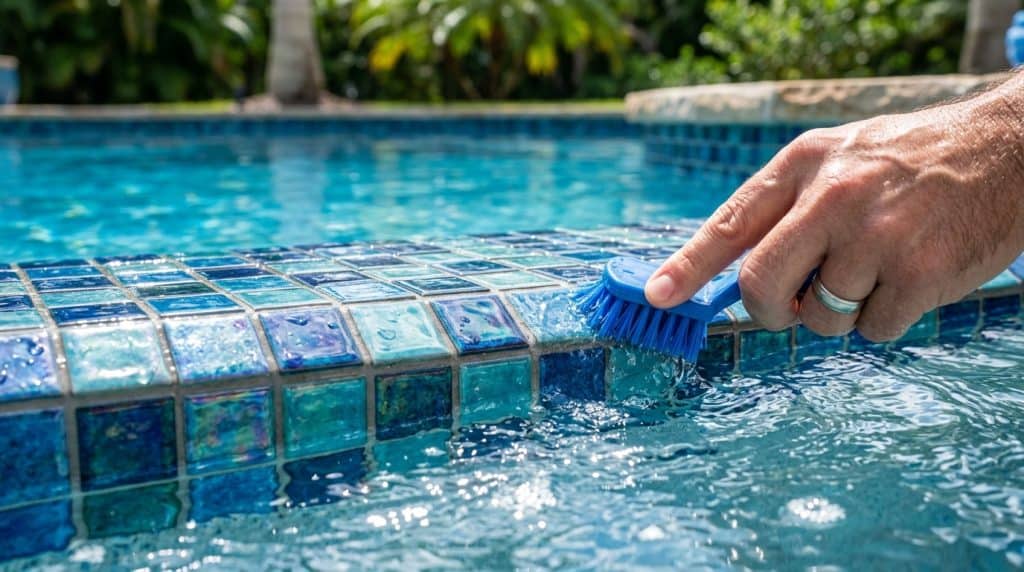
The bright, persistent chalky white band encircling swimming pool tile lines across Central Florida represents more than just a cosmetic blemish. In a region where groundwater originates from deep limestone aquifers saturated with dissolved calcium carbonate, aggressive evaporation driven by relentless sunshine continuously forces minerals out of solution. Eradicating this stubborn mineral crust requires understanding its chemical composition before taking abrasive tools to glazed ceramic surfaces.
Why Florida Water Chemistry Accelerates Waterline Scaling
Waterline scale formation is governed by thermodynamic equilibrium and evaporation dynamics. Routine maintenance from weekly pool service routes across Tampa Bay focuses heavily on stabilizing pH and alkalinity, but intense summer heat frequently defeats standard chemical dosing. As surface water evaporates during ninety-degree afternoons, dissolved calcium remains behind, concentrating along the perimeter waterline where solar exposure is highest.
When pool owners encounter stubborn deposits, executing proper pool tile calcium removal methods becomes essential to prevent permanent damage to expensive ceramic glazes and glass mosaics. In Central Florida municipal water supplies, calcium hardness frequently exceeds three hundred parts per million straight from the outdoor spigot, meaning every automated fill cycle steadily adds fresh mineral load into the swimming pool environment.
Distinguishing Calcium Carbonate from Calcium Silicate
Before selecting a cleaning technique, identifying the exact type of mineral scale adhering to your tile is critical. Swimming pools develop two distinct calcium formations, each requiring entirely different treatment protocols:
- Calcium Carbonate: This is the most common form of waterline scaling. It appears as a flaky, bright white crust. It is relatively soft and reacts vigorously when exposed to mild acids, foaming and dissolving within seconds.
- Calcium Silicate: Appearing as a dull white or grayish glaze, calcium silicate represents a far more resilient crystalline deposit. It forms when high silica levels in fill water interact with calcium under extended periods of elevated pH. Silicate scale does not react or foam when touched with muriatic acid and requires intensive mechanical abrasion to dislodge.
Homeowners can perform a simple diagnostic field test using ordinary white household vinegar or a single drop of diluted muriatic acid applied with a cotton swab to an isolated deposit. If the white mineral residue fizzes vigorously with active carbon dioxide bubbles, the scale is calcium carbonate, which can be dissolved chemically or scraped gently. If no chemical reaction occurs, the crust is dense calcium silicate, indicating that chemical soaking will be entirely ineffective and requiring gentle media blasting instead.
Safe Mechanical Removal: Pumice vs. Soft Abrasive Blasting
For standard calcium carbonate crusts on conventional glazed ceramic tiles, a natural volcanic pumice stone provides a reliable manual solution. The porous stone is softer than fired ceramic glaze, allowing it to scrape away mineral deposits without scratching the tile beneath. However, pumice must never be used on glass mosaic tiles or delicate custom murals, as even soft volcanic rock will permanently scratch and frost smooth glass finishes.
When dealing with extensive calcium silicate buildup or large commercial perimeters, soft abrasive media blasting delivers superior results. Specialized technicians utilize low-pressure mobile blasting systems loaded with non-toxic, water-soluble media such as ultra-fine baking soda (sodium bicarbonate) or crushed walnut shells. These soft abrasives pulverize dense crystalline scaling instantly while leaving ceramic and glass tile glazes completely unharmed.
Chemical Descalers and Acid Washing Considerations
Liquid sulfamic and phosphoric acid formulations designed specifically for waterline maintenance offer a controlled alternative to raw muriatic acid. These viscous gel descalers cling directly to vertical tile surfaces, allowing the active ingredients sufficient contact dwell time to dissolve calcium carbonate without running into the pool water and crashing total alkalinity levels.
However, when scaling extends below the waterline and coats gunite or plaster finishes, evaluating the pool for structural breaches with electronic acoustic pool leak detection ensures that water loss is not compounding mineral saturation through constant automatic water fill cycles that continuously introduce fresh hard tap water.
Long-Term Prevention and Chemical Balancing
Eliminating existing scale is merely half the battle; maintaining balanced saturation dynamics prevents calcium from recrystallizing along the newly cleaned waterline. Introducing polymeric scale inhibitors and organic sequestering agents binds free calcium ions in solution, preventing them from attaching to ceramic surfaces even when summer heat drives water temperatures above eighty-eight degrees. Porous calcium crusts provide prime real estate for stubborn spores; prevent persistent outbreaks by reviewing our protocol for eradicating black algae and yellow mustard algae.
A critical preventative practice in Florida is actively managing the Langelier Saturation Index (LSI), keeping index values strictly between -0.3 and +0.3 year-round. Because rising water temperatures naturally push water into an over-saturated, scale-forming state, pool owners must deliberately lower their total alkalinity and maintain pH near 7.4 during humid summer months to offset thermal scale precipitation.
Furthermore, managing splash-out and overflow cycles during torrential rainy seasons prevents erratic fluctuations in dissolved minerals. By regularly testing both calcium hardness and total dissolved solids every ninety days, homeowners can anticipate scale-forming thresholds well before visible crystalline bands mar the perimeter aesthetics.
The Future of Ultrasonic Descaling and Automated Water Softening
Emerging electronic descaling units, catalytic lime softeners, and automated low-dose acid injection systems are reshaping how Floridians manage severe water hardness, providing effortless, long-term waterline protection that preserves pool aesthetics season after season.