Florida’s coastal environment creates an intense operational proving ground for swimming pool filtration systems. Year-round swimming seasons, heavy pollen drifts from live oaks, fine blown sand from Gulf winds, and torrential subtropical thunderstorms deliver extraordinary debris loads directly into circulation equipment. Maintaining a disciplined filter maintenance schedule is vital to preserve water clarity and pump longevity.
The Central Role of Mechanical Filtration in Subtropical Climates
While chemical sanitizers neutralize algae and bacteria, water clarity depends entirely on your mechanical filter’s ability to trap physical debris. When homeowners book pool filter and equipment repair services, technicians frequently discover that reported pump failures or poor water flow stem directly from choked, unwashed filter elements. In Tampa Bay’s subtropical climate, standard manufacturer guidelines written for cooler northern climates often underestimate real-world debris accumulation.
Establishing an effective pool filter cartridge cleaning schedule requires reading pressure gauges accurately, understanding regional environmental cycles, and recognizing when physical pleats have reached their structural wear limit. Unlike diatomaceous earth or sand filters that utilize multi-port backwashing valves, cartridge systems must be physically disassembled, degreased, and rinsed to restore maximum hydraulic flow.
Determining the Ideal Cleaning Cadence: The 8-10 PSI Rule
The most reliable indicator of when a pool filter cartridge requires cleaning is not an arbitrary calendar date, but differential gauge pressure. Every swimming pool system has a baseline clean pressure, typically between eight and fifteen pounds per square inch (PSI) depending on plumbing layout, pipe diameter, and pump speed. As pleated polyester fibers capture organic silt, skin oils, and microscopic debris, resistance to water flow increases, forcing filter tank pressure upward.
As an industry best practice throughout Central Florida, cartridges should be disassembled and thoroughly cleaned whenever the pressure gauge reads eight to ten PSI above baseline clean pressure. In a typical screened Tampa lanai pool, this threshold is reached every four to six weeks during summer and every eight to ten weeks during cooler winter months. For un-caged pools surrounded by lush landscaping, live oaks, or palm trees, cleaning may be required every three to four weeks during active spring and summer shedding periods.
Step-by-Step Cartridge Cleaning and Degreasing Protocol
Cleaning a cartridge filter properly involves far more than a quick surface blast with a garden hose. Rinsing pleats without addressing embedded oils can permanently bake contaminants into the fabric:
- System De-Energizing and Air Bleed: Turn off electrical breakers to the pump, then slowly open the manual air relief valve on top of the filter tank until gauge pressure reaches zero.
- Tank Disassembly and Inspection: Loosen the central clamp ring, remove the tank lid, and carefully lift out the filter cartridges, inspecting for torn pleats or broken internal core bands.
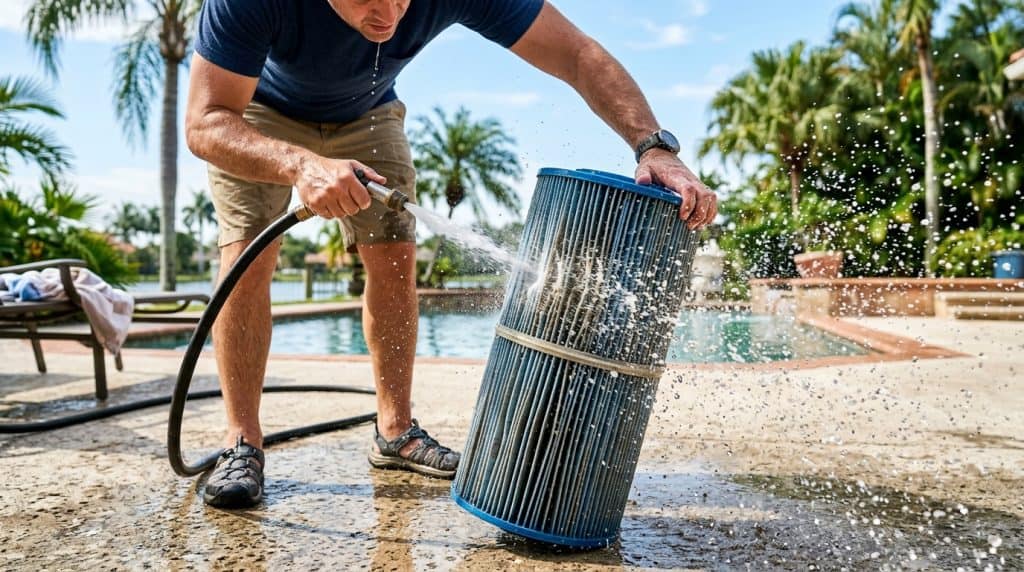
- Directional Water Rinsing: Using a specialized curved filter cleaning wand or hose nozzle at a forty-five-degree angle, wash down each pleat from top to bottom to flush trapped dirt outward.
- Enzyme Degreasing: Oils from sunscreen, body lotions, and airborne pollen adhere tightly to polyester fibers. Soaking elements in a dedicated pool filter degreaser every three to four cleanings breaks down stubborn oils that water pressure cannot dislodge.
- Deep Acid Washing (When Necessary): In hard-water areas, calcium carbonate scales inside filter pleats. Only after degreasing, immerse cartridges in a 10:1 water-to-muriatic-acid bath to dissolve mineral crusting.
Signs Your Filter Cartridge Needs Immediate Replacement
Dirty or torn filter pleats allow dead algae and flocculants to bypass circulation, causing symptoms detailed in our guide on cloudy pool water after chemical shocking. Even with diligent care, polyester cartridge media has a finite service life, typically lasting one to two years under Florida’s continuous year-round filtration demands.
Key warning signs that cartridges have reached the end of their operational life include crushed or collapsed internal plastic support cores, frayed or fuzzy polyester pleat fabric, broken or missing outer support bands, and clean filter pressure that immediately spikes eight PSI above baseline within forty-eight hours of a thorough cleaning.
| Pool Setup | Summer Cleaning Frequency | Winter Cleaning Frequency | Expected Cartridge Lifespan |
|---|---|---|---|
| Screened Enclosure (Lanai) | Every 4 – 6 Weeks | Every 8 – 10 Weeks | 18 – 24 Months |
| Open Backyard (Heavy Trees) | Every 2 – 4 Weeks | Every 4 – 6 Weeks | 12 – 15 Months |
| High-Bather / Pet Pool | Every 2 – 3 Weeks | Every 4 – 6 Weeks | 12 Months Max |
Protecting Hydraulic Hardware from Elevated Head Pressure
Calibrating your filter maintenance cycle alongside efficient turnover speeds is explained in our breakdown of variable speed pool pumps in Florida. When a filter cartridge is neglected and becomes choked with grime, resistance across the tank surges, forcing the drive motor to draw increased amperage while water flow drops.
High filter differential pressure forces circulation motors into hazardous thermal overload; prevent mechanical breakdown with our guide to diagnosing screaming pool pump motors. Maintaining clean cartridges protects bearings, impeller shafts, and mechanical shaft seals against premature heat degradation.
Future Trends in Antimicrobial Media and Modular High-Flow Elements
Advancements in polymer science are transforming swimming pool cartridge design across Florida. Next-generation filters featuring antimicrobial-infused polyester fabrics and trilobal fiber cross-sections capture particulates down to five microns while resisting bacterial colonization within the pleats. Coupled with automated pressure sensors integrated into modern home automation platforms, these smart filtration technologies simplify seasonal pool care for Tampa Bay homeowners.