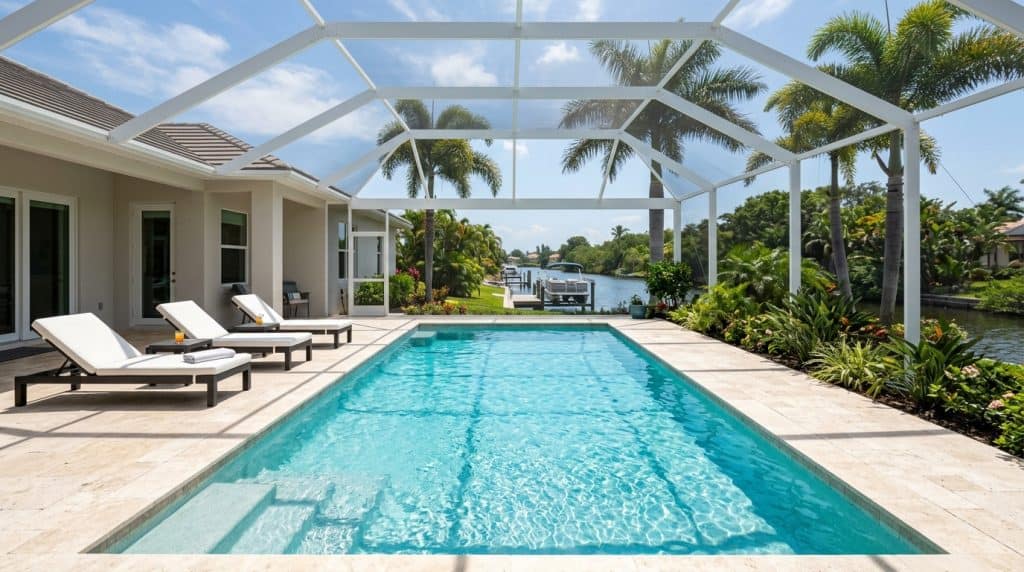
In the heart of the Tampa Bay area, where the sun beats down with relentless intensity and the humidity often reaches triple digits, your pool deck is more than just a decorative border. It is a functional piece of engineering that must withstand extreme UV exposure, heavy summer downpours, and the constant traffic of wet feet. As a CPO (Certified Pool Operator) based here in Florida, I am frequently asked one burning question: “Is travertine too hot for pool deck Florida?”
Homeowners are caught between the classic, budget-friendly appeal of concrete pavers and the high-end, luxurious allure of natural stone. Choosing the wrong material doesn’t just impact your home’s resale value; it impacts whether or not you can walk to your pool without wearing flip-flops or, worse, whether your kids are at risk of a dangerous slip-and-fall accident. In this comprehensive guide, we will dive deep into the science of heat transfer, the reality of slip resistance, and the specific cost factors for Tampa Bay pool owners.
The Heat Factor: Is Travertine Too Hot for Pool Deck Florida?
Let’s address the most common myth right away. Many people assume that because travertine is a stone, it must absorb heat like a piece of granite or dark slate. However, the opposite is true. In the context of the Florida climate, travertine is widely considered one of the “coolest” materials you can install.
Thermal Conductivity vs. Thermal Mass
Travertine is a form of terrestrial limestone deposited around hot springs. Because it is naturally porous, it contains tiny air pockets within its structure. In physics terms, it has low thermal conductivity. While a concrete paver is a dense, man-made composite of cement and aggregate that “soaks up” and holds onto the sun’s energy, travertine reflects a significant portion of UV rays and allows heat to dissipate through its pores.
In my years of testing deck temperatures in the middle of a July afternoon in Clearwater, I’ve found that light-colored travertine (like Ivory or Walnut) can be up to 20% to 30% cooler than traditional brick or concrete pavers. So, to answer the question: is travertine too hot for pool deck Florida? No. In fact, it is often the best solution for those who want to walk barefoot from the sliding doors to the water’s edge.
Color Matters More Than Material
While the material itself is superior for heat management, color plays a massive role. If you choose a “Noche” or dark chocolate travertine, it will still get hot. For Tampa homeowners, I always recommend sticking to the lighter end of the spectrum—ivory, cream, or light gold—to maximize the cooling effect.
Slip Resistance: The “Slippery Travertine” Myth
Safety is the primary concern for any CPO. When discussing natural stone, the conversation inevitably turns to whether it becomes a skating rink when wet. You may have heard warnings about slippery travertine pool coping wet, and there is some truth to this—but only if you choose the wrong finish.
Tumbled vs. Honed vs. Polished
If you go to a high-end hotel and see polished travertine in the lobby, it looks like glass. That finish is incredibly slippery. However, for pool decks, we exclusively use tumbled travertine. The tumbling process involves placing the stone in a large drum with abrasives, which rounds the edges and creates a textured, matte surface. This texture provides excellent “grip” for your feet, even when the stone is submerged or covered in splashed pool water.
Coping Safety
The coping—the edge of the pool where you grab on or sit—is the most critical area for slip resistance. Using tumbled travertine pool deck vs concrete pavers for coping offers a distinct advantage: the natural pits and textures in the stone act like mini-treads. When comparing the two, concrete pavers can actually become “slicker” over time as the factory sealant wears down, whereas travertine maintains its natural grip throughout the thickness of the stone.
Comparing Aesthetics: The French Pattern Travertine Pavers Pool
From a design perspective, concrete pavers are often limited to repetitive geometric shapes. Travertine, however, offers a timeless elegance that concrete simply cannot replicate. The most popular choice in Florida is the french pattern travertine pavers pool layout.
A French pattern (also known as a Versailles pattern) uses four different sizes of stones laid in a specific, recurring motif. This breaks up the “grid” look and creates a more organic, luxurious feel that mimics the villas of the Mediterranean. Because each stone has unique veining and color variations, no two travertine decks in Tampa look exactly alike. This aesthetic appeal is a major driver in property valuation for homes in neighborhoods like South Tampa or St. Pete Beach.
Cost Analysis: Tampa Bay Market Trends
Budget is often the deciding factor for homeowners. When looking at travertine pool deck vs concrete pavers cost tampa, there is a clear “good, better, best” hierarchy.
- Concrete Pavers: Generally the most affordable. In the Tampa market, you can expect to pay between $8 and $13 per square foot installed, depending on the complexity of the design and the condition of the existing deck.
- Travertine Pavers: These are a premium product. Prices typically range from $15 to $25 per square foot installed. While the material cost is higher, the labor is often similar to concrete pavers, but the “mud-set” vs. “sand-set” installation method can shift the price.
While the upfront cost of travertine is higher, many Florida homeowners view it as a long-term investment. Travertine doesn’t fade under the harsh Florida sun, whereas the pigments in concrete pavers can wash out and look “chalky” after 5 to 7 years of UV exposure. Furthermore, travertine can be repaired more easily; if a single stone cracks, you can swap it out without the new stone looking drastically different from the weathered originals.
CPO Diagnostic Checklist: Which Material is Right for You?
As a Tampa Bay Pool Care professional, I recommend walking through this checklist before signing a contract with a renovator:
- Is your pool deck in full sun for more than 6 hours a day? If yes, travertine is the superior choice for heat management.
- Do you have young children or elderly family members? Tumbled travertine offers better natural slip resistance than sealed concrete.
- What is your long-term plan for the home? If you plan to sell within 5 years, travertine offers a much higher “curb appeal” ROI.
- Is your pool salt-water or chlorine? Travertine is highly resistant to salt, making it ideal for the salt-water systems common in Florida.
- Does your backyard have drainage issues? Travertine is typically installed on a sand/road-base bed, allowing for better water percolation compared to solid poured concrete.
Installation Secrets: Sand-Set vs. Mud-Set
In Florida, the way you install your deck is just as important as the material you choose. Because of our sandy soil and high water table, the ground is constantly shifting.
Sand-Set (The Florida Standard)
Most french pattern travertine pavers pool decks in Tampa are “sand-set.” This means the pavers are laid over a bed of crushed concrete and sand. This allows the deck to be flexible. If the ground moves, the pavers move with it. If a paver shifts too much, it can simply be lifted and leveled. This is much more durable than a rigid concrete slab, which will eventually crack under the pressure of Florida’s “sinkhole” geography.
Mud-Set (For Remodels)
If you already have a concrete “cool deck” and want to upgrade, we often use a “mud-set” or thin-set application. We use a 1/2-inch thick travertine paver (remodel paver) and glue it directly to the existing concrete. This is a cost-effective way to get the travertine look without the massive demolition costs of removing a thick concrete slab.
Maintenance and Care for Tampa Pool Owners
Owning a pool in Florida means battling mold, mildew, and calcium deposits. Whether you choose travertine or concrete, maintenance is non-negotiable.
Sealing: To Seal or Not to Seal?
For concrete pavers, sealing is a must to prevent fading. For travertine, sealing is optional but recommended. A “penetrating sealer” will protect the stone from stains (like spilled red wine or organic tannins from falling oak leaves) without making the stone slippery travertine pool coping wet. Unlike concrete sealers that create a plastic-like film on top, penetrating sealers live inside the stone, preserving its natural texture and “cool-to-the-touch” properties.
The “Acid” Warning
One caveat for travertine: it is a calcium-based stone. This means it is sensitive to acid. In the pool industry, we often use muriatic acid to balance pH. As a CPO, I always warn my clients: never spill acid on your travertine deck. It will etch the stone instantly. If you are DIY-ing your pool chemistry, be extremely careful or hire a professional service to handle the chemicals safely.
The Verdict: Why Travertine Usually Wins in Tampa
When you weigh the factors of travertine pool deck vs concrete pavers, the winner for the Florida lifestyle is usually travertine. While the travertine pool deck vs concrete pavers cost tampa comparison shows a higher initial investment, the benefits of heat reduction and longevity are hard to beat.
Imagine a typical Saturday in August. Your pool is 88 degrees, the air is 95 degrees, and the sun is at its peak. If you have concrete pavers, you are scurrying from shade patch to shade patch, or you’re keeping your sandals on until the very last second before jumping in. With a light-colored, tumbled travertine deck, you can walk comfortably, enjoy the aesthetic beauty of the french pattern travertine pavers pool, and rest easy knowing your deck won’t need a total overhaul in a few years.
Summary of Key Takeaways
- Heat: Travertine is significantly cooler than concrete due to its porous nature.
- Safety: Always choose “tumbled” travertine to avoid a slippery surface.
- Cost: Expect to pay $15-$25 per sq. ft. in Tampa for travertine, compared to ~$10 for concrete.
- Design: The French pattern is the gold standard for luxury Florida pool decks.
- Durability: Travertine resists UV fading much better than man-made concrete pavers.
If you are planning a renovation or building a new pool in the Tampa Bay, St. Pete, or Clearwater area, consider your pool deck an extension of your home’s living space. Choosing a material that stays cool and keeps your family safe is the smartest move you can make. For more expert advice on maintaining your Florida pool oasis, stay tuned to our blog or reach out to us at Tampa Bay Pool Care for professional assistance.
Pro Tip from the CPO:
Always ask your contractor for a “wet sample” of the stone you are considering. Pour some water on it and step on it with your bare feet. This is the only way to truly know if the slip resistance meets your personal comfort level before you invest thousands of dollars in a new deck.