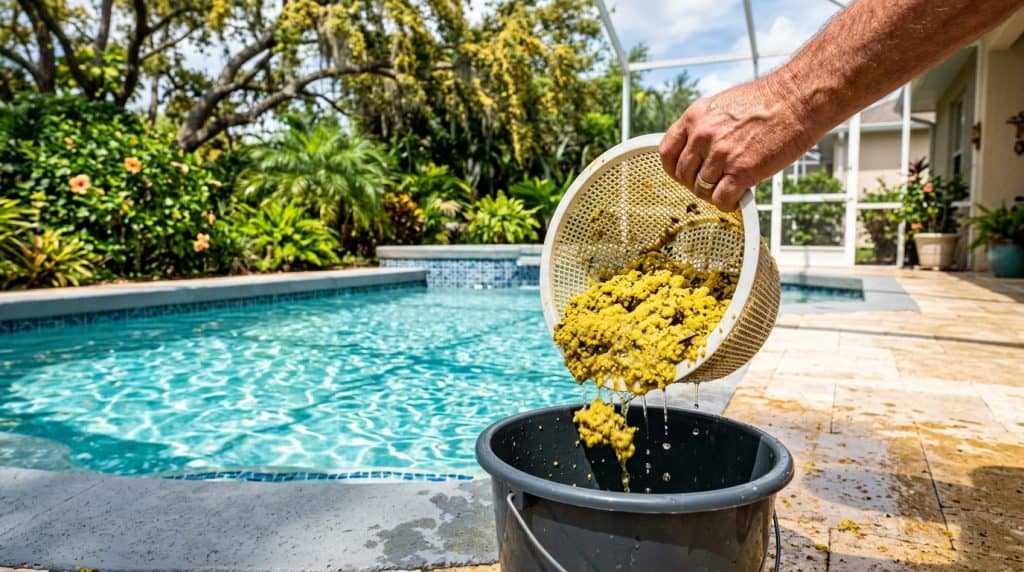
If you live in the Tampa Bay area—whether you are nestled under the historic canopy of Old Northeast St. Pete, enjoying the breezy suburban yards of Brandon, or living near the coast in Clearwater—you know that March brings a very specific, beautiful, yet highly frustrating seasonal event. It is the annual “yellow blizzard.”
As our magnificent Southern Live Oaks (Quercus virginiana) wake up for spring, they drop billions of catkins and release a thick, heavy blanket of fine yellow-green dust. This dust coats our cars, our patios, and, most frustratingly, our swimming pools.
As a certified pool operator (CPO) with years of experience managing residential and commercial pools in Florida’s unique subtropical climate, I can tell you that March is one of the most challenging months of the year for pool filtration and water chemistry. Left unchecked, oak pollen will create a stubborn, greasy yellow ring around your tile line, skyrocket your chlorine demand, clog your filter cartridges with a waxy, cement-like sludge, and leave you wondering if your pool is experiencing a massive algae outbreak.
In this comprehensive guide, we will dive deep into the science of managing florida oak tree pollen in swimming pool systems. We will explore how to tell the difference between pollen and algae, how to protect your filtration system from clogging, and how to keep your pool tile looking pristine all spring long.
—
The Great Spring Debate: Oak Pollen in Pool vs Yellow Algae
Every March, our phone lines at Tampa Bay Pool Care light up with panicked pool owners shouting, “My pool has yellow algae!”
It is an incredibly easy mistake to make. Both substances present as a fine, yellow-to-mustard-colored powder in the water. However, mistaking pollen for algae—or vice versa—can lead to wasted money on unnecessary chemicals or, conversely, a massive algae bloom that takes weeks to cure. Understanding oak pollen in pool vs yellow algae is the first step to reclaiming your backyard oasis.
The Diagnostic Checklist
Use this physical and chemical checklist to accurately diagnose what is floating in your pool water:
- The Location Test: Pollen is highly buoyant. When you see yellow pollen floating on pool water clearwater, it will primarily pool on the surface, drift into corners, or cling directly to the tile line. Yellow (mustard) algae, on the other hand, is a living organism that hates direct sunlight. It will settle on the floor, cling to the vertical walls in the shady spots of the pool, or cluster around pool lights and steps.
- The Touch Test: Scoop some of the yellow debris out of the water or wipe it off the step with your finger. Pollen has a slightly granular, waxy, or organic feel to it. Yellow algae is incredibly fine and powdery; when you brush it, it immediately poofs into a cloudy mist in the water without leaving a greasy residue on your fingertips.
- The Overnight Chlorine Loss Test (OCLT): This is the ultimate scientific test. Retain a high free chlorine (FC) level after sunset and test the water. Test it again before the sun rises the next morning. If your FC drop is less than 1.0 ppm, you do not have an active algae bloom; your yellow debris is simply organic pollen. If you lose significant chlorine overnight, an organic pathogen (algae) is actively consuming your sanitizer.
- The Filter Analysis: Open your skimmer basket. If it is filled with yellow, stringy oak catkins and a greasy yellow film, you are dealing with a pollen heavy-drop.
While pollen itself is not a living organism like algae, it is packed with organic proteins, lipids, and phosphates. This means that even if it isn’t algae today, leaving large amounts of pollen in your pool will quickly deplete your chlorine and fuel a massive algae bloom tomorrow.
—
The Chemistry and Physics of Oak Pollen in Water
To defeat oak pollen, we have to understand what it is made of. Pollen grains are designed by nature to be incredibly tough. They are protected by an outer shell called the exine, which is composed of a highly durable polymer known as sporopollenin. This shell is resistant to chemical slip-agents, acid, and even moderate levels of chlorine.
When millions of these micro-spores land on your pool water, they create several distinct problems:
1. High Organic Load and Chlorine Demand
Chlorine is an oxidizer. Its job is to attack and destroy organic matter in the pool. When your pool is bombarded by organic oak pollen, your free chlorine immediately goes to work trying to oxidize the pollen grains. This causes your chlorine levels to plummet rapidly. If your free chlorine drops to zero, the door is left wide open for black, green, or mustard algae to take over your pool.
2. Nutrient Overload (Phosphates)
Pollen is essentially plant fertilizer. It is incredibly rich in phosphorus and nitrogen. As pollen decomposes in your pool water, it releases these nutrients directly into the water column. Phosphates are the primary food source for algae. High phosphate levels make it incredibly easy for algae to survive and thrive, even in well-chlorinated water.
3. Physical Surface Tension and Aggregation
Because of the waxy nature of the exine shell, pollen does not easily dissolve. Instead, it rides on the surface tension of the water. Wind patterns push this floating yellow sheet into your pool corners, where it mixes with body oils, sunscreen, and dust to form a thick, sticky, yellow-brown paste.
—
Battle Plan: Protecting Your Pool Filters from “Oak Sludge”
During March, your pool’s filtration system is your absolute best friend—and your most vulnerable asset. As the skimmer draws in floating pollen, the fine particles bypass the skimmer basket and lodge deep inside your filter media. Whether you have a cartridge, D.E. (diatomaceous earth), or sand filter, oak pollen will quickly mix with pool oils to create a sticky, restrictive “sludge” that spikes your system’s pressure and drastically reduces water flow.
The absolute cheapest and most effective way to protect your filter during March is to buy a pack of nylon skimmer socks (or even cheap nylon hairnets). Stretch the sock over your skimmer basket. These fine meshes will trap up to 90% of the fine oak pollen and catkins before they can travel down the pipes and clog your expensive filter. Simply peel the dirty sock off daily, throw it away, and replace it.
Managing Different Filter Types During Pollen Season
- Cartridge Filters: These are highly susceptible to pollen clogging. The waxy pollen coats the polyester pleats, sealing off the pores. If your pool pressure rises 8–10 PSI over its clean baseline, remove the cartridges and hose them down thoroughly. Do not just use water; use a specialized spray-on filter cleaner or an enzyme-based soak to break down the organic oils trapped in the fibers.
- D.E. Filters: D.E. filters will catch incredibly small pollen particles (down to 2–5 microns), which means they will clog very quickly. Monitor your pressure gauge daily. You will likely need to perform a backwash and replenish the D.E. powder midway through March to maintain proper flow rates.
- Sand Filters: Sand filters have the largest micron rating (20–40 microns), meaning some of the finest pollen might actually blow right through the sand and back into the pool. To prevent this, use a pool clarifier to clump the pollen particles together, making them large enough for the sand bed to trap.
The Power of Enzymes
To prevent your filter from becoming sludged, we highly recommend adding a natural enzyme treatment to your weekly pool routine during March. Natural enzymes act as biological catalysts. They target and consume the non-living organic wastes, fats, and waxes found in oak pollen. By breaking down these sticky binders, the pollen cannot glue itself to your filter elements or your pool tiles, making it much easier to filter out and wash away.
—
Cleaning Pollen Scum Off Pool Tile
One of the most unsightly side effects of March in Tampa Bay is the thick, dark yellow ring that develops right at the water level. This is caused by the physical action of cleaning pollen scum off pool tile becoming a necessity when floating pollen clings to the tile, bakes under the hot Florida sun, and cures into a hard, sticky crust.
If you try to scrub this off with a standard pool brush, you will quickly find that it smeared and resists water-based brushing. Here is the step-by-step professional method to safely and effectively clean your tile line without damaging your pool chemistry or your tile grout:
Step 1: Lower the Water Level Slightly
Drop your pool’s water level by about two to three inches. This exposes the entire yellow scum line, allowing you to work on it dry without the pool water immediately washing away your cleaning solutions.
Step 2: Choose the Right Cleaning Agent
Do not use harsh household abrasives or wire brushes, which can scratch ceramic tile or wear away delicate glass tiles. Instead, use one of the following:
- Commercial Specialty Tile Cleaner: Look for a gel-based, enzyme-infused tile cleaner. These cling to the vertical tile surfaces and actively digest the organic binders in the pollen.
- DIY Baking Soda Paste: Mix baking soda with a tiny amount of water to create a thick paste. Baking soda is a mild abrasive that will lift the pollen scum without scratching the tile or altering your pool’s pH significantly.
- Pumice Stone (For Pebble/Concrete/Tile Only): If you have stubborn, baked-on crust on ceramic tile, a wet pumice stone can be gently rubbed over the spot. Never use a pumice stone on vinyl liners or fiberglass pools!
Step 3: Apply and Scrub
Apply your cleaner of choice using a non-scratch scrub pad (such as a blue kitchen sponge pad or a specialty pool scrub mitt). Scrub in a circular motion. You will see the yellow scum lift off the tile. Rinse the tile with pool water as you go.
Step 4: Use a Border Blocker
Once your tiles are clean, add an enzyme-based water clarifier. This will help prevent any remaining floating pollen from adhering to the tile walls in the future, keeping the scum line from reforming.
—
Your Weekly March Maintenance Routine for Tampa Bay Pools
To survive the peak of the Live Oak pollen dump, you need a disciplined, proactive maintenance routine. Waiting until your water turns yellow and your pump stops priming will result in costly cleanup bills. Follow this battle-tested weekly checklist:
| Frequency | Task | CPO Professional Reason |
|---|---|---|
| Daily | Empty skimmer & pump baskets; replace skimmer socks. | Prevents basket collapse from heavy leaf/catkin weight and keeps water flowing freely. |
| Daily | Run the pool pump for 10–12 hours minimum. | Pollen must be kept moving to be pushed into the filtration system before it sinks to the bottom. |
| 2x Weekly | Test Free Chlorine & pH levels. | Pollen rapidly depletes chlorine. Keep FC at 3.0–5.0 ppm minimum to prevent opportunistic algae. |
| Weekly | Brush the pool walls, steps, and tile line. | Keeps pollen from settling, clinging, and creating permanent stains or organic nests. |
| Weekly | Add a maintenance dose of broad-spectrum enzymes. | Deconstructs the organic waxes of the pollen, protecting your filters from sludge buildup. |
| Weekly | Check filter pressure gauge. | Clean or backwash immediately if pressure has risen 8–10 PSI over your clean baseline. |
—
Let the Tampa Bay Pool Care Pros Handle the Spring Rush
Maintaining a swimming pool during a Florida spring can feel like a full-time job. Between skim-cleaning the endless cascade of oak leaves, scraping down the yellow tile line, and constantly managing fluctuating chlorine levels, you can easily spend your entire weekend working on your pool instead of enjoying it.
That is where we come in. At Tampa Bay Pool Care, our team of highly trained, local pool technicians understands the exact chemistry and physical demands of Florida’s seasonal changes. We monitor local pollen counts, anticipate chemical shifts, and provide the deep physical skimming, scrubbing, and filter maintenance required to keep your pool sparkling clean, crystal clear, and completely safe for your family all year long.
Do not let March’s “yellow blizzard” ruin your swim season before it even starts. Contact the local experts at Tampa Bay Pool Care today to learn more about our comprehensive weekly pool maintenance programs and get your pool ready for a gorgeous, worry-free Florida spring!