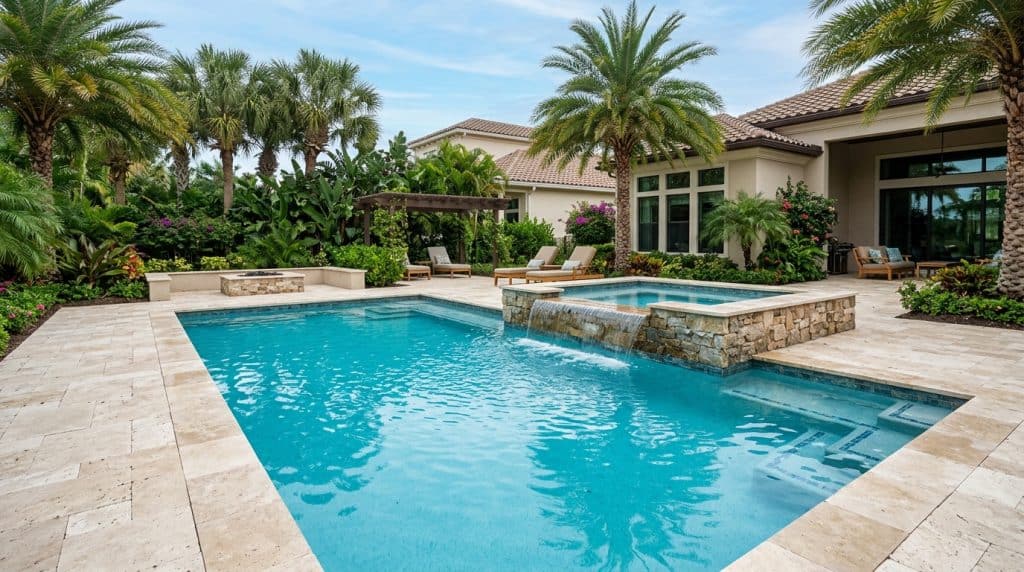
Combination pool-and-spa systems equipped with a raised spillover waterfall deliver aesthetic elegance and soothing ambient sound. However, sharing a single body of water between an 18,000-gallon pool and an 800-gallon hot water vessel introduces complex hydraulic and chemical challenges that frequently baffle residential pool owners.
The Physics of Aeration: Why Spillover Spas Drive pH Skyward
The primary chemical anomaly in spillover spa configurations is runaway pH elevation. While total alkalinity and calcium hardness remain relatively consistent across shared water, running a continuous spillover causes rapid, aggressive carbon dioxide outgassing.
When water cascades over a raised spillover wall into the pool basin, it shatters into fine droplets, exposing a vast surface area to atmospheric air. This aeration strips dissolved carbon dioxide (CO₂) from the water. Because dissolved CO₂ forms carbonic acid (a weak natural acid in water), losing CO₂ drives pH upward without altering total alkalinity. Within 48 hours of uninterrupted waterfall operation, water pH can surge from a balanced 7.4 to an aggressive 8.2.
When pH climbs above 7.8, sanitizing efficiency collapses. Free chlorine loses over 70% of its pathogen-killing power, and dissolved calcium begins precipitating out of solution as unsightly white scaling along waterline tiles. Managing this cycle requires structured routing, as seen when scheduling professional weekly pool service in Tampa Bay to monitor acid demand and prevent scale formation on raised spa stone faces.
Automated Valve Tuning: Spillover Mode vs. Spa Heating Mode
Modern equipment pads utilize automated three-way motorized valves (such as Jandy or Pentair actuators) to govern shared circulation. Understanding how to set cam stops inside these actuators is vital for maintaining balance:
- Pool Mode: Water is drawn from both the pool skimmers and main drain, filtered, sanitized, and returned primarily to the pool basin. A small percentage (typically 10% to 15%) is bled into the spa through an adjustable check-valved bypass line to keep spa water fresh and overflow gently.
- Spillover / Waterfall Mode: Water is drawn exclusively from the pool and pumped 100% into the spa, generating a roaring waterfall cascade across the stone spillway. Running this mode for more than 1 to 2 hours daily triggers severe pH drift.
- Spa Heating Mode: Motorized valves rotate completely, isolating the spa loop. Water is suctioned exclusively from the spa drain and returned directly to the spa jets at high temperature. The spillover ceases entirely, containing heated water within the spa basin.
Homeowners building custom pools across expanding suburbs like residential developments across Parrish frequently install automated control panels (such as Pentair IntelliCenter or Hayward OmniLogic) that limit spillover runtime to scheduled 30-minute intervals, providing water turnover without driving continuous CO₂ outgassing.
Check Valve Failure: The Mysterious Spa Draining Phenomenon
A frequent service call involves a spillover spa that mysteriously drains overnight down to the level of the pool return jets when the pump shuts off. This issue almost always stems from a failing spring-loaded check valve located on the spa return plumbing.
Because the spa sits elevated 12 to 24 inches above the pool water line, gravity exerts downward hydrostatic pressure against the return manifold. When the main pump de-energizes, water naturally attempts to siphon backward through the plumbing into the lower pool basin. A high-quality fluorocarbon (Viton) flapper check valve prevents this backflow. When debris, scale, or a worn spring prevents the flapper from sealing, the spa empties into the pool within hours.
Chemical Management Protocols for Combination Systems
To keep a combination system pristine, certified technicians follow a strict operational regimen designed to balance hydraulics and chemical equilibrium:
| Chemical Parameter | Target Range (Spillover) | Management Strategy |
|---|---|---|
| pH | 7.4 – 7.6 | Dose muriatic acid weekly; limit spillover runtime to 1 hr/day. |
| Total Alkalinity (TA) | 70 – 90 ppm | Keep TA near 80 ppm to reduce carbon dioxide outgassing rate. |
| Calcium Hardness | 250 – 350 ppm | Maintain saturation index (LSI) near zero to protect heater exchanger. |
| Cyanuric Acid (CYA) | 30 – 50 ppm | Prevent chlorine degradation; avoid high CYA in heated spa water. |
In saltwater systems, elevated pH also promotes rapid calcium crusting on chlorine generator titanium plates. Regularly inspecting and cleaning salt cells with muriatic acid preserves cell lifespan and ensures uniform free chlorine generation throughout both pool and spa chambers.
By scheduling spillover automation thoughtfully and calibrating check valves regularly, homeowners enjoy the visual spectacle of cascading water without falling victim to chronic chemical swings or frustrating mechanical leaks.