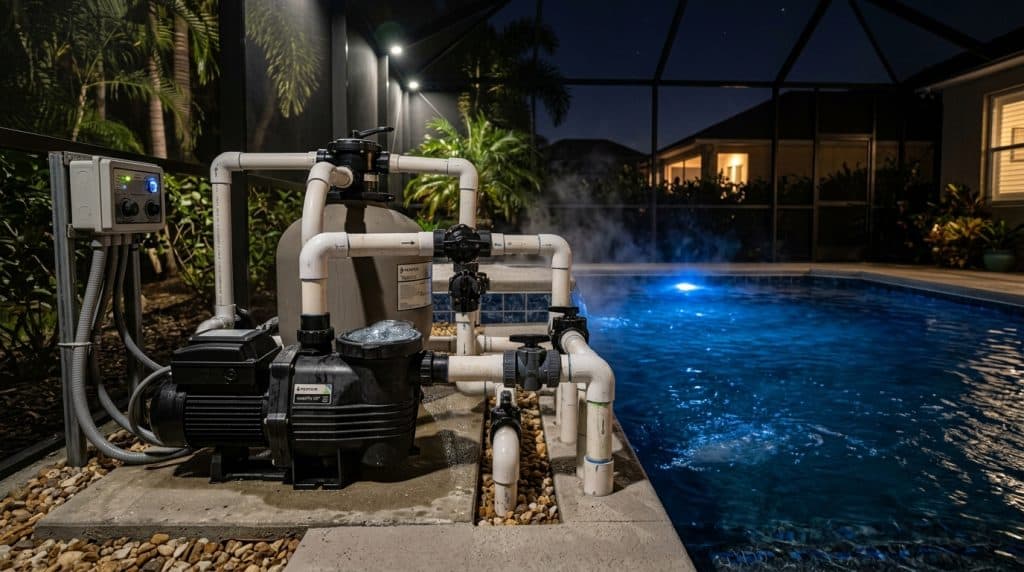
Here in the Tampa Bay area—from the sunny patios of South Tampa to the sprawling backyard oases of Brandon and Riverview—we are blessed with pool weather almost year-round. But every once in a while, Mother Nature reminds us that Florida isn’t entirely immune to winter. When a rare cold front sweeps down the peninsula, plunging overnight temperatures into the low 30s or even upper 20s, local pool owners face a unique set of challenges.
Unlike our neighbors up north, who shut down and winterize their pools in October, Florida pool owners keep their systems open and running 365 days a year. This means our pipes, pumps, filters, and heaters are fully exposed to the elements when a hard freeze threatens. Fortunately, modern pool automation acts as a silent, vigilant guardian during these cold snaps.
As a certified pool operator (CPO) with years of experience keeping Tampa Bay pools pristine and functional, I want to demystify exactly how your automated controller protects your equipment during a freeze. We will tackle the common issues you might face, such as when you find your pool freeze protect mode running constantly, and what to do if your system starts acting up when the frost rolls in.
The Florida Freeze Paradox: Why We Don’t “Winterize”
In colder northern climates, “winterizing” a pool is a multi-step ritual. It involves draining water below the skimmer, blowing out all the plumbing lines with air, plugging the pipes, and adding heavy-duty antifreeze. This is because prolonged, deep-ground freezes will expand the water inside underground pipes, cracking them like ice cube trays.
However, when we talk about winterizing pool plumbing tampa style, we are dealing with an entirely different animal. In Central Florida, we rarely experience “ground freezes.” Our soil remains relatively warm. Instead, our threat comes from “advection freezes”—rapid drops in air temperature accompanied by wind, which can quickly freeze the standing water inside thin, exposed PVC pipes, valves, and expensive equipment above ground (like your pump volute or heater header).
Because these freeze events in Tampa Bay typically only last for a few hours in the early morning, active water circulation is our primary line of defense. Moving water is incredibly difficult to freeze. By keeping the water flowing through the plumbing, we transfer the warmer thermal mass of the deep pool water through the exposed piping, keeping ice from forming. This is where your pool’s automated controller comes into play.
What Temperature Does Pool Freeze Protection Turn On?
If you have an automation system—such as a Pentair EasyTouch, Jandy AquaLink, or Hayward OmniLogic—it is equipped with an air temperature sensor. This small, pencil-sized probe is typically mounted on the underside of your outdoor automation panel or nearby conduit, where it can accurately read the ambient air temperature without being fooled by direct sunlight.
So, what temperature does pool freeze protection turn on?
While water freezes at 32°F (0°C), pool automation controllers are programmed to activate freeze protection well before that threshold is reached. Most factory settings trigger freeze protection mode when the air temperature falls to 34°F to 38°F (usually defaulted to 36°F).
Why the buffer? There are three main reasons for this safety margin:
- Sensor Calibration Drift: Air temperature sensors can lose calibration over time, reading a few degrees warmer or cooler than the actual temperature.
- Microclimates: The temperature at your equipment pad, which might be shielded by your house or landscaping, can be slightly different than the temperature of the exposed pipes on the other side of your yard.
- Wind Chill and Radiative Cooling: On clear, windy nights, heat can rapidly radiate away from exposed plastic pipes, causing the water inside them to drop below freezing even if the ambient air is hovering just above 32°F.
When the sensor detects this threshold temperature, the controller automatically overrides all programmed schedules, fires up your pool pump (usually at a high speed if it’s a variable-speed pump), and begins circulating water through all designated plumbing lines.
Why Is My Pool Freeze Protect Mode Running Constantly?
During a cold winter weekend in Tampa, you might look out at your pool equipment and notice that the pump is roaring at 2:00 PM on a sunny afternoon, with the controller panel flashing a “Freeze Protect” or “FRZ” status indicator. If this happens, you might wonder why you have a pool freeze protect mode running constantly.
To diagnose this behavior, we have to look at two distinct scenarios: normal cold-weather operation and sensor failure.
Scenario A: It Is Actually Cold Outside (Normal Operation)
If overnight temperatures dropped to 30°F, freeze protect mode will activate. However, air temperatures in Florida often rise slowly in the morning. Even if the sun is out, if the air temperature at your equipment pad remains below 38°F, the system will keep running.
Furthermore, many automation systems feature a built-in “delay-off” timer. Once freeze protect is triggered, the system is designed to run for a minimum of 30 to 60 minutes *after* the temperature rises above the threshold. This prevents the pump from cycling on and off rapidly if the temperature hovers right at 36°F, which could damage the motor. If it’s a genuinely cold day, expect your system to run constantly until the weather thoroughly warms up.
Scenario B: It is 75°F and Sunny (System Glitch)
If it is a beautiful, warm Florida afternoon and your pump is still locked in freeze protection mode, you are dealing with a classic pool automation glitch. When this happens, it is almost always caused by a **faulty or disconnected air temperature sensor**.
When an air sensor fails, its resistance changes drastically, often tricking the automation motherboard into believing it is -40°F or 32°F outside. As a safety precaution, the controller is programmed to “fail-safe.” If it loses communication with the sensor, it assumes the worst (a freezing blizzard) and runs the pumps continuously to protect your plumbing.
Quick Diagnostic Checklist for a Constantly Running Freeze Mode:
- Check the Air Temp Reading: Go to your automation panel and find the diagnostics or system status screen. Check what temperature the “Air” sensor is reading. If it reads an absurdly low temperature (like -30°F or 32°F on a warm day), the sensor is bad.
- Inspect the Sensor Wire: Follow the wire from the sensor back to the main panel. Check for signs of dry rot, copper exposure, or chewing by local pests (squirrels and rats love chewing on low-voltage wires).
- Temporary Bypass: If you need to stop the pump from running constantly on a warm day while waiting for a repair, you can temporarily disable the freeze protection feature in your automation settings. Warning: Remember to turn it back on before the next cold front!
The Dangerous Anomaly: Freeze Protect Mode Tripping Breaker
There is nothing worse than waking up at 6:00 AM on a freezing morning, walking outside to check on your pool, and finding the equipment pad dead, silent, and covered in frost. When you open your subpanel, you see the main pool breaker has tripped.
A freeze protect mode tripping breaker scenario is a critical emergency because stationary water in sub-freezing temperatures can freeze and crack a pump basket or filter tank in a matter of hours.
Why does this happen specifically during freeze events?
1. High Amp Draw on Cold Starts
When oil and bearings inside older pool pumps get cold, they stiffen up. When the automation system commands the pump to start up at a high speed in freeze protection mode, the motor has to work much harder to spin. This draws a massive initial surge of electrical current (amperage). If your breaker is old, weak, or already loaded close to its capacity, this temporary surge will trip it instantly.
2. Moisture and GFCI Sensitivity
Winter cold snaps in Florida are often accompanied by heavy dew, frost, or rain. GFCI (Ground Fault Circuit Interrupter) breakers are designed to detect microscopic electrical leaks to ground. If moisture gets inside the pump motor connection box, the heater wiring, or an outdoor outlet, the GFCI breaker will trip immediately to prevent electrocution.
3. Sustained High-Load Running
Normally, your pool pump might run at a low, energy-saving RPM for a few hours a day. When freeze protection activates, it overrides these eco-modes, running the pump at high speed continuously for 12, 18, or even 24 hours. This sustained electrical load generates heat within the breaker panel. If a breaker is worn out or has loose wire connections, the heat buildup will cause it to trip.
What to do: If your breaker trips during a freeze, turn off the breaker, inspect the pump motor for any visible moisture or smell of burning plastic, and try resetting it once. If it trips again immediately, do not force it. You likely have a short circuit or a seized motor. Immediately wrap your exposed pipes in heavy blankets or towels and call a professional to prevent freeze damage.
Best Practices: How to Prep Your Tampa Pool for a Cold Snap
To ensure your system handles a freeze flawlessly, a little preparation goes a long way. Use this CPO-approved checklist when the local news starts warning of overnight lows in the 30s:
Check Your Actuators and Valves
If you have a pool/spa combo, your automation system must cycle the motorized valves (actuators) back and forth during freeze protection. This ensures that water circulates through both the pool plumbing and the spa plumbing. Make sure your toggle switches on the valve actuators are set to “ON” (not “OFF”) so they can rotate automatically.
Clear the Skimmers
High-speed circulation requires a steady flow of water. If your skimmer baskets are choked with fallen oak leaves or pine needles, the pump can starve for water, lose prime, and run dry. Running dry during a freeze can melt the internal pump diffusers and seals.
Leave the Cover Off (With Caveats)
If you use a solar blanket, it is highly recommended to remove it before a freeze event if your pump is going to be running at high speed. Strong currents from return jets can cause solar blankets to shift, sink, or get sucked into the skimmer, blocking water flow and burning out your pump motor.
Keep the Water Level Up
Ensure your pool water level is at the middle of the skimmer tile. If the water level is too low, the skimmer will draw in air, causing the pump to lose prime. Once prime is lost, water stops moving, and your freeze protection is useless.
Need Professional Pool Support in Tampa Bay?
While pool automation systems are designed to make pool ownership effortless, they require regular maintenance and calibration to perform when you need them most. Don’t wait until the next freeze warning to find out your air sensor is broken or your breakers are weak.
Whether you need a routine system check, help diagnosing a faulty controller, or want to upgrade to a modern, energy-efficient automation system that you can monitor from your smartphone, we are here to help. If you want peace of mind all winter long, reach out to the certified experts at Tampa Bay Pool Care to keep your equipment running safely and efficiently, no matter what the Florida weather throws our way.