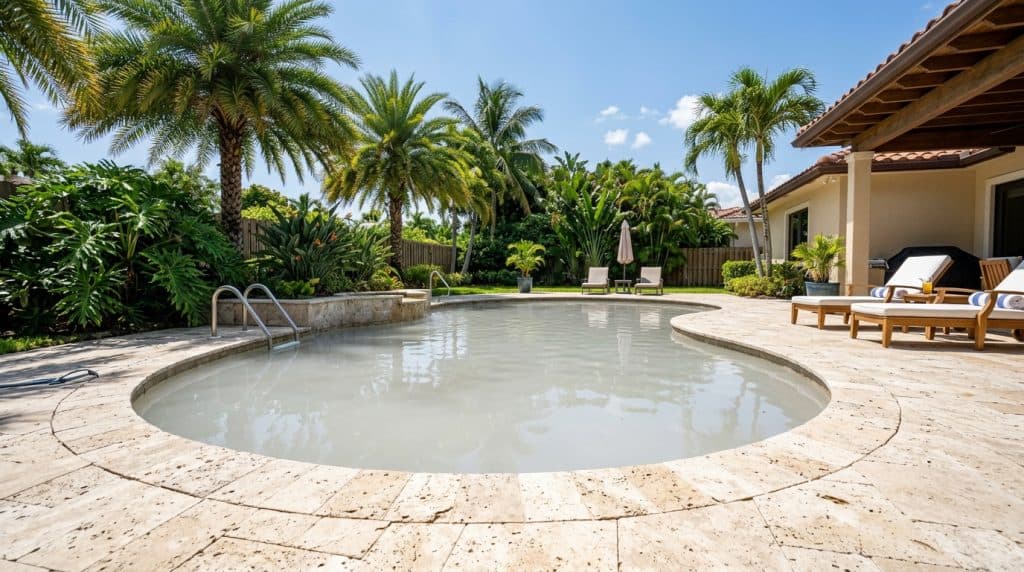
Few scenarios frustrate a Florida pool owner more than watching sparkling clear water turn into a dull, milky fog immediately following a chemical treatment. In our warm coastal climate, rapid evaporation and high ambient humidity accelerate chemical reactions beyond expected baseline timetables. Understanding the chemical kinetics behind post-treatment haziness reveals exactly how to restore pristine clarity quickly.
Immediate Post-Chemical Turbidity: The Chemical Precipitants
When pool owners observe rapid cloudiness directly after broadcast chemical dosing, the culprit is almost invariably chemical precipitation rather than organic contamination. In situations where homeowners consult professional pool water clearing services, technicians immediately examine water balance parameters before administering further additives. Adding sudden shock doses or alkalinity adjusters into water that is already near mineral saturation forces dissolved calcium out of solution into millions of micro-crystals.
Experiencing cloudy pool water after chemicals is frequently triggered by adding granular calcium hypochlorite shock to water with elevated pH or high calcium hardness. In Central Florida, tap water sourced from deep limestone aquifers frequently enters pools with over two hundred and fifty parts per million of dissolved calcium. When shock drives localized pH above 7.8, dissolved calcium carbonates instantaneously solidify into colloidal suspensions, reflecting sunlight in every direction and creating an opaque white cloud across the swimming pool.
Furthermore, broadcasting dry granular chemicals directly across the pool surface without pre-dissolving them in a bucket of water creates localized pockets of hyper-saturation. As heavy granules sink toward the plaster floor, they create concentrated chemical plumes that strip alkalinity locally and cause instantaneous flash precipitation. Ensuring that all granular stabilizers, balancing salts, and shocking agents are fully dissolved before slow perimeter introduction prevents these intense chemical shockwaves from clouding the water column.
The 7 Primary Culprits of Chemical Haziness in Florida Pools
Pinpointing the exact mechanism driving water cloudiness requires evaluating seven distinct chemical and mechanical factors common to subtropical pool systems:
- Calcium Carbonate Precipitation: Broadcasting cal-hypo shock or soda ash too rapidly causes localized pH spikes exceeding 8.2, precipitating calcium solids into the water column.
- Dead Algae Micro-Debris: A successful chlorine shock oxidizes billions of microscopic algae cells; the resulting organic carcasses stay suspended in water until filtered out.
- Stabilizer Oversaturation: Excessive cyanuric acid levels bind free chlorine into ineffective chemical bonds, leading to persistent turbidity.
- Inadequate Mechanical Filtration: Compromised filter pleats or worn sand channels allow cloudy particles to bypass filter media and return directly to the pool.
- Improper Chemical Dosing Sequence: Adding shock and acid simultaneously or within minutes of each other causes erratic chemical clashes and immediate precipitation.
- Clarifier or Flocculant Overdosing: Coagulating chemicals work by binding small particles together; however, overdosing creates excess polymers that act as clouding agents themselves.
- Elevated Total Dissolved Solids (TDS): Old pool water saturated with minerals, salts, and chemical byproducts reaches an equilibrium threshold where additional chemicals cannot dissolve.
The Impact of Stabilizer Buildup and Chlorine Inefficiency
Persistent turbidity despite normal test kit readings is often an indicator of chemical binding; explore remedies in our deep dive on cyanuric acid chlorine lock in Florida pools. When cyanuric acid climbs beyond eighty parts per million, it forms hyper-stable complexes with chlorine ions. While test strips display a deep purple hue signifying ample total chlorine, active hypochlorous acid molecules remain locked away, allowing micro-organisms and chemical particulates to float unchecked through the water.
Under these locked conditions, adding more stabilized chlorine pucks merely exacerbates the problem, adding more cyanuric acid without increasing sanitizing potency. The pool enters a state of perpetual haziness where sunlight catalyzes organic breakdown faster than the suppressed sanitizer can oxidize contaminants. Only by executing measured water dilution or switching to un-stabilized liquid chlorine can the free-to-stabilizer equilibrium be restored, allowing oxidizers to clear suspended particles.
Mechanical Filtration Bottlenecks: When Filters Fail to Clear
Chemical treatments require mechanical filtration to complete the clarification cycle. Inadequate mechanical filtration frequently stalls water clearing; restore flow rates by reviewing our pool filter cartridge cleaning and replacement schedule. If filter media is clogged with mineral scale or oils from sunscreen and lawn fertilizers, turnover rates decline dramatically, prolonging post-shock haziness from twelve hours to several days.
| Cause of Cloudiness | Visual Appearance | Time to Clear | Corrective Action |
|---|---|---|---|
| Calcium Precipitation | Chalky, milky white haze | 12 – 24 Hours | Lower pH to 7.2–7.4; run pump continuously |
| Dead Algae Bloom | Grayish or dull greenish haze | 24 – 48 Hours | Add pool clarifier; deep clean filter cartridges |
| Clarifier Overdose | Slightly iridescent, slippery fog | 48 – 72 Hours | Stop all chemical additions; run filter continuously |
Transitioning from Turbidity to Crystal Clarity
When cloudiness transitions into live algae colonization, transition to emergency measures detailed in our guide to turn a green pool crystal clear in 48 hours. Addressing the foundational chemical balance by aligning pH between 7.2 and 7.4, keeping free chlorine proportional to stabilizer levels, and ensuring unrestricted filtration flow consistently resolves stubborn haze without resorting to excessive algaecide cocktails.
Future Directions in Enzyme Clarification and Continuous Optical Monitoring
Emerging automated pool filtration systems equipped with digital nephelometric turbidity sensors and natural broad-spectrum enzyme additives are transforming water quality maintenance across the Tampa Bay area. By continuously breaking down non-living organics and complex chemical binders before they precipitate, these intelligent circulation systems prevent chemical cloudiness while reducing reliance on aggressive oxidizers.